
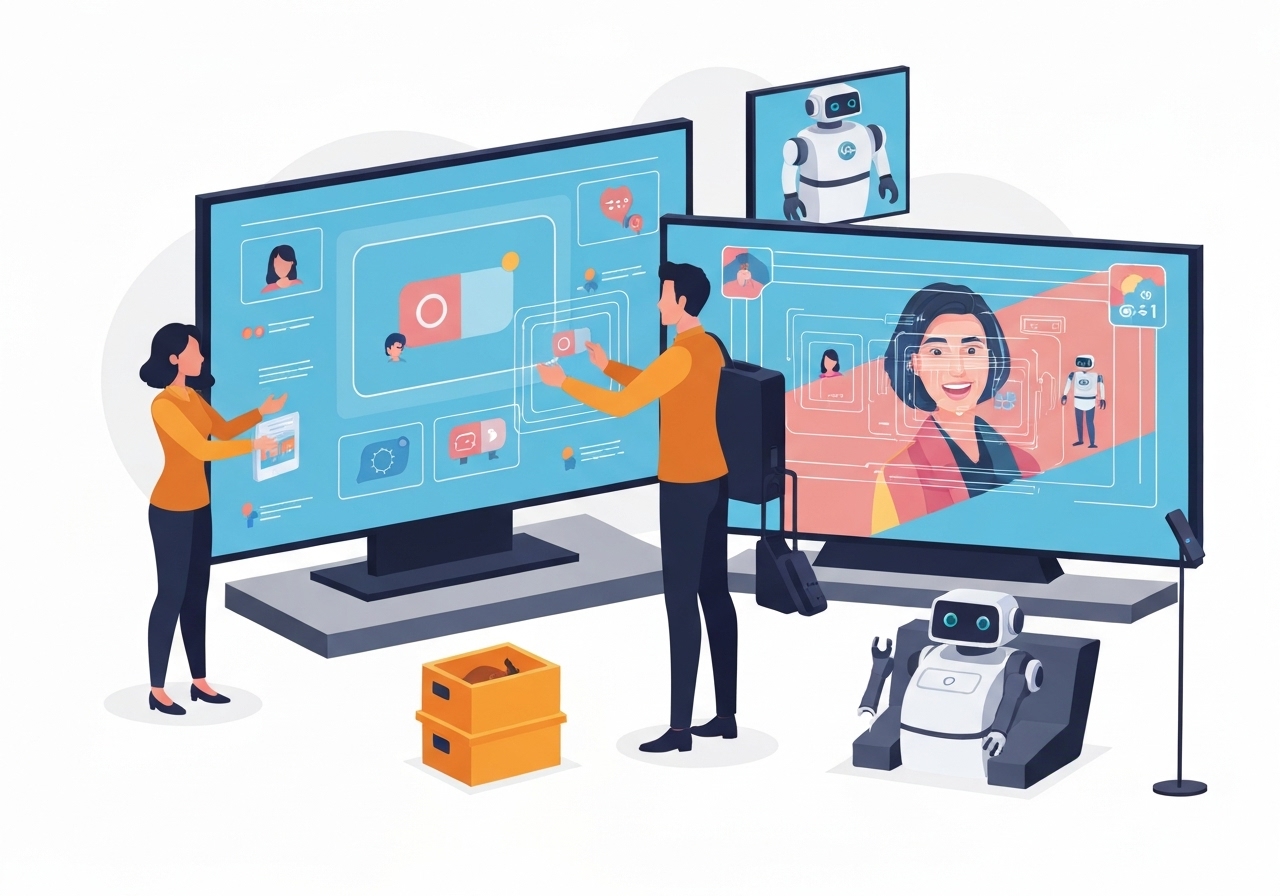
On Jan. 6, 2026 in Las Vegas, the Consumer Electronics Show opened with a flood of announcements from major brands and startups alike. Early coverage highlighted breakthroughs in AI infrastructure, next‑generation displays, wearable compute, and household robotics, with companies such as Nvidia, Samsung, LG, Hisense, Qualcomm, and many smaller entrants unveiling new products and roadmaps. Reporters on the ground and remote trackers signaled a strong CES theme: AI and display innovations driving both flashy prototypes and near‑term consumer devices. Initial demonstrations delivered promising specs, but several claims remain to be fully validated as products reach shipping units and independent testing.
Key Takeaways
- Nvidia introduced the Rubin AI platform built on a 3nm process with HBM4 memory; Nvidia says the Vera Rubin Superchip offers roughly 5× the performance of Blackwell and aims to ship late 2026 while cutting inference costs by about 10×.
- Dolby Vision 2 support is a big TV talking point; Peacock plans to stream NBA and MLB content in the new standard, promising brighter, more vivid imagery for compatible sets.
- Samsung revealed the Galaxy Z TriFold for hands‑on preview; its inner expanded display reduces letterboxing but feels heavier to manipulate than a single‑hinge foldable.
- Dell resurrected the XPS line with Intel Series 3 “Panther Lake” CPUs, claiming up to 57% faster AI performance in the XPS 14 and 78% in the XPS 16, and battery life up to 27 hours on select configurations.
- Robotics and home automation showed notable advances: SwitchBot’s Onero H1 multicompartment household robot and Narwal’s Flow 2 vacuum with 30,000Pa suction and adaptive AI features drew attention.
- Jackery previewed large off‑grid concepts: a Solar Gazebo using 2,000W panels with up to 10 kWh/day and a follow‑along Solar Mars Bot; the Explorer 1500 Ultra was billed as extremely rugged.
- Qualcomm announced the Snapdragon X2 Plus for midrange laptops with a 10‑core Oryon CPU, updated Adreno GPU, LPDDR5x support, Wi‑Fi 7, and Snapdragon Guardian security features.
- Several novel wearables and peripherals appeared: Project Luci (a magnetic AI pin with a 12MP camera and semantic search features) and new smart glasses with eSIM support and HDR10 capability were among the highlights.
Background
CES has long been the premier global stage for consumer electronics, where manufacturers unveil both production devices and experimental technologies aimed at setting industry direction. In recent years the show has shifted from purely gadget reveals to a forum for AI, health sensing, and display innovation because those areas promise near‑term commercial returns and ecosystem lock‑in for platforms and content providers. Major OEMs use the event to signal product roadmaps and partner commitments that influence component suppliers, content services, and retail timing.
Trade shows also amplify a particular tension: bold, sometimes speculative pitches sit alongside incremental, certified products. That split is evident this year—announcements range from silicon platform timelines (Nvidia Rubin) to immediate accessories on sale now (Belkin’s Switch 2 travel case). Media scrutiny at CES typically separates what will ship and what remains conceptual; independent testing and regulatory clearances (FDA for health devices, FCC for radios) are the checkpoints that follow first impressions.
Main Event
Nvidia’s Rubin platform dominated early headlines. Positioned as the next architecture for agentic AI and trillion‑parameter models, Nvidia says Rubin is built on a 3nm node coupled with HBM4 to drive the Vera Rubin Superchip. Company material claims roughly a fivefold uplift over Blackwell and integrated CPUs plus high‑speed networking intended to lower inference costs. Nvidia anticipates shipping Rubin‑based systems in late 2026 and continuing annual iterations to keep cloud providers and hyperscalers supplied.
Display makers leaned into new formats and image standards. Multiple brands touted Micro RGB and Dolby Vision 2 support, and Peacock announced plans to deliver NBA and MLB programming in Dolby Vision 2, which should improve HDR brightness and color for compatible TVs. Samsung previewed 6K glasses‑free 3D monitors in its Odyssey line and showed off a range of modular and high‑pixel displays—while LG reintroduced an ultra‑thin Wallpaper TV on glass with a 165Hz panel and wireless Zero Connect support, hinting at premium pricing.
Wearables and personal AI devices were plentiful. Project Luci surfaced as a compact magnetic wearable that records up to four hours and offers semantic, searchable memory via an on‑device model called Mavi; privacy features include a physical shutter and a local hub. Smart glasses advanced too: some new models support eSIM for standalone connectivity and HDR10 rendering for augmented visuals.
Robotics at CES blended household convenience with AI. SwitchBot’s Onero H1 was shown as a multifunction wheeled robot capable of grasping and performing chores using visual and tactile feedback. Narwal’s Flow 2 robot presented AI behaviors such as quieter cleaning near a crib, loss‑item alerts, 30,000Pa suction, and combined mop/wash capabilities. These demos aim to illustrate how perception, mapping, and object recognition can move beyond vacuum navigation to richer home services.
Analysis & Implications
Nvidia’s Rubin, if delivered as presented, would reshape how cloud providers amortize model inference costs; a 10× inference cost reduction could accelerate broader deployment of large multimodal systems in consumer and enterprise services. However, shipping timelines and silicon yields on 3nm nodes will determine vendor competitiveness and pricing. The industry is watching whether Rubin’s annual cadence can keep pace with competitors and the rapid growth of model parameter counts.
Display and content ecosystems are aligning: TV makers pushing Micro RGB and Dolby Vision 2 will only realize value if broadcasters and streaming services adopt the new standards at scale. Peacock’s NBA/MLB commitments are a meaningful first step, but wide consumer benefit depends on affordable panels and consistent content availability. Glasses‑free 3D and extremely high refresh rates aim at niche professional and gaming segments; mainstream adoption will hinge on price and demonstrable quality gains without motion artifacts.
The proliferation of always‑listening/recording wearables such as Project Luci surfaces privacy and regulatory questions. Semantic search of personal memory raises data‑locality and consent issues; vendors stressing on‑device processing reduce some risk but do not eliminate concerns around theft, loss, or misconfiguration. Policymakers and standards bodies may need to update guidance to address persistent recording devices and the way derived personal data is stored and shared.
Comparison & Data
| Product | Key Specs | Price / Timing |
|---|---|---|
| Vera Rubin Superchip (Nvidia) | 3nm, HBM4, ~5× perf vs Blackwell, integrated CPU/networking | Expected late 2026 |
| LG Wallpaper TV (new) | Glass panel, 165Hz, Zero Connect wireless box | Estimated $2,000–$20,000 (brand premium) |
| Narwal Flow 2 | 30,000Pa suction, mop & wash, adaptive AI behaviors | Demo at CES; retail timing TBA |
| Jackery Solar Gazebo | 2,000W solar setup, up to ~10 kWh/day (company estimate) | Concept preview; availability TBA |
| DuRobo Krono | Handheld e‑reader, 128GB storage | Preorder $280, ships later in Jan. 2026 |
The table highlights demonstrated specifications and company timing claims. Some items are shipping or available for preorder today (DuRobo Krono, Belkin Switch 2 travel case), while larger platform releases and concepts (Rubin, Jackery gazebo) involve multi‑quarter roadmaps and depend on manufacturing validation.
Reactions & Quotes
“Rubin is designed for agentic AI and trillion‑parameter workloads, with a focus on lowering inference costs for cloud providers.”
Nvidia (company statement)
This statement framed Nvidia’s pitch at CES: infrastructure vendors are positioning hardware to enable larger, more interactive AI services while touting efficiency gains.
“We’re integrating AI broadly across home devices—from vacuum spill detection to refrigerator recipe suggestions—to make everyday tasks smarter.”
Samsung spokesperson (CES presentation)
Samsung emphasized a connected, AI‑enabled home ecosystem rather than a single breakthrough product during its First Look event.
“With this product, we wanted it to be the most stylish, elegant Pebble ever… it had to be thin.”
Eric Migicovsky, Pebble (interview excerpt)
Pebble’s CEO summarized the brand’s design priority for the Pebble Round 2: maintain a watch‑like feel while improving display legibility and battery life.
Unconfirmed
- The real‑world performance and availability of Rubin’s claimed 5× uplift and 10× inference cost reduction remain to be independently verified when hardware is shipped and benchmarked.
- Lockin’s AuraCharge wireless charging for the V7 Max smart lock and Jackery’s claim that the Explorer 1500 Ultra can withstand a magnitude‑9 earthquake are vendor assertions that need third‑party testing or certification.
- Samsung’s glasses‑free 6K 3D monitors and Micro RGB implementations will require hands‑on evaluation to confirm image quality and motion handling at consumer price points.
Bottom Line
Day 1 of CES 2026 emphasized two overlapping narratives: infrastructure‑grade AI hardware and new display/content experiences. Nvidia’s Rubin sets expectations for the next wave of data‑center silicon, while TV and monitor makers pushed image standards and novel form factors that depend on content ecosystem uptake. Wearables and household robots illustrated how AI is moving into everyday devices, but privacy, reliability, and deliverability remain practical hurdles.
For buyers and watchers: expect a mix of immediate product releases (accessories, selected wearables, some laptops and TVs) and longer timelines for platform changes (new silicon generations, off‑grid living concepts). Independent testing, regulatory clearances, and early adopter feedback over the next months will separate durable innovations from concept stage hype.