
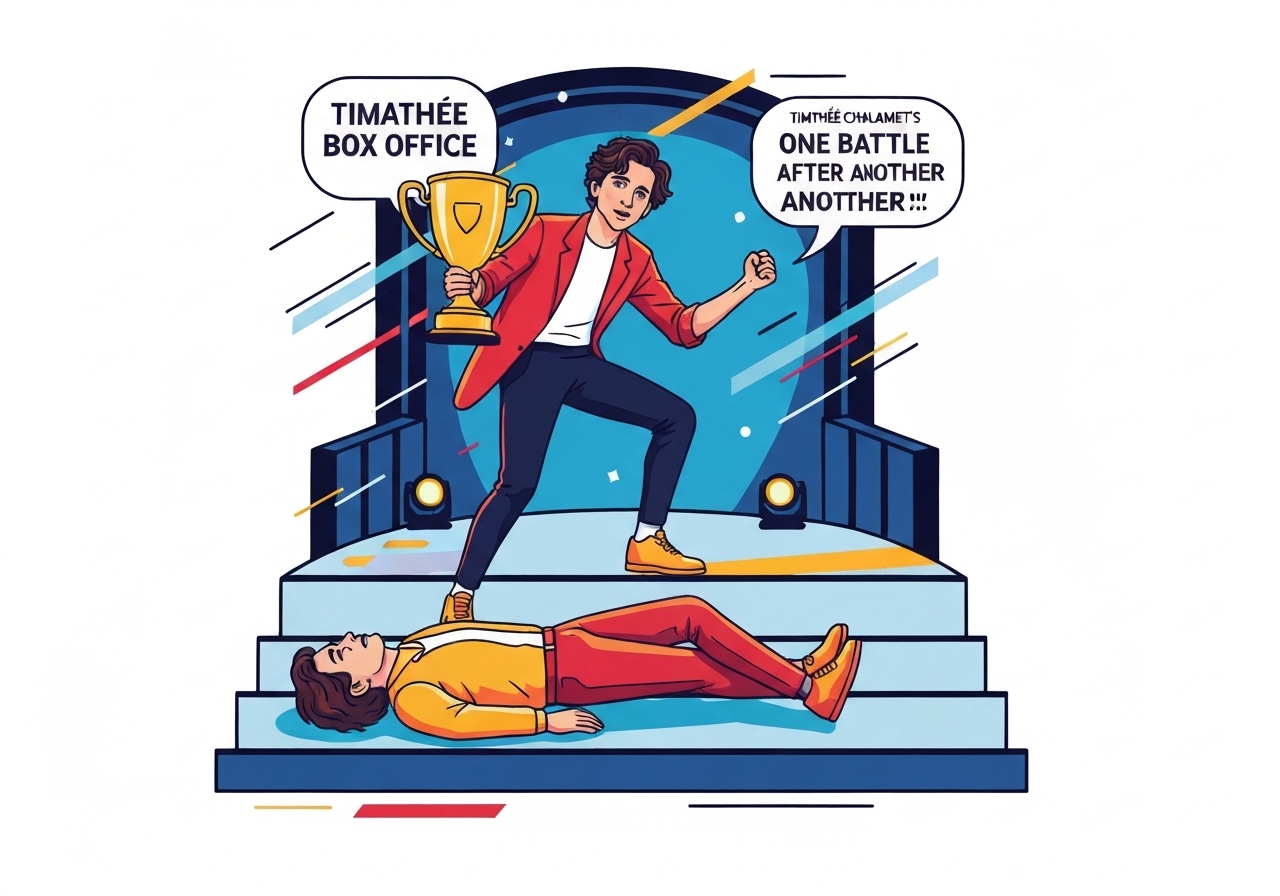
Timothée Chalamet’s hands-on marketing push helped A24’s Marty Supreme surge past Leonardo DiCaprio’s One Battle After Another in U.S. theatrical receipts this week, with A24 reporting an estimated domestic cume of $72.27 million as of Tuesday. The achievement comes after a holiday opening fueled by deliberately viral stunts — from a staged Zoom marketing pitch to large-scale orange activations — and follows Chalamet’s recent Golden Globe win for lead actor. Marty Supreme, a sports dramedy produced on a reported $60–$70 million budget, is still early in its international rollout but has already posted strong early returns in the U.K. and other markets.
Key takeaways
- Marty Supreme reached an estimated U.S. cumulative box office of $72.27 million, according to A24.
- One Battle After Another sits slightly north of $71.6 million domestically and has reported $154.5 million in international receipts for a global total cited at $206.1 million.
- Marty’s foreign gross is nearly $10 million so far, including a record U.K. opening for an A24 release of more than $8.4 million.
- A24’s production budget for Marty Supreme is reported at $60–$70 million, making it the studio’s most expensive production to date.
- Industry estimates project Marty Supreme could finish with $170–$180 million or more worldwide if its overseas rollout follows current trends.
- Chalamet’s campaign leaned on staged viral content, experiential stunts (orange lighting, blimps, pop-up trucks) and curated appearances rather than standard press touring.
- Chalamet’s Golden Globe victory is expected to provide a short-term box office lift heading into the Oscar season.
Background
A24 has built a reputation for turning distinctive, director-driven projects into cultural events; Marty Supreme represents a notable escalation for the specialty label because of its larger budget and the studio’s willingness to back a cinematic original with broad promotional ambition. Historically, small studios have relied on festival buzz and critic endorsements; A24 has increasingly invested in larger-scale campaigns to give its tentpoles a chance against major-studio releases. The company’s choices reflect growing competition for theatrical attention in a streaming-era marketplace where unique, in-person experiences can still drive ticket sales.
Actors increasingly take an active role in marketing their own films. High-profile examples include Ryan Reynolds’ early involvement with Deadpool’s unconventional rollout, which industry observers credit with helping that film break out beyond conventional superhero marketing. Chalamet — whose star power rose rapidly after a string of acclaimed performances — has embraced promotional authorship, treating campaign mechanics as an extension of creative work. That shift dovetails with studios’ experimental approaches to publicity: blending staged moments, social-first content and experiential activations aimed at generating earned media and social sharing.
Main event
This past fall, Chalamet shared a recorded Zoom meeting that doubled as a scripted marketing demonstration: he pitched a series of audacious ideas to A24 marketing executives, including a custom “corroded” orange hue tied to the film’s protagonist and concepts as large-scale as an orange-branded blimp fleet. The staged session was intentionally provocative—designed to be shared and to spark debate—and it achieved viral lift when posted publicly. The pitch combined theatrical humor with disciplined positioning: Chalamet repeatedly framed the campaign as needing to be “intentional” and “relentless.”
Participants discussed logistical and safety concerns—among them whether blimps could conjure unwanted historical associations or present hazards—while Chalamet pushed for memorable, risky-leaning gestures. The team moved forward with a number of high-visibility activations: lighting New York landmarks orange for the film’s premiere and deploying pop-up trucks, branded giveaways and coordinated festival appearances. Photographs show the Empire State Building lit in orange at the New York premiere on Dec. 15, 2025, underscoring the campaign’s theatrical scale.
Beyond visual stunts, Chalamet staged experiential moments that played directly to online audiences, including a high-profile climb of Las Vegas’s Sphere, which was temporarily repurposed as a giant orange ping-pong ball. The promotional architecture deliberately aimed to convert social attention into ticket sales, using short-form video, celebrity co-signs (including Tyler, the Creator’s involvement) and strategic festival placements to keep the film top of mind through awards season.
Analysis & implications
Chalamet’s campaign illustrates how star-driven authorship can amplify a film’s reach without a traditional blockbuster’s advertising spend. By engineering shareable moments, the campaign multiplied earned-media impressions and created a narrative that made the movie feel like a cultural event. For A24, the payoff is twofold: immediate box office upside and a longer-term brand signal that the studio can scale promotional ambition on an original property.
There are trade-offs. Large, theatrical stunts require careful risk management and can attract criticism if perceived as tone-deaf or unsafe. The campaign’s willingness to flirt with provocative imagery was calculated; the staged nature of the Zoom session and tightly choreographed activations limited real-world hazards while maximizing talkability. Still, replicating this approach requires significant starbuy-in and a marketing team comfortable with controlled risk.
On the awards and revenue front, the timing is favorable. Chalamet’s Golden Globe win and the film’s strong post-holiday momentum make an Oscars-era bump plausible — a familiar pattern when awards-season attention aligns with a film still playing wide. International expansion will be pivotal: early U.K. results signal appetite for the film overseas, but sustaining that performance across additional territories will determine whether Marty reaches the higher-end global forecasts.
Comparison & data
| Film | Domestic | International | Reported/Projected Global |
|---|---|---|---|
| Marty Supreme (A24) | $72.27M (A24 est.) | ~$10M (early markets; includes £8.4M+ U.K.) | Projected $170–$180M+ |
| One Battle After Another (Warner Bros./PTA) | ~$71.6M (domestic) | $154.5M (foreign) | $206.1M (reported) |
| Everything Everywhere All At Once (A24) | $77.2M | — | $147M (A24 comparison benchmark) |
| A Complete Unknown (Chalamet) | $75M (North America) | $65.4M (rest of world) | $140.4M global |
The table summarizes reported tallies and studio projections cited publicly. Marty’s international rollout remains early, so global estimates are contingent on continued market-by-market expansion.
Reactions & quotes
Industry and campaign voices emphasized the intentionality behind the stunts and the role of star authorship in modern marketing.
“People’s attention spans are so short these days… How do you convince them to go to the cinema?”
Timothée Chalamet, quoted to The Guardian
On the campaign mechanics, a source close to the promotion described the effort as athlete-like in its discipline and relentlessness, highlighting pop-culture stunts, a choreographed Zoom video and global pop-ups as core tactics.
“He’s treating the campaign like being an athlete… it’s been amazing.”
Campaign source (anonymous)
At least one A24 executive expressed pragmatic reservations about the risk profile of certain ideas, but remained open to high-visibility activations that would keep the film culturally prominent.
Unconfirmed
- The full financial contribution breakdown between A24 and outside partners for the campaign activations has not been publicly disclosed.
- Exact projections for final global gross (the $170–$180 million range) are estimates from industry observers and remain subject to market performance.
- Precise timelines tying each stunt (Sphere climb, blimp flights, festival drops) to measurable ticket spikes have not been released by A24 or the campaign team.
Bottom line
Marty Supreme’s climb past One Battle After Another in U.S. box office grosses is a clear signal that inventive, star-driven marketing can materially affect theatrical outcomes for original films — even those from specialty studios. The campaign’s blend of staged virality and high-visibility stunts converted cultural attention into measurable ticket sales while keeping the film in awards-season conversation.
That said, the campaign’s ultimate success will be judged on international performance and longevity: sustaining momentum outside initial markets is essential to meet optimistic global projections. For studios and marketers, Marty Supreme offers a playbook illustration: when a marquee talent is granted creative ownership of promotion, the payoff can be both immediate and brand-enhancing, but it requires careful calibration between spectacle and safety.
Sources
- The Hollywood Reporter — industry press report and primary account of the campaign and box office figures.
- A24 (official) — studio site and production information (studio/official).
- Box Office Mojo — historical box-office data and comparative film totals (industry data).
- The Guardian — source of Chalamet’s quoted remarks on attention spans and audience engagement (news interview).