
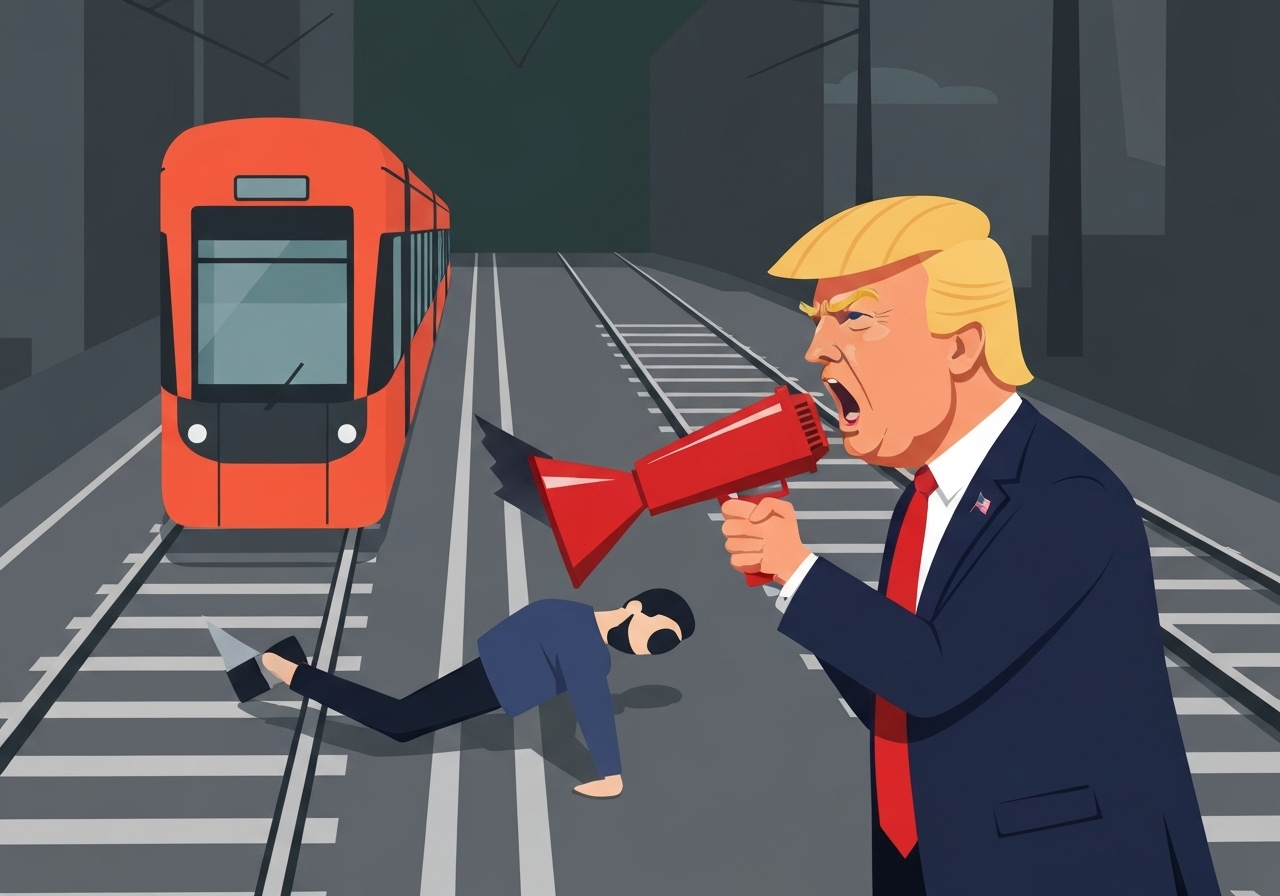
President Donald Trump publicly called for the death penalty for the man charged in the Aug. 22 fatal stabbing of 23-year-old Ukrainian immigrant Iryna Zarutska on Charlotte’s Lynx Blue Line. Federal prosecutors in the Western District of North Carolina have charged Decarlos Brown Jr., 34, with an act causing death on a mass transit system — a charge that can make him eligible for capital punishment. Local officials said the assault appeared unprovoked and that Zarutska was stabbed multiple times on the train and pronounced dead at the scene. The attack has prompted immediate security steps by the city and intensified political scrutiny at the state and federal levels.
Key Takeaways
- Victim and suspect: Iryna Zarutska, 23, was fatally stabbed Aug. 22 on the Lynx Blue Line; Decarlos Brown Jr., 34, was arrested that day and now faces federal charges.
- Federal charge and penalty: Brown is charged with committing an act causing death on a mass transportation system, a federal offense that can permit the death penalty under DOJ guidelines.
- Incident details: According to an affidavit, the suspect pulled a knife roughly four and a half minutes into the train ride, stood, and stabbed the victim three times; she was pronounced dead at the scene.
- Security response: Charlotte officials announced increased commuter-train security; CATS said security teams patrol but are not stationed on each vehicle.
- Political reaction: President Trump called for an expedited trial and capital punishment; U.S. Transportation Secretary raised questions about local protective measures.
- Suspect history: Brown has a prior criminal record, including a 2015 robbery conviction that led to a five-year prison term and at least 14 prior charges or arrests.
- Family and community: Zarutska’s family described her as hardworking and devoted to the U.S.; they demanded a full investigation and plan to bury her in the United States.
Background
Public transit safety has become a focal point in U.S. cities as ridership patterns shift and staffing models evolve. Charlotte’s Lynx Blue Line serves commuters and residents across multiple neighborhoods; like many systems, it relies on roving security rather than uniformed officers on every vehicle. In that operational context, attacks that occur aboard short, crowded runs can escalate quickly before responders can intervene.
The federal statute invoked in this case targets violent acts on mass transportation and carries enhanced penalties, including potential capital punishment in specified circumstances. Prosecutors and federal agents have in recent years used those statutes selectively for high-profile incidents that cross local-jurisdiction thresholds. Local officials, transit authorities and victims’ families each occupy distinct roles: public safety and operations on one hand, criminal investigation and prosecution on the other, and advocacy and grief on behalf of survivors and relatives.
Main Event
Authorities say Zarutska boarded the Lynx Blue Line after finishing a shift at a local pizzeria and sat in an aisle seat in front of the suspect. Surveillance and the affidavit obtained by reporters indicate the train traveled about four and a half minutes before the suspect took a knife from his pocket, unfolded it, then stood and struck the victim three times. A witness flagged officers to the location of the suspect after the assault; emergency responders later pronounced Zarutska dead at the scene.
Following the arrest on Aug. 22, federal prosecutors in the Western District of North Carolina filed an indictment charging Brown with an act causing death on a mass transportation system. U.S. Attorney Russ Ferguson said the office would seek justice for Zarutska and her family while describing the act as terroristic in nature. Federal agents met with the victim’s relatives to inform them of the charges.
Charlotte Area Transit System (CATS) confirmed there were no security personnel physically assigned to the specific train during the incident, noting its security teams patrol the system rather than remain stationed on individual vehicles. Mayor Vi Lyles announced an immediate increase in security on commuter trains as video of the assault circulated and officials faced pressure from state and federal leaders to act.
Analysis & Implications
Legal pathway and capital exposure: The federal charge used here is relatively unusual for a single-target stabbing but becomes plausible because the alleged crime occurred on a mass transportation system. If prosecutors pursue the death penalty, the case will enter a lengthier and more resource-intensive federal capital process, raising questions about priorities and timelines for victims’ families seeking swift resolution.
Public-safety implications: The case is already shaping local and state debates about transit security models. Officials have emphasized that roaming security can deter crime broadly, but critics argue visible, stationed officers or expanded onboard staffing could have prevented or interrupted this attack. The discussion pits operational cost and feasibility against immediate public-safety demands.
Political consequences: High-profile reactions from federal figures have amplified the incident beyond local policy circles. Calls for expedited trials and capital punishment politicize prosecutorial choices and may increase pressure on the U.S. Attorney’s Office. Those dynamics can affect charging decisions, resource allocation and public perception of whether the justice system is acting impartially or reacting to political winds.
Community impact and immigrant concerns: Zarutska’s background as a Ukrainian who had lived in a bomb shelter before immigrating to the U.S. underscores broader narratives about safety and refuge. Her family’s demand for a thorough investigation and vow to keep her burial in the United States highlight both personal grief and a symbolic stance about belonging and protection in her adopted country.
Comparison & Data
| Date | Event |
|---|---|
| Aug. 22 | Stabbing on Lynx Blue Line; suspect arrested at scene |
| Aug. (following week) | Federal charging decision announced by U.S. Attorney’s Office |
| Sept. 19 | Suspect’s next scheduled court appearance (court records) |
| Sept. 22 | Candlelight vigil planned at 8 p.m. |
The timeline shows rapid arrest followed by federal involvement within days. The table omits granular investigative steps but underscores that criminal processing is proceeding on a defined schedule, including a court date in mid-September and a planned community memorial in late September.
Reactions & Quotes
Federal and local officials framed the assault as both a criminal and public-safety issue. U.S. Attorney Russ Ferguson emphasized prosecutorial commitment to the victim’s family and called the act heinous.
We will pursue justice for the victim and support her family during this process.
U.S. Attorney Russ Ferguson (paraphrased)
President Trump used social media to demand capital punishment for the suspect and urged an expedited trial; his statement intensified national attention and drew commentary from other elected officials. Transportation Secretary Sean Duffy publicly questioned local protections and announced a departmental review.
If mayors cannot keep mass transit safe, federal funding priorities must be examined.
U.S. Transportation Secretary (paraphrased)
Local community leaders and Zarutska’s family called for a full investigation into how the assault occurred and whether systemic failures contributed to the outcome. Family statements stressed their pain and appealed for changes to prevent similar tragedies.
We are heartbroken and demand a full accounting of the circumstances that led to Iryna’s death.
Family statement (paraphrased)
Unconfirmed
- Any specific motive for the attack beyond the affidavit’s timeline and witness statements has not been established in court and remains unproven.
- Whether additional security measures planned by the city will be implemented on a permanent basis or be temporary remains unclear pending formal policy announcements.
- It is not yet publicly confirmed whether Brown has retained counsel who will speak on his behalf or how his defense will respond to federal capital exposure.
Bottom Line
The Aug. 22 killing of Iryna Zarutska aboard Charlotte’s Lynx Blue Line has become both a local tragedy and a flashpoint in debates over transit safety, prosecutorial priorities and political rhetoric. Federal charges open the possibility of seeking the death penalty, which will shape the trajectory of the case and extend its timeline while increasing public scrutiny of prosecutorial discretion.
For residents and policymakers, the immediate questions are operational: how to improve visible security, whether staffing models should change, and how to balance resource constraints with passenger safety. For the victim’s family and the community, the focus remains on accountability and preventing future deaths; the coming weeks of court activity and investigations will determine how those goals are pursued.
Sources
- ABC News — national news report summarizing local reporting and official statements
- U.S. Department of Justice — federal agency and prosecutorial office (official)
- City of Charlotte / CATS — municipal and transit authority information (official)