
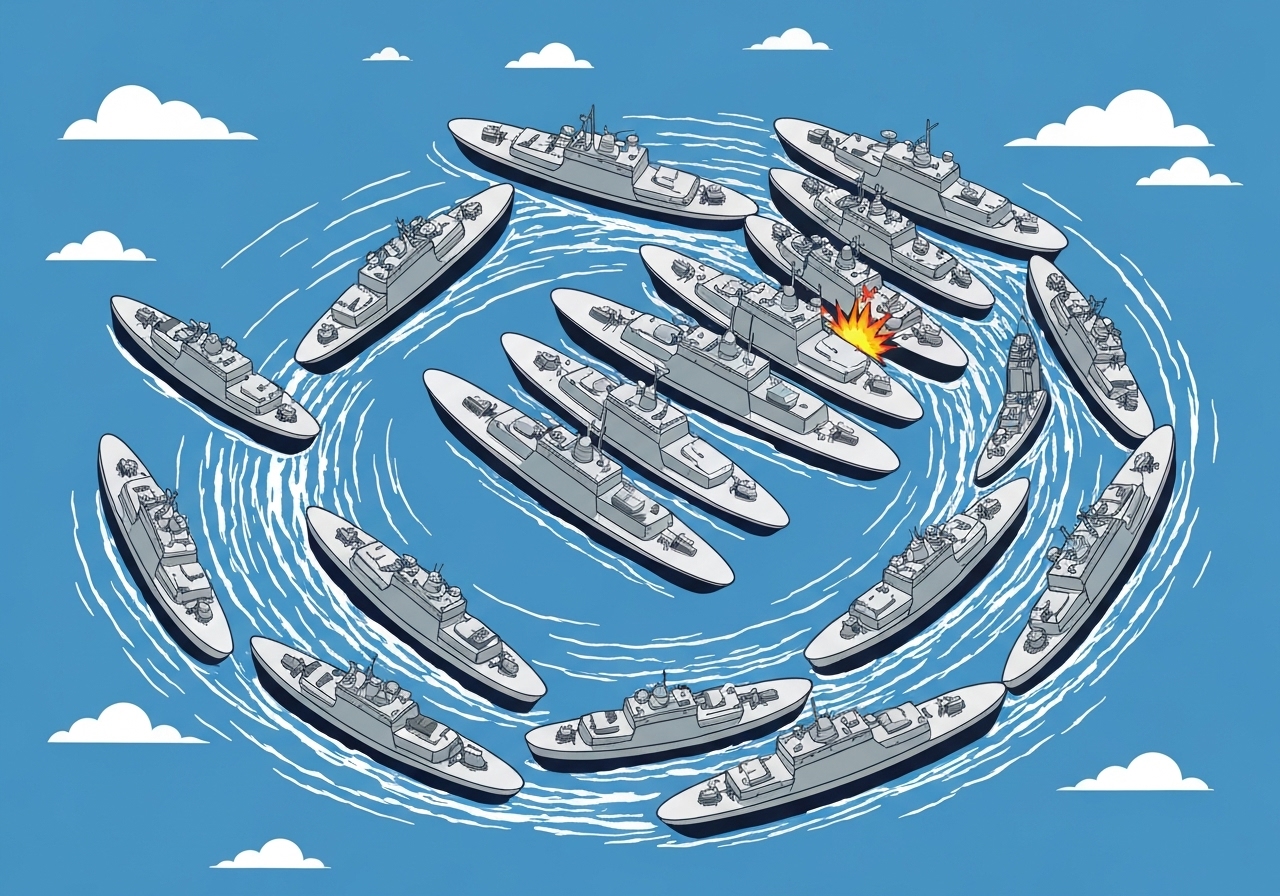
On Tuesday, China’s People’s Liberation Army conducted a second consecutive day of large-scale exercises around Taiwan, staging live-fire sea, air and ground drills under the banner “Justice Mission 2025.” The Eastern Theater Command deployed destroyers, frigates, fighters, bombers and long-range artillery to waters north and south of the island to practice coordinated sea‑air operations and blockade tactics. Taiwan’s authorities reported the detection of 130 Chinese aircraft, 14 military ships and eight other official vessels within a 24‑hour period and said roughly 90 aircraft crossed the strait’s median line. The drills disrupted civilian routines: seven temporary “dangerous zones” were announced and more than 100 international or domestic flights were delayed, rescheduled or canceled.
Key Takeaways
- The PLA carried out live-fire exercises labeled “Justice Mission 2025,” deploying ships, fighters, bombers and ground artillery around Taiwan on the second straight day.
- Taiwan’s Defense Ministry reported 130 Chinese aircraft, 14 military ships and eight other official vessels between 6 a.m. Monday and 6 a.m. Tuesday.
- About 90 Chinese aircraft crossed the median line of the Taiwan Strait; a Chinese military balloon was also detected during the same window.
- Seven temporary “dangerous zones” were notified to Taiwan’s Civil Aviation Administration, causing schedule changes for over 100 flights at four international airports.
- The PLA said the drills signaled deterrence against external military aid to Taiwan; Beijing’s state media framed the actions as a warning to “separatists.”
- Taiwan’s government described the maneuvers as provocative and disruptive to regional stability and maritime and aviation safety.
- The exercises coincided with heightened China‑Japan rhetoric and follow U.S. announcements about potential arms sales to Taipei exceeding $10 billion (pending congressional approval).
Background
The mainland and Taiwan have been governed separately since 1949 after the Chinese civil war. Beijing maintains its long‑standing position that Taiwan is part of China and has not ruled out the use of force to achieve unification; Taipei rejects unification under Communist Party terms and has built closer ties with outside partners for defensive purposes. In recent years, Beijing’s incursions near Taiwan—often involving warplanes and naval vessels—have become frequent, punctuating a sustained campaign of pressure that mixes military posturing with diplomatic and economic measures.
These latest maneuvers occur amid a broader regional context of intensifying U.S.-China competition and renewed attention to Indo-Pacific security. Washington’s obligations under U.S. law to assist Taiwan’s defense, combined with recently announced potential arms sales to Taipei valued at more than $10 billion, have been repeatedly criticized by Beijing. Tokyo’s comments about possible involvement if Beijing acts against Taiwan further complicated the regional diplomatic environment and drew sharp rebukes from Chinese officials.
Main Event
The Eastern Theater Command said its forces simulated joint long‑range strikes integrating air, naval and missile assets in waters north and south of Taiwan. Chinese ground units in Fujian province reportedly fired live rounds toward a designated target zone roughly 44 kilometers (24 nautical miles) off Taiwan’s northern coast, with impact zones identified near that line. State media posted footage and images showing ship‑borne and shore‑based firing, framed as achieving the command’s “desired effects.”
Taiwan’s Defense Ministry detailed the scope of the activity, saying 130 aircraft—fighters and bombers among them—operated near the island between 6 a.m. Monday and 6 a.m. Tuesday, and that 90 crossed the median line. The ministry also reported 14 Chinese military ships and eight other official vessels in the area and said it deployed aircraft, navy ships and coastal missile systems to monitor and respond.
Civilian impact was immediate: Taiwan’s Civil Aviation Administration received notice of seven temporary danger zones around the strait. Flight information posted by Taiwan’s four international airports showed more than 100 flights experienced time changes, delays or cancellations on Tuesday afternoon. Local fishing communities were also affected; officials in Keelung described hourly broadcasts to warn boats away from exercise areas and warned of economic harm to fishers.
Analysis & Implications
Operationally, the drills tested PLA capabilities in combined arms coordination at sea and in the air while rehearsing blockade methods that could be used to isolate the island in a crisis. Repeated exercises of this scale sharpen China’s ability to choreograph multi‑domain operations and stress the logistics and command links needed to sustain pressure over time. For Taipei, the demonstrations underscore vulnerabilities in air and sea approaches and the need to maintain rapid detection, dispersal and defensive readiness.
Politically, Beijing’s framing of the operations as a response to so‑called “separatist” actions and external meddling is intended to signal resolve to domestic and international audiences. The public rhetoric from Chinese state media and officials seeks to construe deterrence as legitimacy for escalatory measures, complicating diplomatic space for de‑escalation. For the United States and regional partners, these drills raise questions about crisis signaling, escalation control and the management of military contacts to avoid miscalculation.
Economically and societally, the disruption to aviation and fisheries illustrates how military activity can impose immediate non‑military costs. Over 100 flight adjustments and fishermen prevented from going to sea translate into economic losses and logistical headaches that ripple beyond the narrow military domain—affecting commerce, tourism and local livelihoods. Such friction can shape domestic political responses in Taiwan and among neighboring states.
Comparison & Data
| Metric | Reported Figure |
|---|---|
| Chinese aircraft detected (24‑hour window) | 130 |
| Chinese military ships | 14 |
| Other official Chinese vessels | 8 |
| Aircraft crossing median line | 90 |
| Temporary aviation danger zones | 7 |
| International/domestic flights altered | 100+ |
The numbers above come from Taiwan’s Defense Ministry and airport schedules published during the incident. Compared with daily PLA sorties—often dozens in routine weeks—this event’s scale was notable primarily for the density of combined live‑fire maneuvers and the simultaneous maritime, air and artillery elements. The presence of long‑range artillery impacts and reported crossings of the median line represent escalatory markers relative to lower‑intensity probe missions.
Reactions & Quotes
“We will act responsibly by neither escalating nor provoking disputes,”
President Lai Ching‑te (Facebook post)
President Lai framed Taipei’s posture as restrained while criticizing Beijing’s repeated pressure. His statement emphasized measured deterrence and the importance of international norms and civilian safety.
“The actions are highly provocative and undermine regional stability,”
Defense Minister Wellington Koo (Taiwan Defense Ministry)
Taiwan’s defense leadership characterized the drills as a security threat that interfered with shipping and aviation; the ministry said forces remained on alert and monitored the situation closely.
“Each escalation will be met with stronger countermeasures,”
Xinhua commentary (Chinese state media)
State media and PLA spokespeople presented the exercises as legitimate warnings aimed at deterring what Beijing calls secessionist activity and external support for Taiwan’s defense.
Unconfirmed
- Whether the Chinese military balloon detected was linked to the live‑fire drills or served a separate surveillance purpose remains unclear.
- Attribution of specific intent—whether the drills were timed to influence U.S. congressional debate over arms sales—has not been independently verified.
- Reports of precise impact zones and damage claims from live rounds published by state media have not been corroborated by independent observers.
Bottom Line
The second day of large‑scale PLA drills demonstrated China’s growing proficiency in integrated sea‑air‑land operations and its willingness to impose short‑term disruptions on civilian life around Taiwan. While Beijing framed the exercises as targeted deterrence, they carry clear costs for regional aviation, fisheries and diplomatic trust. Taipei’s defensive responses and public messaging emphasized restraint but also highlighted ongoing readiness concerns.
Looking ahead, observers should watch for changes in the frequency and geographic scope of PLA sorties, any tightening of economic or maritime controls, and diplomatic signals from Washington, Tokyo and other regional partners. The pattern of rehearsals and rhetoric suggests a persistent escalation risk that will shape security calculations across the Indo‑Pacific in 2025 and beyond.
Sources
- Associated Press (International news organization) — original reporting and compilation of official statements.
- Taiwan Ministry of National Defense (Official) — operational reports and aircraft/ship detection figures.
- Xinhua News Agency (Official/state media) — commentary and state perspective on the exercises.