
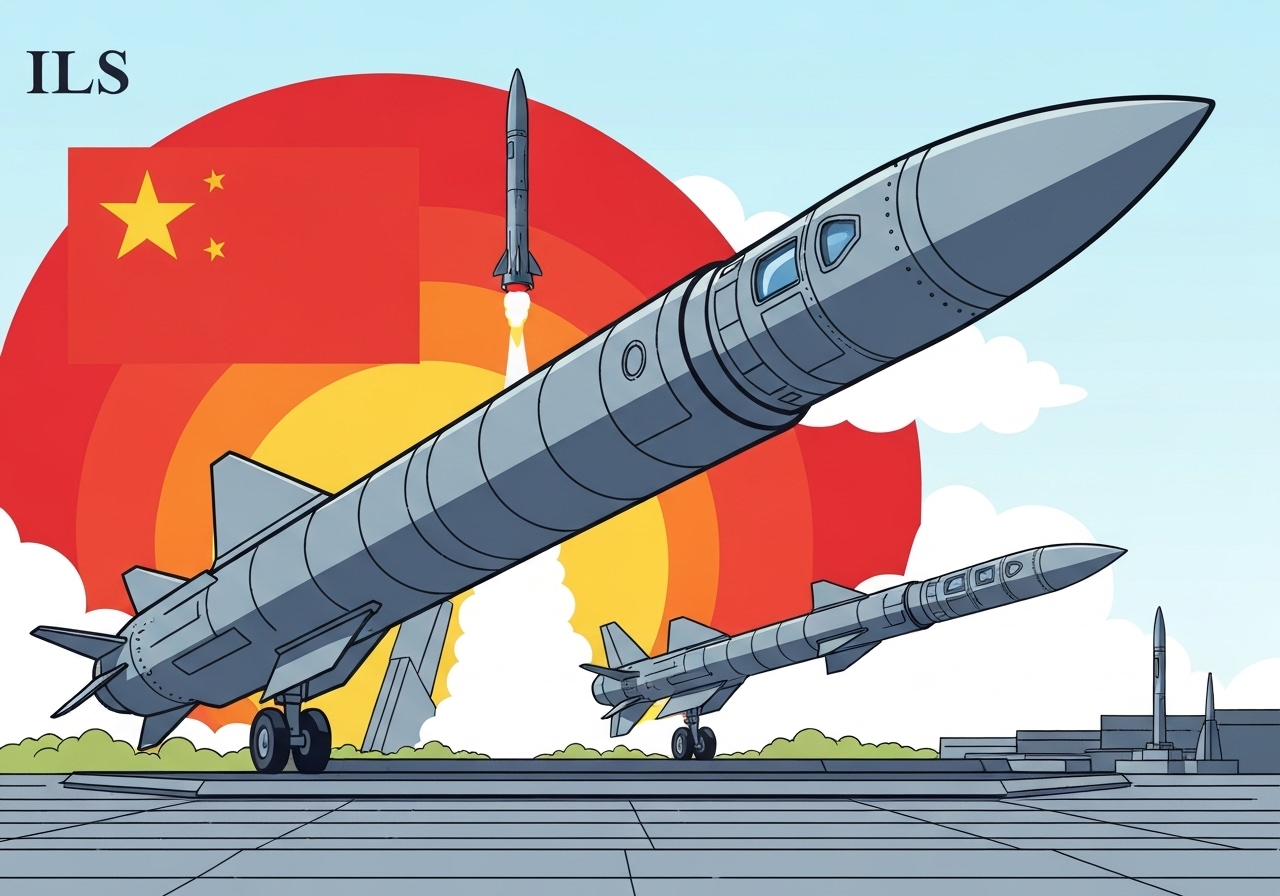
China publicly displayed a new nuclear-capable air-launched ballistic missile called the JL-1 at a large military parade in Beijing on Sept. 3–4, 2025, marking the first time the country has shown elements of its land, sea and air nuclear forces together. The missile was presented alongside ICBMs and SLBMs and was described by state media as nuclear-capable with an asserted range near 8,000 kilometers.
Key takeaways
- The JL-1 ALBM made its official public debut at Beijing’s military parade on Sept. 3–4, 2025, displayed with China’s ICBMs and SLBMs.
- The missile on show is likely the system the West has tracked as CH-AS-X-13 (sometimes linked to the KF-21 label) and has been sighted previously carried by H-6N bombers.
- Design cues—two-stage layout with a maneuverable reentry vehicle (MARV) and a three-fin tail—align it broadly with the DF-21 family, though a boost-glide variant has been speculated.
- State media narration cited a range of about 8,000 km; if accurate, that would significantly exceed assessed ranges for DF-21/DF-26 variants.
- The H-6N bomber, shown publicly in 2019 and known to accept external ALBMs and in-flight refueling, remains the primary carrier platform.
- China’s public display completes a visible, official air leg to what the country and outside analysts now treat as a nuclear triad.
- U.S. defense assessments note rapid Chinese nuclear expansion, including a greater number of silo fields and an increase in warhead counts in recent years.
Verified facts
At the Beijing parade, Chinese authorities exhibited a missile labeled JL-1 (Jinglei‑1), described in state narration as a nuclear-capable air-launched ballistic missile. The missile was shown together with other strategic systems, including sea- and land‑based ballistic missiles, creating the first public depiction of all three legs of China’s strategic nuclear forces in a single event.
Open-source imagery and earlier sightings have linked a similar missile to the H-6N heavy bomber, which features modifications to carry an external ALBM and an in-flight refueling probe. Analysts have previously identified the design under the Western designation CH-AS-X-13; China has not previously acknowledged the system formally until this parade.
Observers note the JL-1’s external design resembles two-stage DF-21-series missiles with a separate maneuverable reentry vehicle (MARV) on top. A MARV permits limited terminal maneuvering and greater accuracy compared with an unguided reentry bus. Some imagery and commentary have also raised the possibility of a different upper-body shape consistent with a boost-glide vehicle (HBGV), though that remains distinct technically from a MARV.
During the parade narration, state media reportedly attributed a range of roughly 4,970 miles (8,000 km) to the JL-1. That figure, if confirmed, would exceed unclassified U.S. assessments of DF-21 and DF-26 variants, which have been publicly estimated in the low thousands of kilometers.
Context & impact
The public unveiling matters beyond the missile itself because it signals China’s aerial component of strategic deterrence is now on official display. Only a handful of states field triads in some form; China’s visible inclusion of the JL-1 confirms an air-leg capability alongside growing sea- and land-based forces.
Strategically, an ALBM carried by a long-range, air-refuelable bomber gives Beijing additional operational flexibility and dispersal options. Air-launch extends effective reach by adding launch altitude and speed, complicating regional targeting and response planning.
U.S. defense reports have described China’s nuclear buildup as rapid and multifaceted: silo construction for ICBMs, more sea-based assets, and a projected increase in deployed warheads. The Pentagon’s 2024 assessment estimated China had surpassed 600 operational warheads by mid-2024 and projected growth toward 1,000 by 2030.
That expansion, together with diversified delivery modes, affects regional stability and crisis dynamics. Analysts warn it could incentivize changes in alert postures—such as moves toward launch-on-warning—and alter adversary calculations about escalation and deterrence.
State narrators at the parade described the JL-1 as a nuclear-capable air-launched ballistic missile with an approximate range of 8,000 kilometers.
Chinese state media / parade narration
Unconfirmed
- Whether the JL-1 is functionally identical to previously reported CH-AS-X-13 designs or represents a distinct variant.
- The exact internal configuration—whether the upper stage is a MARV, an HBGV, or multiple options for different missions.
- Operational status and deployment numbers of JL-1 systems in active service.
- Whether the JL-1 will be fielded in both nuclear and conventionally armed variants for anti-ship and land‑attack roles.
- The verified maximum range in operational conditions versus the parade narration’s 8,000 km figure.
Bottom line
The JL-1’s public debut is a significant development in China’s strategic forces: it makes the air leg of a now-visible nuclear triad unmistakable and underscores Beijing’s rapid diversification of delivery systems. Even with many technical questions still open, the display is likely to sharpen policy and military planning across the Indo‑Pacific and beyond and will prompt renewed intelligence and diplomatic attention to China’s evolving doctrines and force posture.