
Lead
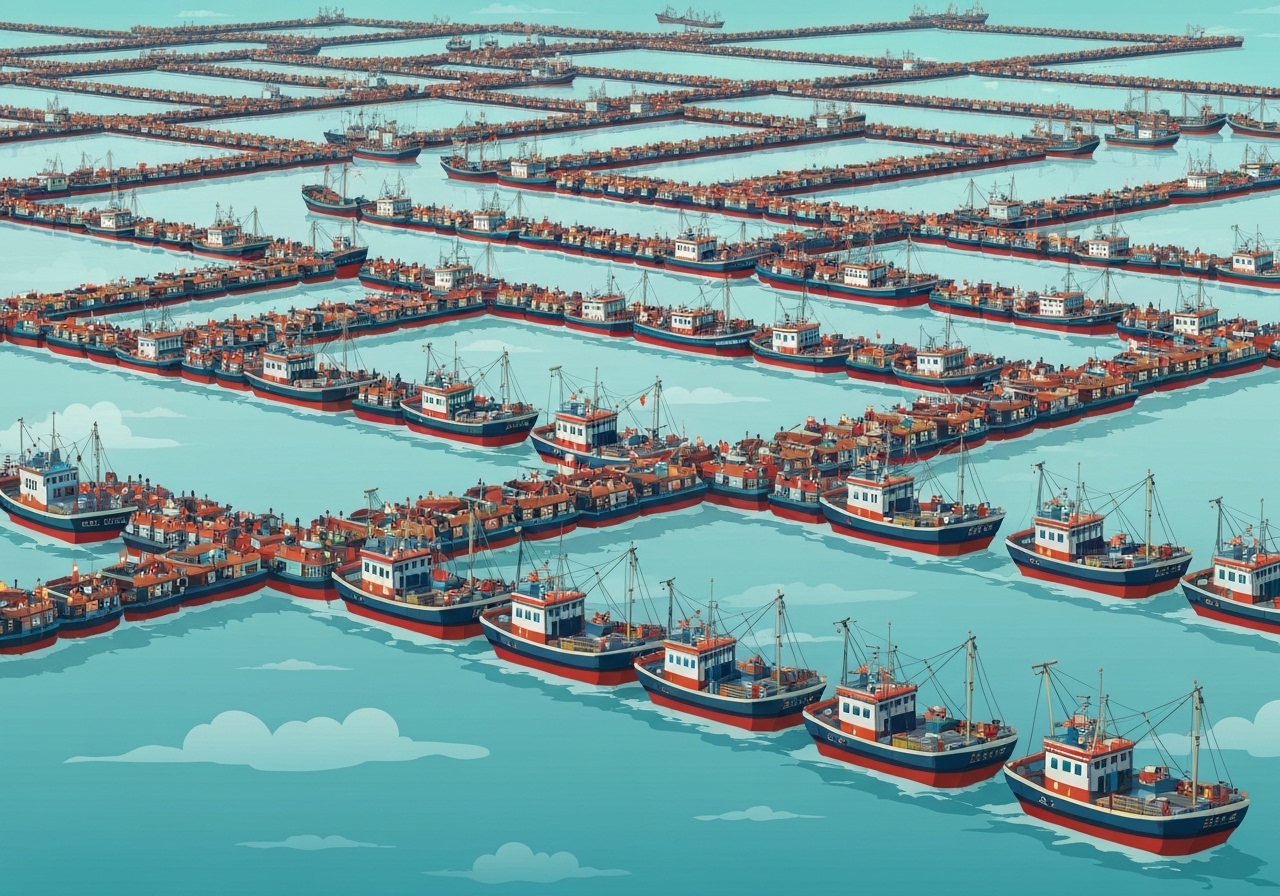
In late December 2025 and again on Jan. 11, 2026, thousands of vessels registered as Chinese fishing boats gathered in the East China Sea to create unusually long, dense formations near major shipping lanes. Ship-tracking (AIS) and satellite data analyzed by independent firms show roughly 2,000 boats on Dec. 25, 2025 and about 1,400 on Jan. 11, 2026, assembling into lines and a rectangle stretching more than 200 miles. Analysts and former officials say the patterns are consistent with exercises by China’s maritime militia and represent a new level of coordination that could complicate movement for commercial and military vessels. Beijing has offered no public explanation for the gatherings.
Key Takeaways
- About 2,000 China-flagged fishing vessels formed two parallel lines on Dec. 25, 2025, each line estimated at roughly 290 miles long.
- On Jan. 11, 2026, around 1,400 vessels shifted from fishing tracks to hold steady positions and assembled into a rectangle exceeding 200 miles in extent.
- AIS and Planet Labs satellite imagery were used to identify movements; analysts judged the signals not to be spoofed.
- Experts say the formations indicate improved command-and-control of civilian boats often described as China’s maritime militia.
- The formations were located in the East China Sea near major lanes radiating from Shanghai — a strategic chokepoint for trade and military movement.
- Analysts warn the massing could be used to impede navigation, act as decoys for sensors or practice so-called quarantine or blockade tactics short of declared war.
- Japanese defense and coast guard officials declined public comment, citing operational security.
Background
China has for years relied on large numbers of civilian vessels — particularly fishing boats — to advance maritime claims and support naval activity in disputed waters. These so-called maritime militia units have been observed anchoring near reefs, shadowing foreign ships, and at times colliding with vessels in confrontations. That practice has been a central feature of Beijing’s grey-zone tactics designed to alter facts on the water without triggering full armed conflict.
Technological upgrades and wider adoption of navigation and communications equipment have made it easier to coordinate dispersed, privately owned boats at scale. Analysts track such activity using automatic identification system (AIS) broadcasts, commercial satellite imagery, and proprietary ship-position datasets. While AIS is imperfect — transmissions can be intermittent or erroneous — independent firms in this case cross-checked multiple sources and concluded the patterns reflected a genuine, coordinated mobilization.
Main Event
On Dec. 25, 2025, ship-position records show two elongated, parallel formations in the East China Sea, each roughly 290 miles long and together forming a reverse L shape, according to analysts. The gathered vessels held positions atypical for fishing, lacking the back-and-forth trawl tracks usually recorded by AIS. Observers noted the density and linearity of the formations as striking compared with prior episodes involving smaller clusters of boats.
Weeks later, beginning Jan. 10 and culminating in a recognizable formation by Jan. 11, 2026, an estimated 1,400 China-flagged fishing vessels departed fishing patterns or left home ports to assemble into a dense rectangle exceeding 200 miles across. Commercial ship-position mapping showed some cargo ships diverting course or weaving through narrow gaps to avoid the massed boats. Satellite imagery from Jan. 10 captured vessels transiting toward the assembly area.
Independent analysts at ingeniSPACE and Starboard Maritime Intelligence detected the patterns and shared findings with other researchers. Experts said the boats maintained stationary or near-stationary positions rather than typical fishing routes, indicating an ordered rendezvous rather than weather- or fish-driven congregation. The Chinese government has not publicly acknowledged these specific operations.
Analysis & Implications
The formations mark an evolution in how civilian maritime assets could be used in crises. Mobilizing thousands of small, maneuverable vessels in contested waters could create operational friction for navies and merchant shipping without amounting to formal naval engagement. That friction could slow resupply, complicate tactics, and impose political pressure in a crisis scenario, such as a contingency involving Taiwan.
Maritime militia boats lack the size and firepower to enforce a legal blockade effectively, but their numbers can clog sea lanes and complicate sensor environments. Former U.S. naval and intelligence officers caution that masses of small craft could overwhelm radar operators and unmanned sensors or serve as decoys for torpedoes and missiles, degrading the situational awareness of opposing forces.
The events also signal improved mobilization capacity: routing, timing, persistent station-keeping, and the scale observed suggest stronger coordination between authorities and civilian fleets. If repeated, such exercises could normalize large-scale civilian assemblies as a tool of statecraft, lowering the political threshold for disruptive operations in peacetime and tension periods.
Comparison & Data
| Date | Estimated Vessels | Formation Shape | Approx. Length |
|---|---|---|---|
| Dec. 25, 2025 | ~2,000 | Two long parallel lines (reverse L) | Each ~290 miles |
| Jan. 11, 2026 | ~1,400 | Dense rectangle | >200 miles |
The table summarizes the two notable gatherings identified by AIS and satellite data. Analysts emphasize that AIS positions are snapshots and subject to transmission gaps, but the scale and disciplined geometry seen in the tracks are uncommon compared with routine fishing behavior. The locations intersect key commercial routes that connect Shanghai with transoceanic shipping lanes, increasing the potential impact on trade and military movements.
Reactions & Quotes
Analysts and former officials responded to the formations with concern about coordination and intent. The comments below are short excerpts placed in context of their broader assessments.
“This is not right — I’ve seen high hundreds of boats before, but nothing of this scale or formation.”
Jason Wang, COO, ingeniSPACE (commercial data analyst)
Wang flagged the Dec. 25 patterns and later confirmed the Jan. 11 assembly, emphasizing both the unusual number and disciplined positioning of vessels compared with typical fishing AIS traces.
“They are almost certainly not fishing, and I can’t think of any explanation that isn’t state-directed.”
Gregory Poling, Director, Asia Maritime Transparency Initiative, CSIS (think tank)
Poling and CSIS researchers cross-checked the same ship-location patterns and judged the gatherings consistent with a deliberate maritime-militia mobilization designed to practice massing civilian vessels in contested waters.
“The level of coordination to get that many vessels into a formation like this is significant.”
Mark Douglas, Analyst, Starboard Maritime Intelligence (private maritime intelligence)
Douglas highlighted the operational challenge of routing and holding large numbers of independently owned boats in tight geometries, noting improvements in navigation and communications tools likely aided the effort.
Unconfirmed
- Whether Chinese central authorities directly ordered these specific Dec. 25 and Jan. 11 operations has not been publicly confirmed by Beijing or official documents.
- The exact number of participating vessels could be higher or lower than AIS-derived estimates because some ships do not transmit AIS or may transmit incorrect data.
- Some ships shown in satellite imagery or AIS feeds may not have been Chinese fishing vessels; vessel identity for every unit has not been independently verified.
Bottom Line
The massing of thousands of China-flagged fishing vessels in discrete formations near major shipping arteries represents an operational shift with strategic implications. Even if the fleets lack the combat power of navy units, their ability to gather quickly and hold positions can disrupt commercial traffic, complicate allied naval operations, and offer Beijing flexible, deniable options in crises.
Observers should watch for follow-on mobilizations, changes in vessel registration patterns, and upgrades in communications and navigation equipment among civilian fleets. Tracking efforts that combine AIS, satellite imagery, and independent intelligence will remain essential to distinguish routine fishing from coordinated maritime-militia activity.