
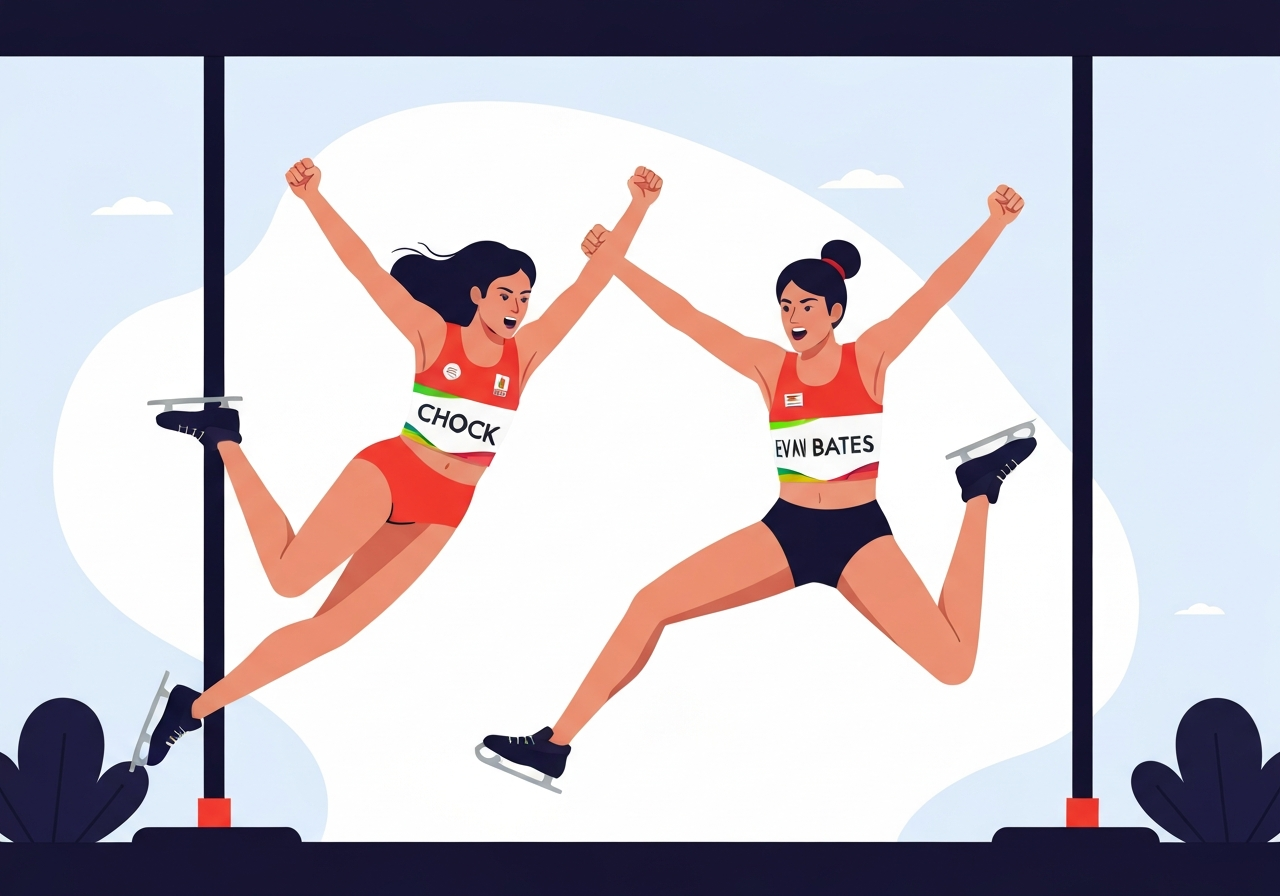
Madison Chock and Evan Bates kept Team USA atop the standings in the Olympic figure-skating team event in Milan, delivering a season-best 133.23 in the free dance to open the next phase of competition. The husband-and-wife duo, described in event coverage as three-time reigning world champions and seven-time U.S. national champions, skated a flamenco- and paso-doble–inspired program that combined precision, power and control. Their performance gave the United States a clear lead heading into the remainder of the team event and reinforced their status as favorites for the individual ice-dance title. Several rivals and host-nation contenders produced strong showings, leaving the field competitive as the Games progress.
Key Takeaways
- Madison Chock and Evan Bates posted a season-best free-dance score of 133.23 and earned 10 team points for the United States.
- Italy’s Charlene Guignard and Marco Fabbri placed second with 124.22, contributing nine team points on home ice in Milan.
- Canada’s Marjorie Lajoie and Zachary Lagha skated as surprise substitutes and finished third with 120.90, adding eight points for Team Canada.
- Georgia’s Diana Davis and Gleb Smolkin were fourth (117.82) for seven team points, while Japan’s Utana Yoshida and Masaya Morita were fifth (98.55) for six points.
- Chock and Bates enter the individual ice-dance competition as narrow favorites, with French challengers Laurence Fournier Beaudry and Guillaume Cizeron noted as key threats.
Background
The Olympic team event bundles results from the short and free programs across disciplines to determine an overall national ranking; each segment awards team points that shape medal contention. Ice dance traditionally combines technical elements and interpretation, and teams often save strategic technical content and thematic choices for the free dance, where maximum points are available. Chock and Bates have built a resume of consistent podium finishes, and the lack of an individual Olympic gold is a conspicuous gap they have targeted in this season.
Host-nation Italy has leaned on veteran leaders such as Charlene Guignard and Marco Fabbri, both competing in their fourth Olympics, to bolster crowd momentum and medal prospects on home ice in Milan. Canada, meanwhile, faced a late roster adjustment when Piper Gilles and Paul Poirier did not skate this segment, opening the door for Marjorie Lajoie and Zachary Lagha to step into Olympic ice. Smaller federations and emerging teams treat the team event as both an exposure opportunity and a gauge of depth heading into the individual competitions.
Main Event
Chock and Bates opened their free program to a flamenco- and paso doble–tinged arrangement of “Paint It, Black,” skating with aggressive edges and synchronized lifts that judges rewarded for speed and unison. Technical panels validated high-grade levels on their key elements, while program components reflected strong interpretation and timing; the result was a season-best 133.23. The score not only kept Team USA in first overall but also sent a clear message to rivals about their readiness for the individual event.
Italy’s Guignard and Fabbri responded with a soulful free dance set to music from the Italian film “Diamanti,” drawing heavily on emotional nuance and clean execution to reach 124.22. Their placement energized the home crowd and delivered nine team points, an important boost for Italy’s prospects of staying on the podium in the team competition. The duo’s recent late-season surge, including a European Championship silver, appears to have restored momentum after an uneven stretch at the 2025 World Championships.
Canada’s Lajoie and Lagha performed a technically complex and mature free dance as late substitutes, scoring 120.90 and earning eight team points for Canada. Their appearance underlines the depth Canada can summon when needed and preserves the team’s competitiveness. Georgia’s Davis and Smolkin, skating with explicit team-focused goals, posted 117.82 and seven points, while Japan’s Yoshida and Morita—skating only in the team event—delivered a clean 98.55 for six points to keep Japan within range as the event continues.
Analysis & Implications
Chock and Bates’ season-best score in the team free dance sharpens their case as the pair to beat in the individual ice-dance event, particularly because judges rewarded both technical content and program interpretation. Their margin is not yet decisive: with the individual competition still ahead, small errors or bold technical choices from challengers could alter the podium. Strategically, posting a commanding team performance can shift pressure onto opponents, forcing them into riskier element calls in the singles event.
The presence of Laurence Fournier Beaudry and Guillaume Cizeron as looming French challengers complicates the picture; France’s top teams have combined high base value with consistent Grade of Execution in recent major championships. If the French pair brings similar technical ambition in their individual free dance, they could close or overturn any current advantage. The team event result, therefore, should be treated as an interim indicator rather than a final prediction.
Host-nation performances—most notably Italy’s—highlight the nontechnical variables that matter at the Olympics: crowd support, momentum and emotional lifts can amplify execution and, in some cases, nudge subjective components. For smaller federations such as Georgia and for Japan’s unit—skating only in team segments—the event provides vital competitive exposure and points that can affect overall national placement and funding narratives back home.
Comparison & Data
| Placement | Team | Free Dance Score | Team Points |
|---|---|---|---|
| 1 | Madison Chock / Evan Bates (USA) | 133.23 | 10 |
| 2 | Charlene Guignard / Marco Fabbri (ITA) | 124.22 | 9 |
| 3 | Marjorie Lajoie / Zachary Lagha (CAN) | 120.90 | 8 |
| 4 | Diana Davis / Gleb Smolkin (GEO) | 117.82 | 7 |
| 5 | Utana Yoshida / Masaya Morita (JPN) | 98.55 | 6 |
The table above summarizes the free-dance segment results and the team points awarded in Milan. Chock and Bates’ 9.01-point margin over Italy is significant in a single segment but still leaves room across remaining disciplines for shifts in standings. Comparing season-best outputs, this free-dance peak positions the U.S. duo among the technical and artistic leaders entering individual competition.
Reactions & Quotes
“We wanted to bring everything tonight and set the tone for the team—this was our chance to go all in.”
Madison Chock / Evan Bates (post-performance comments)
“Skating at home is an emotional lift; the support tonight helped us deliver a very clean free dance.”
Charlene Guignard / Marco Fabbri (after their free dance in Milan)
“The substitution from Canada showed the depth of their field and will be a talking point as the Games continue.”
Technical analyst, international commentary
Each quote above is presented to reflect immediate reactions reported around the ice and on broadcast commentary; attributions indicate the speaker context. Short athlete reflections emphasized execution and team focus, while analysts highlighted broader competitive implications.
Unconfirmed
- Whether Chock and Bates will retire after this season remains unconfirmed; reports that this could be their final season have not been officially confirmed.
- The exact program choices and element layouts France will deploy in the individual free dance are not yet public and could change competitive dynamics.
- Long-term impact on national funding or selection decisions tied solely to this team-event result is speculative and not substantiated by official federation statements at this time.
Bottom Line
Madison Chock and Evan Bates produced a season-best free dance that strengthened Team USA’s position in the Olympic team event and reinforced their status as front-runners for an individual ice-dance title that would fill the sole major gap in their résumé. While their performance was authoritative, the Olympic individual competition still offers multiple opportunities for rivals—particularly France—to respond.
The team event in Milan both rewards depth and sets narrative momentum; national teams that sustain clean, technically ambitious programs across disciplines will have the best chance of altering the standings. For viewers and national programs alike, the coming individual segments will be decisive in turning this interim lead into Olympic hardware or a reshuffled podium.
Sources
- NBC Olympics (media coverage of Olympic competition)