
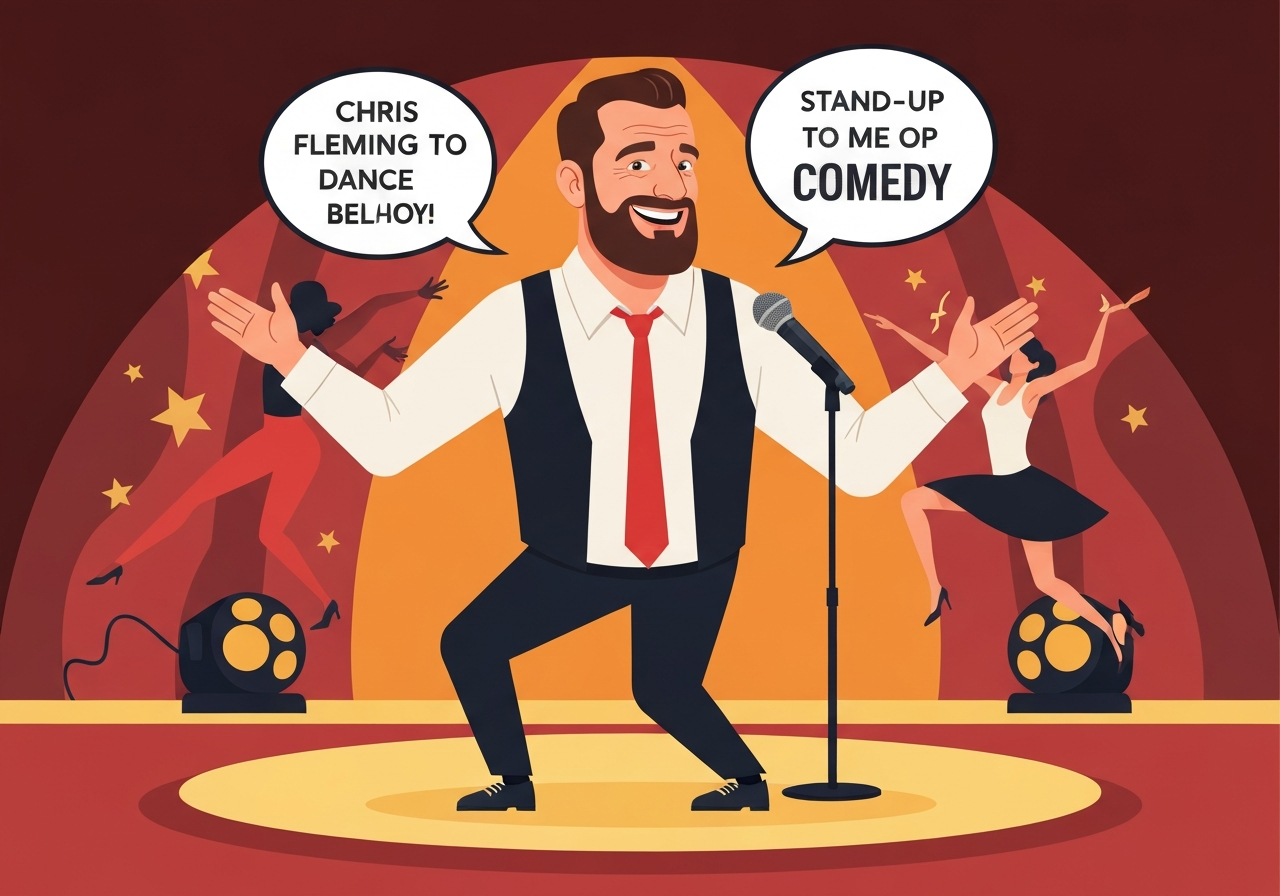
— Chris Fleming, 39, arrives on HBO this week with his first special, Chris Fleming: Live at the Palace. In the special, Fleming blends modern-dance training, bold costuming and deliberate physicality to shape punch lines and timing onstage. The result is a brand of stand-up that relies as much on choreographed movement as on written jokes, winning notice from peers and a high-profile producer. Early reactions suggest the special reframes how physical performance can carry contemporary comedy.
Key Takeaways
- Chris Fleming is 39 years old and his HBO special, Chris Fleming: Live at the Palace, premieres this Friday on the network.
- Conan O’Brien served as a producer on the special, signaling substantial industry backing for Fleming’s work.
- Fleming mixes stand-up writing with choreography, citing influences as varied as modern-dance pioneer Isadora Duncan; he often uses movement to time jokes.
- Distinctive wardrobe — bright jazz shoes, jewel-toned flares and theatrical accessories — accentuates Fleming’s lanky presence onstage and enhances visual punch lines.
- One recurring bit involves Fleming embodying a dirty cast-iron skillet, illustrating his use of physical transformation to land laughs.
- Peers such as Mike Birbiglia have praised Fleming’s originality and uncensored material, comparing his energy to an unlikely combination of Kathy Griffin, Lenny Bruce and Cirque du Soleil.
- Fleming himself has described involuntary movement as a tool: “My leg brain will take over,” he has said about relying on motion to get a laugh.
Background
Physical comedy has a long lineage, from silent-film performers to slapstick and vaudeville, but modern stand-up has tended to favor verbal storytelling and observational delivery. Over the past decade some performers have pushed back, integrating movement, props and theatricality into sets to create hybrid forms that sit between theater and comedy. Fleming’s approach draws on that trend while foregrounding formal choreography rather than incidental movement.
The broader marketplace helps explain HBO’s interest: premium platforms continue to invest in distinct, auteur-driven specials that can differentiate their catalogs. For an artist like Fleming, who combines niche theatrical training with internet-era visibility, a high-profile special can translate cult acclaim into a wider audience. Industry figures who platform emerging acts — podcast hosts, late-night producers — remain influential in deciding which alternative comics receive larger-budget productions.
Main Event
Chris Fleming: Live at the Palace centers on a stage routine where tightly rehearsed physical sequences punctuate and sometimes replace traditional punch lines. Fleming modulates tempo and posture to create comic beats; a subtle shift in stance or a deliberately awkward gait becomes the equivalent of a vocal inflection. The choreography is not decorative alone: it serves as a structural device that reshapes how jokes build and release tension.
Costuming plays an active role. Fleming’s choice of bright jazz shoes, jewel-toned flares and theatrical accessories amplifies silhouette and motion, making small gestures read clearly at distance and on camera. Those visual cues are integral to several bits, including one that literalizes a metaphor by having Fleming perform as a soiled cast-iron skillet, using bodily contortions to sell the gag.
Behind the scenes, established figures have helped bring the project into the mainstream. Conan O’Brien is credited as a producer, and Mike Birbiglia, who has hosted Fleming on his podcast, publicly lauded the comedian’s originality. That endorsement network — podcast platforms, late-night connections and producer backing — allowed Fleming’s idiosyncratic style to reach HBO’s curated audience.
Analysis & Implications
Fleming’s fusion of choreography and stand-up raises questions about genre boundaries. If movement becomes a primary vehicle for timing and surprise, the craft of comedy may increasingly require multidisciplinary training: performers who can write, act and move with precision will have an advantage. That could broaden the skill set expected of serious comics and change how comedy schools and workshops approach training.
From a commercial standpoint, visually distinctive specials can travel well across platforms: short clips and GIFs of striking movement are highly shareable on social media, potentially extending reach beyond traditional stand-up audiences. HBO’s investment suggests networks see value in acts that produce memorable visual moments as much as quotable lines.
There are also questions about accessibility and audience fit. A performance that privileges visual and physical language may land differently across demographic groups and viewing formats (live theater versus streamed video). Critics and programmers will likely assess whether Fleming’s work scales to larger venues or international audiences who may not share the same cultural touchpoints.
Comparison & Data
| Performer | Primary Tool | Era/Context |
|---|---|---|
| Charlie Chaplin | Physical pantomime and silent-film gestures | Early 20th century, cinema |
| Modern stand-ups (typical) | Verbal storytelling and observational set pieces | Late 20th—21st century, live/streaming |
| Chris Fleming | Choreographed movement integrated with written bits | 2020s, premium-special format |
The table highlights a qualitative contrast rather than quantitative metrics: Fleming sits at an intersection where cinematic physicality, theatrical choreography and stand-up writing meet. That hybrid position could influence how specials are produced — from rehearsal schedules to camera blocking — and how networks evaluate talent for visual distinctiveness.
Reactions & Quotes
Comedian and podcast host Mike Birbiglia framed Fleming’s act as unusually original and uncensored, noting a blend of influences and an arresting stage presence.
“Chris is one of the most exciting comedians to watch right now… Plus his material is very uncensored. He’s like Kathy Griffin meets Lenny Bruce meets Cirque du Soleil.”
Mike Birbiglia (comedian, podcast host)
Fleming himself has described an involuntary bodily response that he channels onstage; that instinctive motion often becomes the pivot for a joke rather than a fallback.
“My leg brain will take over. If I’m in front of an audience and I’m struggling, my legs know how to get a laugh.”
Chris Fleming (performer)
Industry response, illustrated by Conan O’Brien’s role as a producer, signals that established curators see commercial and artistic value in Fleming’s hybrid approach. Audience commentary since early previews has emphasized surprise at how movement reconfigures comedic timing.
Unconfirmed
- Specific national or international tour dates following the HBO special have not been publicly confirmed as of Feb. 27, 2026.
- Early viewership or streaming figures for Chris Fleming: Live at the Palace have not been released; any circulation numbers cited online remain unofficial.
Bottom Line
Chris Fleming’s HBO special presents a clear experiment in using choreography as a structural tool for stand-up. The combination of rehearsed movement, striking costuming and uncensored writing produces a style that may broaden definitions of what a comedy special can be. Industry backing from figures like Conan O’Brien and public praise from peers suggest Fleming’s work will reach audiences beyond his existing following.
For viewers and programmers, the key question is whether this hybrid form will become a sustained strand within mainstream comedy or remain a distinctive niche. Either way, Fleming’s special is likely to influence how performers, producers and platforms think about motion, staging and the visual potential of joke delivery.