
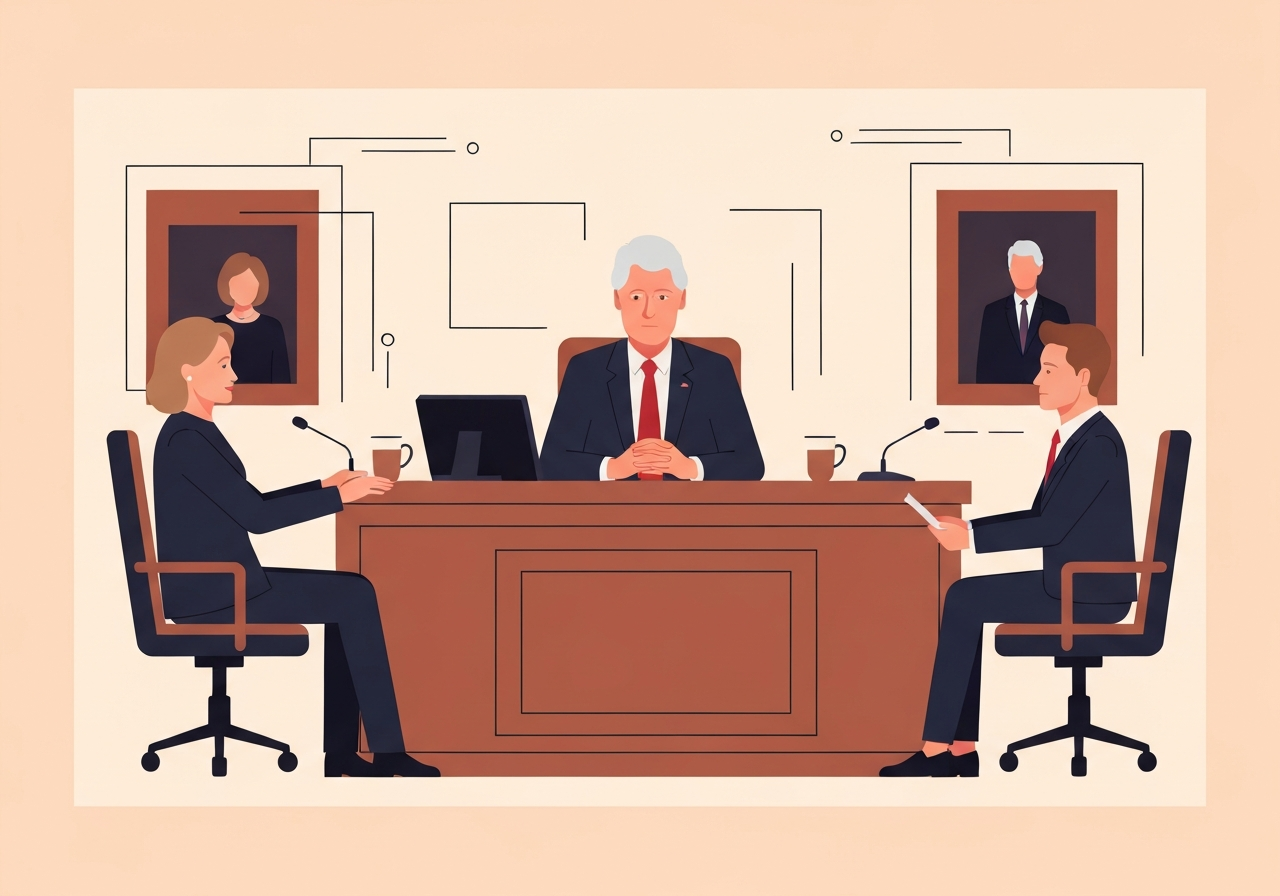
Lead: On Thursday in Chappaqua, N.Y., former secretary of state Hillary Clinton gave a closed-door, more-than-six-hour deposition to the House Oversight Committee, denying any contact with Jeffrey Epstein and any knowledge of his crimes. Republicans on the committee pressed her about donations and social ties; the session was interrupted when a Republican member leaked a photograph to a conservative podcaster. Former President Bill Clinton is scheduled to give a compelled deposition on Friday as the panel expands questioning tied to the Epstein files.
Key Takeaways
- Hillary Clinton testified under oath for more than six hours at the Center for Performing Arts in Chappaqua, N.Y., and said she never met Jeffrey Epstein and never flew on his plane or visited his island, homes or offices.
- Representative James R. Comer chairs the House Oversight Committee; a photo from the deposition was leaked by Representative Lauren Boebert and posted by podcaster Benny Johnson, prompting a 30-minute pause.
- Committee Democrats demanded the unedited transcript be released within 24 hours; Representative Robert Garcia said Republicans violated committee rules by releasing images from inside the room.
- Bill Clinton is scheduled to be deposed on Friday — the first compelled testimony by a former president before a congressional committee — as the panel continues its Epstein-related investigation.
- The Justice Department separately sued five states on Thursday for full voter rolls (Utah, Oklahoma, West Virginia, Kentucky and New Jersey), bringing earlier reported totals to 29 states and the District of Columbia targeted in the administration’s data requests.
- The Pentagon shot down a Department of Homeland Security aircraft over a border area near El Paso, prompting FAA airspace restrictions below 18,000 feet near Fort Hancock and renewed questions about interagency coordination.
- Local outrage followed the death of a visually impaired refugee in Buffalo after Border Patrol agents left him at a Tim Hortons following his release from custody; Erie County authorities said the death was from health complications and an investigation is ongoing.
Background
The House Oversight Committee launched its investigation into Jeffrey Epstein and associates amid continuing public interest in the files gathered about Epstein and Ghislaine Maxwell. Chairman James Comer has issued subpoenas to many figures named in the documents, contending the committee must probe connections to public officials and donors. Democrats and some ethics observers have said the committee’s focus has often appeared partisan and disproportionate to the evidence presented so far.
Both Hillary and Bill Clinton resisted subpoenas for months, calling them politically motivated and legally dubious before eventually complying under threat of contempt votes. The panel’s rules require consultation between the chair and the top Democrat before releasing testimony or materials; Democrats argued that the leaked photo broke those rules and undermined agreed safeguards for closed depositions.
Main Event
Hillary Clinton arrived at the Center for Performing Arts in Chappaqua under subpoena and delivered a lengthy opening statement, later distributed by her aides, accusing the committee of staging “partisan political theater” and saying the investigation was meant to protect a single political party. During questioning she repeatedly said she had no relevant information and described much of the Republican questioning as repetitive.
Tension spiked about an hour into testimony when Representative Lauren Boebert provided a photograph from inside the deposition to a right-leaning podcaster, who then posted it on social media. Clinton’s counsel objected vocally; Democrats called for journalists to be allowed to document the session and demanded the chair produce the full transcript promptly.
Republicans pressed Clinton on fundraising ties and social encounters that overlap with names in the Epstein files, including whether she or her husband had contact with Epstein or with Ghislaine Maxwell, who attended Chelsea Clinton’s wedding as a guest of a guest. Clinton said Maxwell was a distant acquaintance at most and that she did not know her.
After the break the deposition resumed for several more hours. Some Democratic members said the session produced little new information and criticized the committee for focusing on peripheral matters — including questions that veered toward conspiracy theories — rather than on witnesses who appear more prominently in the files.
Analysis & Implications
The compelled testimony of a former first family is unusual and politically charged. For Republicans, compelling testimony from the Clintons advances a narrative of comprehensive review; for Democrats, the proceedings risk appearing selective and retaliatory. That dynamic will shape how the public and courts evaluate any material the committee produces.
The photograph leak exposed structural weaknesses in congressional oversight processes meant to protect closed proceedings and witness privacy. House rules require consultation before release of deposition materials; Democrats say the photo violated those protections and could chill future cooperation by witnesses who expect agreed confidentiality.
Separately, the Justice Department’s aggressive pursuit of unredacted voter data from nearly 30 states signals a parallel federal strategy to centralize information that states typically manage. Courts have already rebuffed similar efforts in several states, and the mixed compliance among Republican-led states will almost certainly mean prolonged litigation heading into the midterms.
National security and operational coordination issues surfaced with the downing of an aerial object near El Paso. The incident underscores gaps in interagency notification when military or law enforcement counter-drone systems are employed in civilian airspace — an area Congress has recently tightened with new coordination requirements.
Comparison & Data
| Metric | Count / Notes |
|---|---|
| Hillary Clinton deposition length | More than six hours (closed-door) |
| States sued by DOJ over voter rolls | 29 states + District of Columbia (administration total) |
| Approximate Republican-governed states that complied | About 11, per the Brennan Center |
The table shows distinct but concurrent federal efforts: congressional investigations into Epstein-related records and an executive-branch effort to collect state voter rolls. Both initiatives involve legal pushback and have produced early court losses for the administration in some jurisdictions, making the ultimate outcomes uncertain and likely to be resolved after extended litigation.
Reactions & Quotes
“You have compelled me to testify, fully aware that I have no knowledge that would assist your investigation,”
Hillary Clinton, opening statement (distributed by aides)
Clinton framed her appearance as compelled and politically motivated; her aides distributed the full opening statement in advance. Democrats on the committee used the break after the photo leak to criticize the Republicans’ conduct and to demand procedural remedies.
“We are sitting through an incredibly unserious clown show of a deposition,”
Representative Yassamin Ansari (D-AZ)
Several Democrats used blunt language to describe the proceedings and questioned the committee’s priorities; others said they welcomed any truthful disclosures that help survivors of Epstein’s crimes. Republican members said they were pursuing legitimate leads cited in the Epstein files and that witnesses should answer questions under oath.
“The situation is alarming and demands a thorough, independent investigation,”
Senator Tammy Duckworth (D-IL), on Pentagon laser incidents
The Pentagon’s use of high-energy lasers near civilian airspace drew bipartisan alarm and calls for inspector general reviews to clarify coordination failures and prevent repeat episodes.
Unconfirmed
- Whether the photograph leak from the deposition was part of a deliberate strategy by committee staff or an individual member remains unverified; internal committee investigations were ongoing.
- It is not yet confirmed whether the military operators who fired lasers believed the downed object belonged to Mexican cartels, the Department of Homeland Security, or was otherwise hostile; official determinations were pending.
- The plan to convene a special grand jury in Fort Pierce and whether matters will be moved there for decisions by Judge Aileen Cannon remain subject to judicial and prosecutorial decisions and are not finalized.
Bottom Line
This week’s events reflect overlapping strains in U.S. politics: a high-profile congressional inquiry that blends factual pursuit with partisan theater, an executive push for centralized voter data that courts have begun to rebuff, and operational missteps between federal agencies that risk public safety and trust. Each thread could have long tails, with litigation and oversight battles extending into the midterm calendar.
For readers, the immediate takeaways are narrow but consequential: Hillary Clinton’s testimony produced no new admissions about Epstein; Bill Clinton’s compelled deposition will intensify political attention; and unrelated federal actions — from voter-data litigation to disputed counter-drone strikes — underscore a broader administration push that is attracting legal and congressional scrutiny.