
Lead
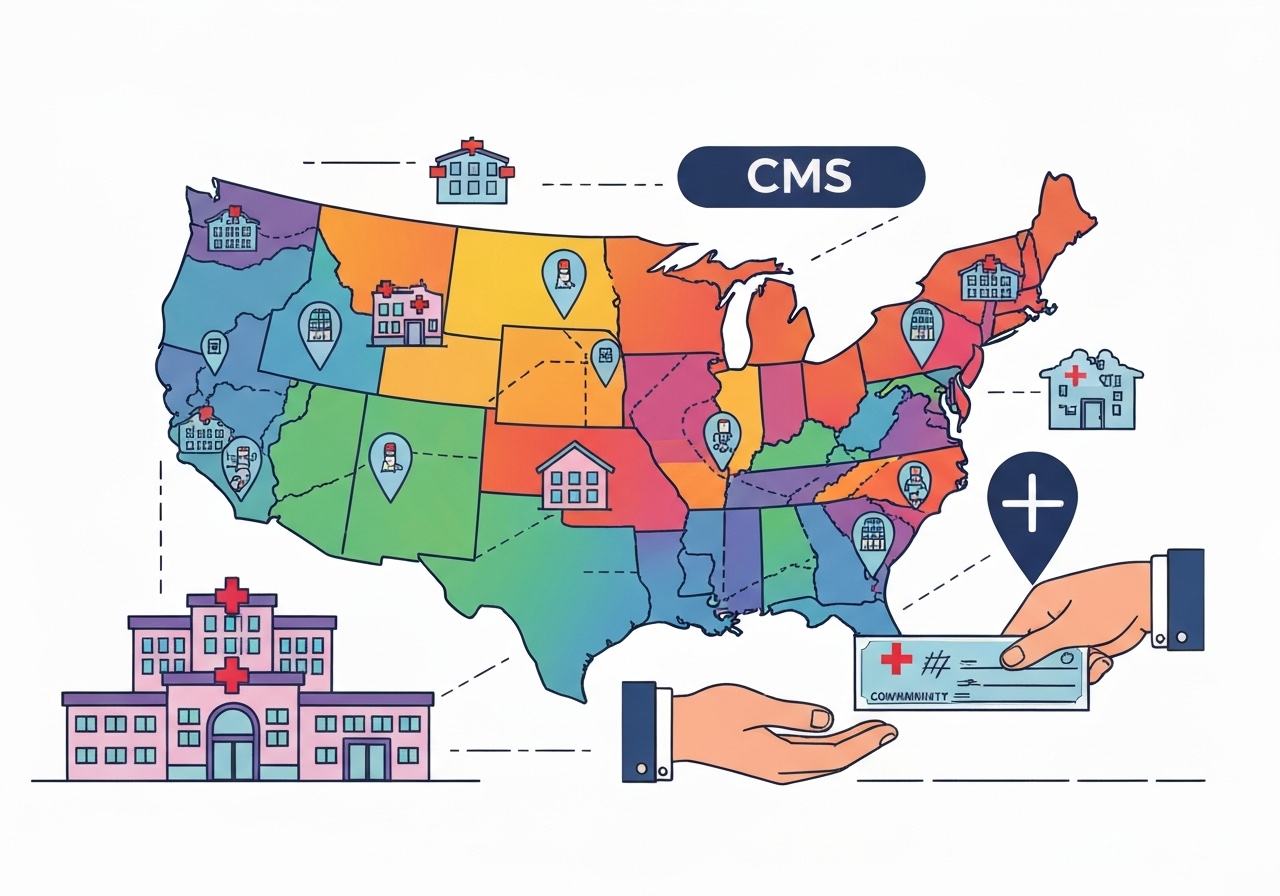
Who: The Centers for Medicare & Medicaid Services (CMS) announced awards to all 50 states. When: First-year awards will be disbursed in 2026 as part of a five-year program running 2026–2030. Where: Nationwide, covering rural communities in every state. What and result: The Rural Health Transformation Program allocates $50 billion to expand access, modernize infrastructure and workforce, and pilot new care models, with first-year state awards averaging about $200 million (range $147M–$281M).
Key Takeaways
- CMS is distributing $50 billion across five years (2026–2030), with $10 billion available each year.
- All 50 states received awards for FY26; the average first-year award is roughly $200 million, with amounts ranging from $147,250,806 to $281,319,361.
- Funding distribution: 50% split equally among approved states and 50% allocated by metrics including rurality, state policy actions, and projected impact.
- Major goals include expanding primary, maternal, behavioral and emergency care, modernizing facilities and telehealth, and strengthening workforce pipelines.
- States may deploy hub-and-spoke systems, regional centers of excellence, interoperable data platforms, and value-based payment pilots.
- CMS will assign project officers to each state, require regular reporting, and host an annual Rural Health Summit beginning at the 2026 CMS Quality Conference.
- Merit review followed standard HHS procedures with federal and non-federal experts and conflict-of-interest screening.
Background
The Rural Health Transformation Program was created under Public Law 119-21, the Working Families Tax Cuts legislation, to target longstanding access and infrastructure gaps in rural America. Rural residents—more than 60 million people—experience higher distances to care, fewer specialists, and a weaker clinical workforce compared with urban populations. Prior federal efforts have included targeted grant programs and Medicaid incentives, but leaders and advocates have long called for larger, sustained investments to stabilize local hospitals and broaden primary and preventive services.
The new program combines a guaranteed base allocation with needs- and performance-based funds to balance equity and impact. That design intends to give every state a predictable foundation while rewarding proposals that demonstrate scalable improvements in outcomes or system efficiency. CMS positions the awards as both a capital and operating support mechanism, allowing states to propose investments in facilities, technology, workforce training, and alternative payment models.
Main Event
CMS announced that each approved state will receive a FY26 award; the federal commitment totals $50 billion over five years with $10 billion available annually. CMS officials emphasized that half of the program pool is distributed equally to ensure baseline capability across states and half is allocated through scoring factors such as rural population, existing infrastructure, and the scope of proposed interventions. The FY26 award list published by CMS records specific dollar amounts for each state, from New Jersey at about $147.3 million up to Texas at $281.3 million.
CMS Administrator Dr. Mehmet Oz and HHS Secretary Robert F. Kennedy Jr. highlighted the initiative in public statements, framing the investment as a means to bring affordable, locality-driven care closer to rural families and to reduce bureaucratic barriers. CMS will deploy project officers to work with each state on kickoff meetings, technical assistance, and ongoing oversight to track implementation and identify promising approaches for broader adoption.
States outlined a range of planned uses: expanding preventive and maternal health services, bolstering EMS communication and treat-in-place options, scaling telehealth and remote monitoring, and piloting workforce pathways such as rural residencies and recruitment incentives. Many applications incorporated evidence-based population health measures — for example, food-as-medicine programs and chronic disease prevention models—aimed at addressing root causes of poor outcomes.
Analysis & Implications
The $50 billion commitment represents an unprecedented federal infusion targeted specifically to rural health systems and could materially change the operational landscape for rural hospitals, federally qualified health centers, and EMS services. By combining equal base funding with a competitive allocation for impact, the program attempts to prevent widening disparities between states while incentivizing high-value innovation. If states use funds to shore up essential services and invest in workforce pipelines, rural communities may see reduced closures and improved access to primary and emergency care.
However, the program’s success depends on execution. Large grants can be transformative, but states must show capacity for implementation, procurement, and sustainable financing beyond federal dollars. Strengthening broadband, interoperability, and cybersecurity will be essential if telehealth and remote monitoring are to scale safely and equitably. Workforce strategies—such as residency expansion and retention incentives—require multi-year commitments from educational institutions and health systems to create durable pipelines.
There are potential fiscal and political trade-offs. States choosing capital-intensive projects may struggle to sustain operating costs, while those emphasizing service expansion must manage workforce shortages. The performance-based half of funding will favor states with solid existing plans and administrative capacity, which may leave smaller or resource-constrained states reliant on their equal-share allotment to begin work.
Comparison & Data
| State | FY26 Award (USD) |
|---|---|
| Alabama | 203,404,327 |
| Alaska | 272,174,856 |
| Arizona | 166,988,956 |
| Arkansas | 208,779,396 |
| California | 233,639,308 |
| Colorado | 200,105,604 |
| Connecticut | 154,249,106 |
| Delaware | 157,394,964 |
| Florida | 209,938,195 |
| Georgia | 218,862,170 |
| Hawaii | 188,892,440 |
| Idaho | 185,974,368 |
| Illinois | 193,418,216 |
| Indiana | 206,927,897 |
| Iowa | 209,040,064 |
| Kansas | 221,898,008 |
| Kentucky | 212,905,591 |
| Louisiana | 208,374,448 |
| Maine | 190,008,051 |
| Maryland | 168,180,838 |
| Massachusetts | 162,005,238 |
| Michigan | 173,128,201 |
| Minnesota | 193,090,618 |
| Mississippi | 205,907,220 |
| Missouri | 216,276,818 |
| Montana | 233,509,359 |
| Nebraska | 218,529,075 |
| Nevada | 179,931,608 |
| New Hampshire | 204,016,550 |
| New Jersey | 147,250,806 |
| New Mexico | 211,484,741 |
| New York | 212,058,208 |
| North Carolina | 213,008,356 |
| North Dakota | 198,936,970 |
| Ohio | 202,030,262 |
| Oklahoma | 223,476,949 |
| Oregon | 197,271,578 |
| Pennsylvania | 193,294,054 |
| Rhode Island | 156,169,931 |
| South Carolina | 200,030,252 |
| South Dakota | 189,477,607 |
| Tennessee | 206,888,882 |
| Texas | 281,319,361 |
| Utah | 195,743,566 |
| Vermont | 195,053,740 |
| Virginia | 189,544,888 |
| Washington | 181,257,515 |
| West Virginia | 199,476,099 |
| Wisconsin | 203,670,005 |
| Wyoming | 205,004,743 |
The table shows FY26 award amounts published by CMS. The range spans roughly $147.3 million to $281.3 million; states with larger rural populations or complex service geographies received higher awards within the allocation methodology. This dataset will serve as the baseline for CMS monitoring and future comparative analyses of program outcomes.
Reactions & Quotes
Officials framed the awards as historic federal support for rural care. CMS and HHS emphasized state-led plans and local control as central program features, while CMS also signaled ongoing oversight and knowledge-sharing to spread effective practices.
This historic investment puts local hospitals, clinics, and health workers in control of their communities ability to deliver quality care.
Robert F. Kennedy Jr., HHS Secretary
HHS leadership positioned the funding as restoring access and lowering bureaucratic barriers for rural patients; this sets expectations for measurable improvements in service proximity and affordability.
States are stepping forward with bold plans to expand rural access and modernize care; CMS will help turn those ideas into lasting improvements.
Dr. Mehmet Oz, CMS Administrator
CMS indicated it will assign project officers and convene states annually to accelerate learning; stakeholders welcomed the oversight but noted implementation capacity will determine real-world impact.
Unconfirmed
- Specific local project starts and timelines are not yet verified; states will publish implementation schedules after kickoff meetings.
- Long-term sustainability plans for recurring operating costs tied to capital investments remain largely dependent on state decisions and are not fully documented in initial submissions.
- Exact allocation formulas used to determine each state’s variable share were described at high level in the Notice of Funding Opportunity, but granular scoring weights and state-by-state score breakdowns are not publicly posted.
Bottom Line
The CMS $50 billion Rural Health Transformation Program is a substantial federal commitment intended to reshape rural care access, workforce, and infrastructure across all 50 states. If implemented and monitored effectively, the combination of equal base funding and targeted impact awards could stabilize local systems, expand primary and emergency services, and accelerate telehealth and workforce solutions.
Success will depend on state execution capacity, durable financing beyond the federal grant window, and careful attention to equity so that smaller or lower-capacity states convert funding into measurable improvements. CMS oversight, reporting requirements, and the planned Rural Health Summit provide mechanisms for accountability and cross-state learning that could amplify high-performing models.
Sources
- CMS press release (official announcement)
- Rural Health Transformation Program: State Project Abstracts (official program documents)