
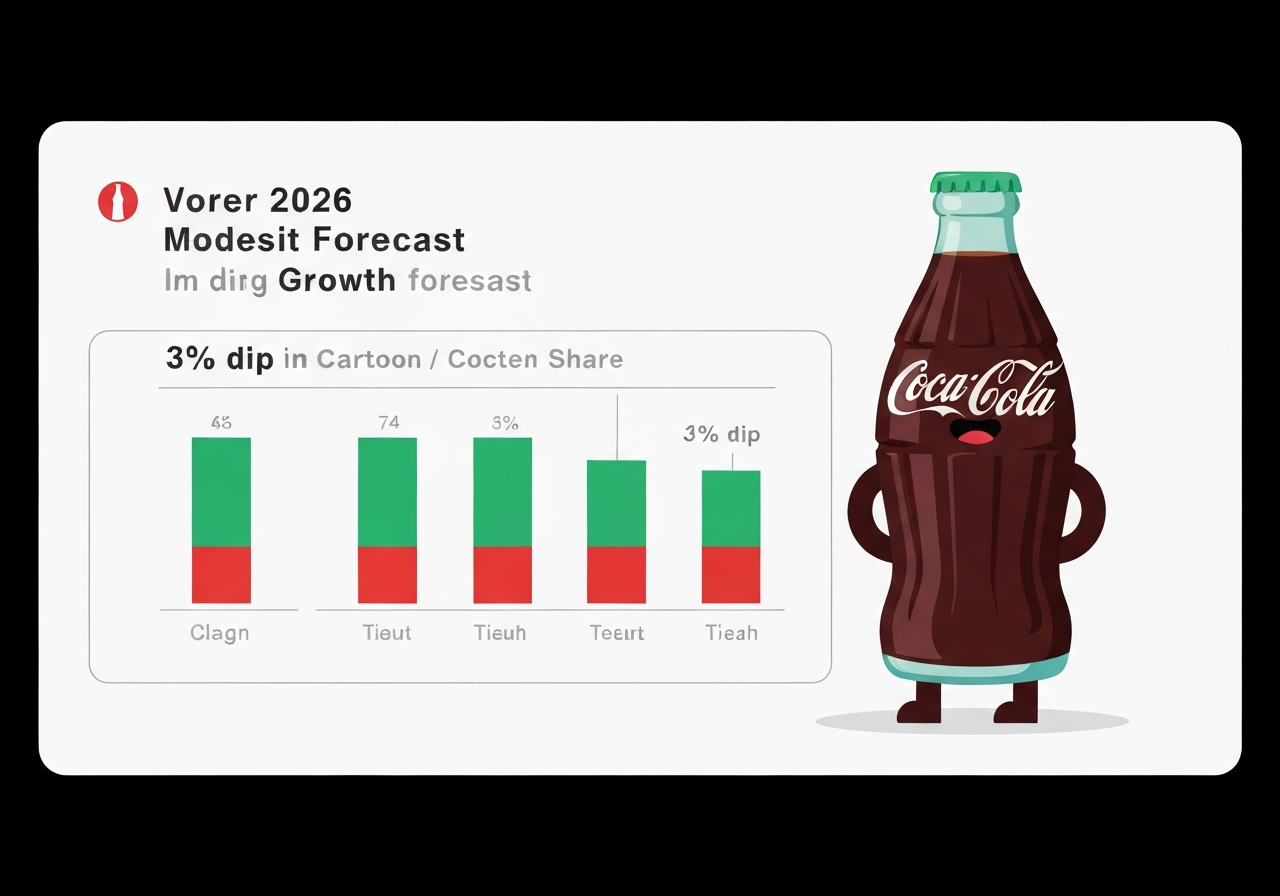
Lead: Coca-Cola reported mixed fourth-quarter results for the period ended Dec. 31, 2025, and issued a cautious outlook for 2026, projecting organic revenue growth of 4%–5% and comparable EPS growth of 7%–8%. Adjusted EPS beat the LSEG consensus at $0.58 versus $0.56 expected, but adjusted revenue of $11.82 billion fell short of the $12.03 billion forecast. Unit case volume rose 1% in Q4 and organic revenue climbed 5%, yet investors pushed the stock down about 3% in premarket trading on the more conservative guidance. The company highlighted strength in water, sports and premium beverage brands while sparkling volume remained largely flat.
Key takeaways
- Q4 adjusted EPS: $0.58, ahead of LSEG consensus of $0.56.
- Q4 adjusted revenue: $11.82 billion, below the $12.03 billion analysts expected.
- Organic revenue increased 5% in the quarter; unit case volume rose 1% — the second consecutive quarter of volume growth.
- 2026 guidance: organic revenue growth of 4%–5% and comparable EPS growth of 7%–8% for the full year.
- Division performance: water, sports, coffee and tea grew volume by about 3%; sparkling soft drink volume was flat overall.
- Brand highlights: Coke (namesake) volume +1%; Coke Zero Sugar volume +13%; juice/dairy/plant-based volumes fell 3%, partly influenced by the sale of finished-product operations in Nigeria.
- Shares have still risen roughly 22% over the last 12 months, valuing the company at about $335 billion as of Monday close.
Background
Coca-Cola has navigated a post-pandemic consumer landscape where grocery spending patterns and eating-out habits ebb and flow with inflationary pressure and shifting household budgets. In 2025 overall volume was flat year-on-year even as certain premium categories — notably bottled water, sports beverages and functional drinks — attracted higher consumer spend. PepsiCo and other peers have reported similar demand headwinds, as value-seeking shoppers trade down or cut discretionary purchases during periods of tighter household finances.
The company measures performance across several adjusted metrics: organic revenue (which strips out acquisitions, divestitures and currency), unit case volume (which excludes pricing and FX to reflect underlying demand) and comparable earnings per share. Those metrics are closely watched by investors because they separate pure consumption trends from accounting and portfolio effects. Coca-Cola’s global footprint and dependence on both developed and emerging markets expose it to currency swings and regional demand variability.
Main event
For the quarter ended Dec. 31, 2025, Coca-Cola reported net income attributable to shareholders of $2.27 billion, or $0.53 per share, up from $2.20 billion, or $0.51 a year earlier. On an adjusted basis — excluding transaction gains and one-time items — the company recorded $0.58 in EPS. Net sales rose 2% to $11.82 billion, while organic revenue, which excludes acquisitions, divestitures and currency effects, increased 5%.
Volume trends were mixed by region. North America volume rose 1% and Latin America volume rose 2% in the quarter, two markets the company singled out as showing early signs of recovery. Globally, water, sports, coffee and tea outperformed, with about 3% volume growth driven by brands like Smartwater and Bodyarmor. By contrast, Coca-Cola’s sparkling beverages were flat overall, though the namesake Coke brand edged up 1% and Coke Zero Sugar grew 13% in the period.
The company’s juice, value-added dairy and plant-based segment reported a 3% decline in volume. Management attributed part of that drop to the sale of finished-product operations in Nigeria to a local bottler, which removed some product from the company’s direct reporting base. Despite the mixed headline numbers, some premium brands — notably Fairlife and Smartwater — demonstrated consumers’ willingness to pay more for perceived higher-value or healthier options.
Analysis & Implications
Coca-Cola’s guidance for 2026 — organic revenue growth of 4%–5% and comparable EPS growth of 7%–8% — signals management expects modest demand improvement but not a rapid rebound. The midpoint of the revenue guidance implies continued but tempered pricing and mix gains rather than a strong volume-driven recovery. Investors interpreted the tone as cautious, leaning toward preservation of margin and measured reinvestment rather than aggressive market share spending.
Operationally, the company’s split performance across categories matters for strategy. Water, sports and premium non-sparkling beverages are showing that health-oriented and functional offerings can sustain price premiums. That supports Coca-Cola’s portfolio approach of leaning into higher-growth, higher-margin categories while managing the legacy sparkling business, which faces intense competition and more elastic demand.
Regionally, the modest volume gains in North America and Latin America are meaningful because they reversed extended declines, but they are not yet robust enough to offset weakness elsewhere. Emerging markets remain an important source of long-term growth, but sales mix, currency and local economic conditions will determine how much of the 4%–5% organic target is driven by volume versus price and portfolio changes.
For investors, the guidance tightens the path to achieving full-year EPS targets: modest top-line expansion coupled with disciplined cost and capital deployment is the likely roadmap. If the company can sustain premium brand momentum and convert trial into repeat purchase, it may exceed the guidance; conversely, a deeper pullback in consumer spending could compress both volume and pricing power.
Comparison & Data
| Metric | Q4 2025 Reported | Wall Street (LSEG) Expectation |
|---|---|---|
| Adjusted EPS | $0.58 | $0.56 |
| Adjusted revenue | $11.82 billion | $12.03 billion |
| Net income attributable to shareholders | $2.27 billion | — |
| Unit case volume (Q4) | +1% | — |
| Organic revenue (Q4) | +5% | — |
The table highlights the key miss on adjusted revenue despite an EPS beat, a profile that often occurs when pricing, mix or one-time items buoy profitability while reported top-line dollars lag consensus. Over the last year the share price has risen roughly 22%, reflecting investor confidence in Coca-Cola’s brand strength and cash generation even as near-term demand patterns fluctuate.
Reactions & quotes
Company guidance for 2026 calls for organic revenue growth of 4%–5% and comparable EPS growth of 7%–8%.
Coca-Cola (official guidance)
Analyst consensus based on an LSEG survey expected $0.56 adjusted EPS and $12.03 billion in adjusted revenue for the quarter.
LSEG (analyst survey)
Shares fell roughly 3% in premarket trading after the results and guidance were released.
Market data (trading, premarket)
Each response reflects a different lens: the company’s forward-looking plan, the analysts’ baseline expectations, and immediate market pricing. Together they form the near-term narrative investors will assess against execution in the coming quarters.
Unconfirmed
- Whether Coke’s premium beverage growth (Smartwater, Fairlife, Bodyarmor) will translate into sustained market-share gains across all major regions remains to be confirmed by subsequent quarters.
- The exact contribution of the Nigeria finished-product sale to the juice/dairy segment’s 3% decline requires more granular disclosure to quantify fully.
- Management’s internal assumptions about currency, commodity costs and bottler performance underlying the 2026 guidance were not fully disclosed in initial remarks.
Bottom line
Coca-Cola’s Q4 results show a company balancing resilient premium-brand demand against slower mass-market beverage consumption. The EPS beat and organic revenue growth indicate underlying strength, but the revenue miss and cautious 2026 guidance prompted a swift market reaction, underscoring investor sensitivity to top-line momentum. Management’s emphasis on higher-growth categories — water, sports and premium — frames the strategic response: prioritize mix improvements and margin resilience while monitoring volume recovery in sparkling categories.
Near term, watch quarterly volume trends in North America and Latin America and progress in converting premium-brand trials into repeat purchases. For investors, the trade-off is between a strong balance sheet and predictable cash generation versus the uncertainty of consumer spending patterns; execution against the 4%–5% organic revenue and 7%–8% EPS targets will determine whether the stock’s recent gains are sustained.
Sources
- CNBC — Q4 2025 earnings summary (media/financial reporting)
- Coca-Cola Company investor relations (official corporate disclosure)
- LSEG analyst consensus (financial data/consensus survey)