
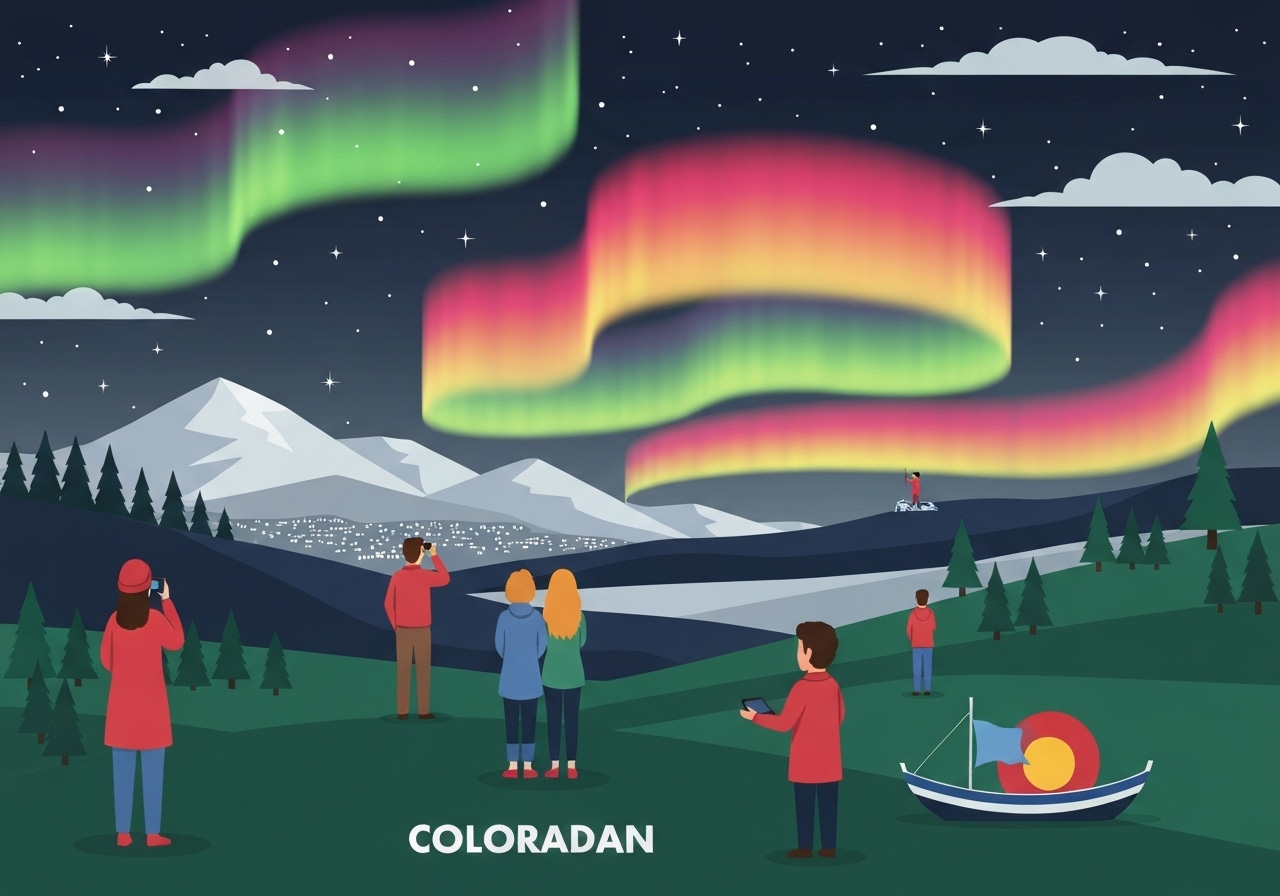
Lead: On Tuesday evening, Nov. 11, 2025, residents across Colorado reported seeing and photographing vivid displays of the aurora borealis. A geomagnetic storm rated G-4 by space-weather agencies produced unusually bright, colorful bands visible from mountain towns to Denver neighborhoods. The best viewing window was forecast for roughly 8–11 p.m. MST, and photographers — both professional and amateur — captured striking images from Lake Loveland, Denver, Thornton, Colorado Springs and Pagosa Springs. Officials warned the same storm can affect power systems and satellites even as it created a rare statewide spectacle.
Key Takeaways
- The event occurred on Nov. 11, 2025, and was linked to a geomagnetic storm classified as G-4 (severe) on the NOAA/space-weather scale.
- Peak visibility in Colorado was expected between about 8:00 and 11:00 p.m. MST on Tuesday, with additional activity into Wednesday night.
- Photographers reported clear sightings from Lake Loveland (photo taken around 7:00 p.m.), Denver’s Central Park area, Thornton, Colorado Springs and Pagosa Springs.
- Cameras with long exposures—roughly 8–10 seconds for phones in still conditions, longer where light pollution is low—produced the most vivid images; tripods or timers were recommended to avoid blur.
- The G-4 storm level indicates a severe magnetic disturbance that can cause voltage irregularities, satellite-tracking issues and broader aurora visibility farther south than usual.
- Local news staff and readers submitted multiple high-quality photos; CBS Colorado credited photographer Dale Atchinson for a Lake Loveland shot and published reader photos from Sherry Gillooly, Susan Anne and Lesann Hollenbeck Young.
Background
Auroras result when charged particles from the Sun interact with Earth’s magnetosphere and atmosphere, producing light at high latitudes. Such displays are common near the Arctic Circle but only occasionally reach states like Colorado in vivid form. The intensity of auroral displays correlates with geomagnetic activity driven by solar flares and coronal mass ejections that send streams of energetic particles toward Earth.
Space-weather monitoring centers, including NOAA’s Space Weather Prediction Center, use a scale from G1 (minor) to G5 (extreme) to classify storms; a G-4 designation denotes a severe event with potential infrastructure impacts. In the U.S., local utilities, aviation operators and satellite controllers track these warnings to mitigate risks. For the public, a G-4 event raises the odds that auroras will be visible far from Arctic latitudes.
Main Event
The storm unfolded on Nov. 11, 2025, producing the most vibrant auroral displays Colorado has seen in several years. Reports and photographs began circulating in the early evening, with one CBS Colorado photographer capturing a bright display over Lake Loveland at about 7:00 p.m. MST. As darkness deepened, viewers across the Denver metro area and farther south reported seeing colorful arcs and streaks with the unaided eye.
In Denver’s Central Park neighborhood, a CBS producer documented visible bands despite urban light. Thornton resident Sherry Gillooly submitted a clear image showing green and pink hues above the horizon, while submissions from Colorado Springs and Pagosa Springs demonstrated that the phenomenon extended hundreds of miles apart. Observers noted that the colors and motion were more pronounced where skies were darker and unobstructed.
Photographers used a range of techniques to capture the lights: stable mounts or tripods, long exposures (often 8–10 seconds on phones under good conditions), and reduced ISO values on manual modes for Android devices. Reported advice included using a wired headphone button or a timer to trigger the shutter to prevent camera shake. CBS Colorado compiled staff- and reader-submitted images that illustrate how settings and location influence the resulting photographs.
Analysis & Implications
Scientifically, a G-4 storm signals a strong interaction between solar ejecta and the geomagnetic field. For space-weather researchers and satellite operators, such storms increase drag on low-Earth-orbit satellites and can cause temporary anomalies in satellite tracking and communications. Utilities may see voltage irregularities on high-latitude transmission lines, and navigation systems reliant on high-frequency radio may be intermittently disrupted.
For the general public, the immediate consequence was an unusual, widely visible natural show. The event highlights how solar activity can produce both aesthetic effects (northern lights far south of their usual range) and tangible risks to technological infrastructure. Emergency planners and operators typically rely on forecasts to implement mitigations; the public benefit comes from clearer alerts and from knowing when to expect stronger auroral activity.
Economically and culturally, notable aurora events can drive local interest and tourism to dark-sky locations, boosting evening visitation to parks and mountain communities. However, the potential for infrastructure impacts tempers that upside: authorities must balance public safety and access with readiness for possible service interruptions.
Comparison & Data
| G-scale | Description | Typical Impacts |
|---|---|---|
| G1 (Minor) | Minor geomagnetic storm | Weak aurora at high latitudes; minor HF radio degradation |
| G2 (Moderate) | Moderate storm | Possible power grid fluctuations; aurora visible farther south |
| G3 (Strong) | Strong storm | Voltage corrections; satellite orientation issues |
| G4 (Severe) | Severe storm | Possible grid impact, satellite tracking problems; aurora visible well south of normal |
| G5 (Extreme) | Extreme storm | Widespread power and satellite disruptions; significant aurora reach |
The table contextualizes the Nov. 11 event as G-4 — the second-highest classification — explaining why auroras were unusually visible across Colorado. While G4 events are uncommon, they are not unprecedented; preparedness protocols exist for utilities and satellite operators to reduce risk during such storms.
Reactions & Quotes
“We observed a severe geomagnetic storm classified as G-4, producing aurora visible far from typical latitudes.”
Space Weather Prediction Center (NOAA) — official classification summary
NOAA and space-weather monitoring organizations issued alerts indicating the storm’s classification and potential technical impacts; agencies emphasized monitoring for satellite and power-system effects. Local viewers and outlets framed the event primarily as an unusual visual phenomenon.
“I stepped outside and could clearly see shifting green bands over Thornton — it was unreal from my backyard.”
Local resident and photo submitter
That reaction mirrors dozens of reader submissions describing easily visible colors even inside the Denver metro area. Photographers credited steady mounts and manual exposure settings for the most dramatic images.
“A few seconds of exposure on a still phone or a short tripod sequence will capture more color than the naked eye sometimes can.”
Local photographer and CBS Colorado contributor
Practical advice from local photographers emphasized stillness, long exposures and minimal light pollution to maximize color capture.
Unconfirmed
- Reports of widespread power outages in Colorado tied directly to the Nov. 11 storm were not substantiated at the time of reporting.
- Claims that the aurora would persist all night statewide beyond the 8–11 p.m. peak were not independently verified.
- Single-source social media posts suggesting damage to specific satellites lacked corroboration from satellite operators.
Bottom Line
The Nov. 11, 2025 G-4 geomagnetic storm produced some of the most vivid auroral displays seen in Colorado in recent years, enabling clear sightings from mountain locations and urban neighborhoods alike. While the lights offered a rare public spectacle and strong photo opportunities, the storm’s G-4 classification also carried real-world implications for satellites and power systems that merit attention by operators and policymakers.
For the public, the best chance to see or photograph similar events is to monitor official space-weather alerts, seek dark, unobstructed sky views during predicted peak windows, and use stable mounts and long exposures for cameras. Authorities and infrastructure operators should continue following established mitigation plans when G-scale alerts are issued to minimize technical impacts.