
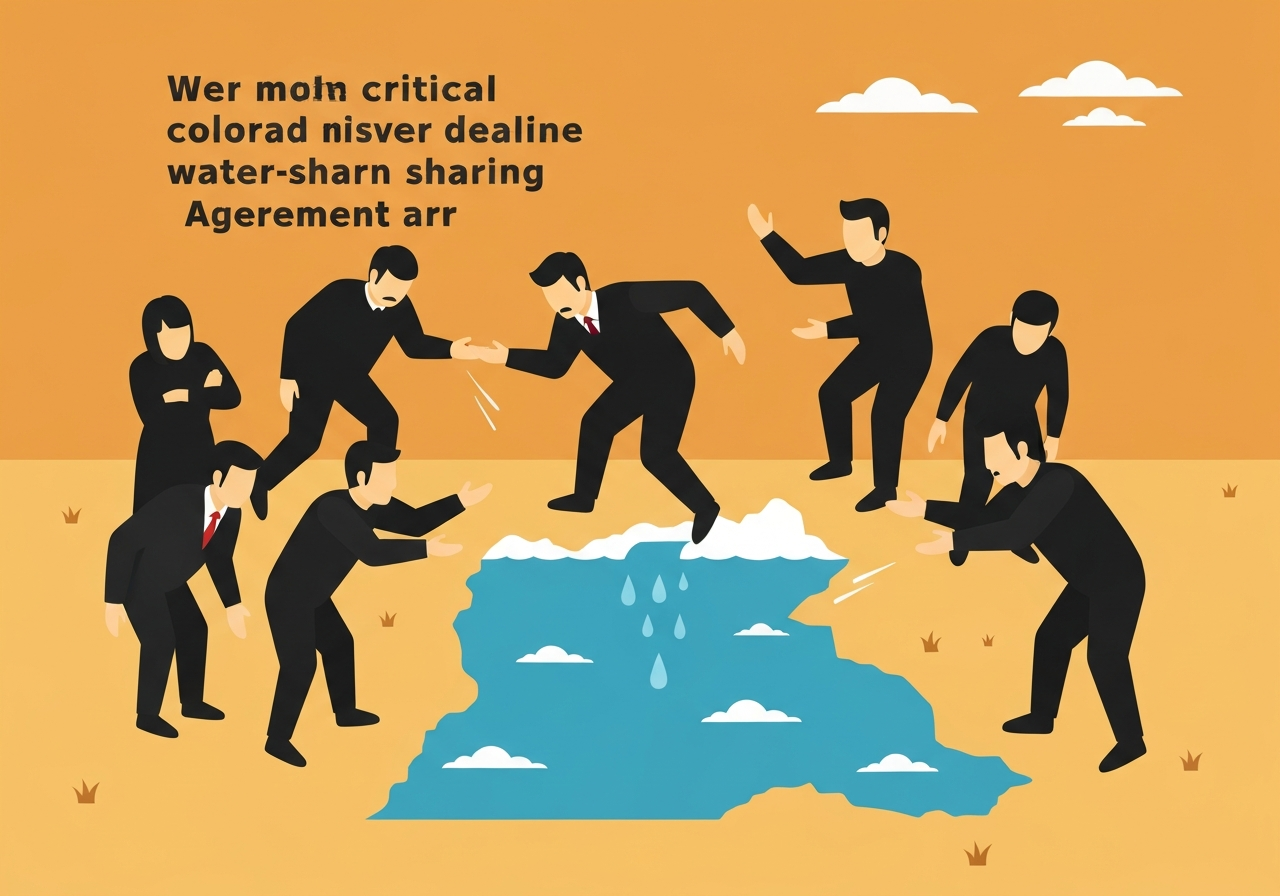
Lead: The seven Western states that rely on the Colorado River missed a Saturday deadline for the second time to finalize a shared plan to confront record drought and looming water shortages across the basin. Lower Basin governors from Arizona, California and Nevada urged greater concessions from the Upper Basin states — Colorado, New Mexico, Utah and Wyoming — after negotiators failed to bridge differences over how to divide cuts. The impasse raises the prospect of federal intervention, litigation and sharper reductions if parties cannot agree before this year’s guidelines expire. Over 40 million people, Mexico and numerous tribes depend on the river for water, food production and power.
Key Takeaways
- The seven basin states missed a second deadline on Saturday to reach a consensus on a plan to address ongoing shortages and record drought.
- Arizona has proposed a 27% reduction in Colorado River allocation, California 10% and Nevada 17%, according to state announcements.
- Negotiations have been under way for more than two years; a previous deadline set by the U.S. Bureau of Reclamation in November was also missed.
- More than 40 million people in the U.S., plus Mexico and Native American tribes, rely on Colorado River water for agriculture, municipal supply and hydropower.
- Scientists report Western snow cover and snow depth at multi-decade lows; normal winter snow cover of about 460,000 sq. miles fell to roughly 155,000 sq. miles this season.
- If states remain deadlocked, the federal government could impose a plan, increasing the chances of legal challenges and dissatisfaction among basin stakeholders.
Background
The Colorado River has been governed by interstate agreements and compacts dating to the 1922 Colorado River Compact, which apportioned flows based on historical estimates that are now widely considered optimistic. The basin’s hydrology depends heavily on winter mountain snowpack in the Upper Basin states, which historically accumulated more water than the region consumed. Over decades the Lower Basin, which includes major agricultural regions, has become the primary consumer of river allocations.
Beginning in the early 2000s, the basin experienced an extended drought amplified by higher temperatures linked to climate change; that combination has steadily reduced river flows and lowered reservoir elevations at Lake Mead and Lake Powell. Federal guidelines currently governing allocations and shortage sharing are scheduled to expire after this year, prompting an extended round of negotiations among all seven basin states, tribes, Mexico and the federal government.
Main Event
On Saturday negotiators again failed to produce a compact plan that would distribute mandatory reductions across the basin, leaving outstanding disputes over equity, timing and who must shoulder the largest cuts. Governors of Arizona, California and Nevada issued a joint statement urging the Upper Basin states to offer deeper concessions, saying the Lower Basin has already conserved large volumes of water in recent years to stabilize supplies.
Colorado Senator John Hickenlooper, who oversaw contingency planning as Colorado’s governor in 2019, described the basin’s condition as dire, citing an especially low snowpack and warning that litigation will not fix the long-term trend toward aridification. Meanwhile Southern Nevada Water Authority General Manager John Entsminger emphasized that prior conservation moves were meant to protect communities should conditions worsen, and expressed frustration over the lack of progress in talks.
Negotiations have stretched for over two years and passed an earlier November deadline set by the Bureau of Reclamation, which has encouraged states to reach a voluntary plan before federal action becomes necessary. With current interim rules expiring at year’s end, stakeholders face compressed timelines for agreement or risk a federally imposed solution that could be less tailored and more contentious.
Analysis & Implications
If the seven states cannot reach a negotiated settlement, the federal government could step in and issue directives on allocations and shortage triggers; such a move would likely prompt legal challenges from one or more parties. Federal intervention could produce a one-size-fits-all remedy that leaves some states or water users feeling unfairly treated, heightening political and courtroom conflict.
Economically, larger mandatory cuts would hit irrigation-dependent agriculture hard in Lower Basin areas, potentially reducing crop output and local employment where water is a primary input. Urban water providers in major metropolitan areas face difficult choices about mandatory conservation measures, rate adjustments and investments in alternative supplies, from desalination to wastewater reuse.
For tribes and Mexico — both of which hold legal and treaty interests in Colorado River water — the stakes include long-promised deliveries and negotiated settlements that have historically been sidelined or delayed. Any major reallocation could require new agreements with tribal nations and diplomatic coordination with Mexico to prevent supply shocks across borders.
Comparison & Data
| State/Region | Recent Reduction Offer | Role in Basin |
|---|---|---|
| Arizona | 27% | Lower Basin; large municipal and agricultural demand |
| California | 10% | Lower Basin; largest single-state water consumer in basin |
| Nevada | 17% | Lower Basin; major urban demand (Las Vegas) |
The table summarizes reduction offers publicly announced by the three Lower Basin governors. The Upper Basin states have not matched those percentages with widely published counterproposals, leaving a gap in negotiators’ ability to craft an across-the-board plan. Data from the National Snow and Ice Data Center show regional snow cover this winter shrank from an average near 460,000 square miles to roughly 155,000 square miles, a dramatic decline that reduces runoff and reservoir inflows in coming months.
Reactions & Quotes
Lower Basin governors issued a joint appeal to the Upper Basin to increase concessions, arguing that conserved volumes from the Lower Basin should be met by shared responsibility across all seven states. Their statement framed conservation as a collective obligation to protect communities and economies.
“All seven basin states must share in the responsibility of conservation,”
Arizona, California and Nevada governors (joint statement)
Sen. John Hickenlooper urged collaborative action and warned against relying on litigation as a solution. He highlighted the immediate hydrologic warning signs, such as thin snowpack, as reasons for expedited, cooperative measures.
“The best path forward is the one we take together; litigation won’t solve long-term aridification,”
Sen. John Hickenlooper (Colorado)
Southern Nevada Water Authority officials said two decades of local conservation are aimed at buffering worse outcomes and expressed frustration at stalled interstate progress, noting that proactive regional measures are insufficient without basinwide agreement.
“Our actions are about protecting ourselves if things go from bad to worse,”
John Entsminger, Southern Nevada Water Authority
Unconfirmed
- Specific counteroffers from Upper Basin states have not been detailed publicly; the size and timing of any concessions remain unclear.
- The exact form and timing of potential federal intervention have not been announced; Bureau of Reclamation guidance will shape next steps but specifics are pending.
- The immediate, quantifiable impact on particular tribes’ water deliveries if a federal plan is imposed has not been fully disclosed in public documents.
Bottom Line
The failure to reach agreement by Saturday highlights deep political and hydrologic tensions in the Colorado River Basin as climate-driven shortages intensify. With current guidelines set to expire after this year, stakeholders face a narrowing window to craft a voluntary, equitable plan that avoids federal imposition and costly litigation.
What happens next will hinge on whether Upper Basin states offer substantive concessions that can be reconciled with Lower Basin proposals, and on how quickly the Bureau of Reclamation and federal policymakers act to mediate or enforce a solution. For communities, farmers and utilities across the basin, the practical consequences — from reduced irrigation allocations to tougher municipal restrictions — could begin to appear within months if a binding deal is not reached.
Sources
- Associated Press (news report)
- National Snow and Ice Data Center (scientific data and analysis)
- U.S. Bureau of Reclamation (federal agency — policy and guidance)