
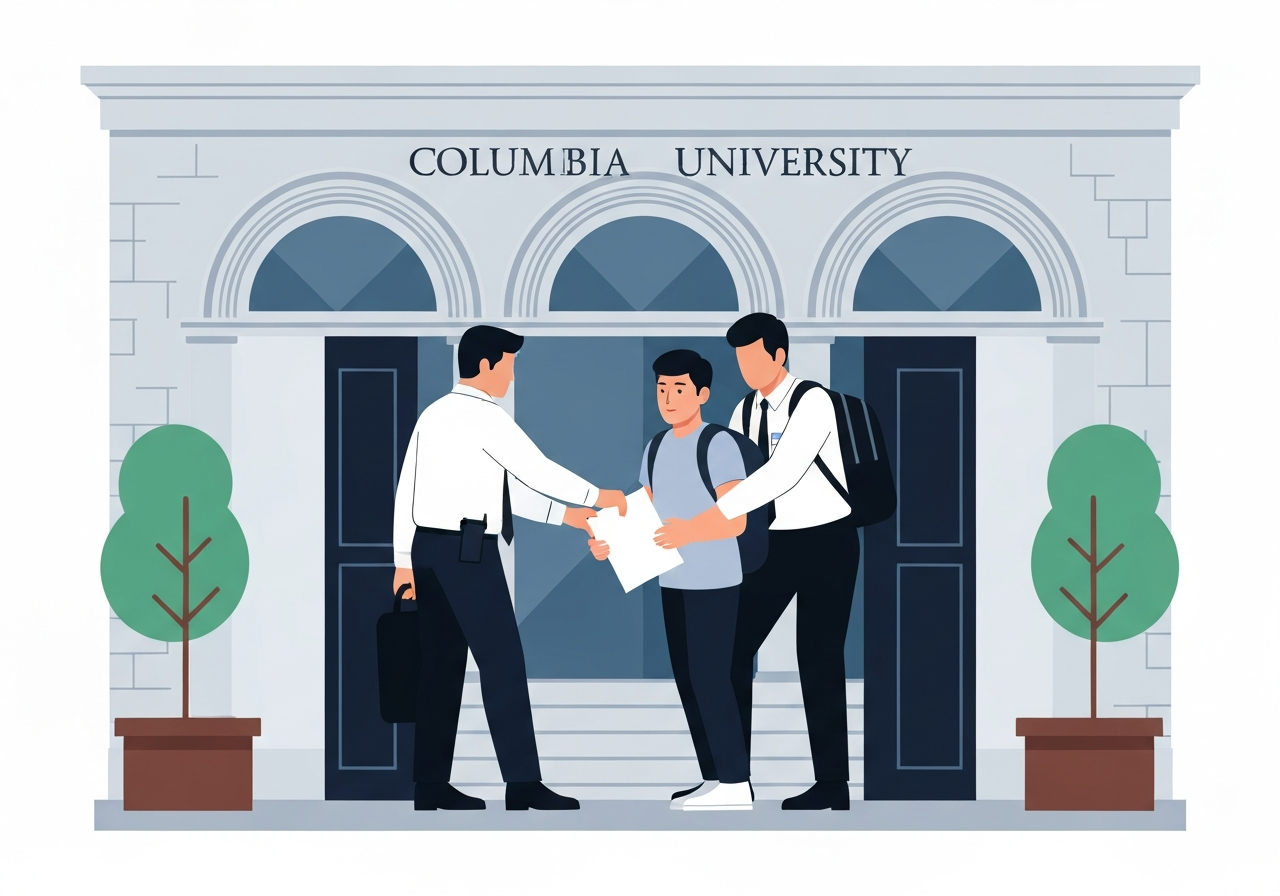
Lead: Columbia University said federal Department of Homeland Security agents entered a Columbia-owned residence early on Feb. 26, 2026, and detained a senior student. University officials said they are investigating how the officers gained access after being told officers misrepresented their identity. The student, identified by friends as Ellie Aghayeva, an international senior in neuroscience and political science, was taken from an apartment on West 121st Street. Columbia’s acting president said the school is working to gather more details about the incident.
Key Takeaways
- On Feb. 26, 2026, DHS agents entered a Columbia-owned residential building and detained a student early Thursday morning, according to the university.
- The detained student is Ellie Aghayeva, a senior studying neuroscience and political science, identified by friends and a faculty group as an international student with a visa.
- Columbia’s acting president, Claire Shipman, said officials believe federal agents misrepresented themselves to gain entry, reportedly saying they were searching for a “missing person.”
- A state assemblyman said university officials told him the agents presented themselves as New York City Police Department officers when seeking access.
- The student posted a one-second Instagram video from the back of a vehicle with the caption, “Dhs illegally arrested me. Please help,” which circulated on campus and drew immediate concern.
- Columbia has opened an internal inquiry and is seeking information from federal authorities while students and faculty call for transparency and protection for international students.
Background
Colleges and universities are common locations of tension over immigration enforcement because many students are noncitizens with visa status and rely on campus as a primary residence and community. Federal immigration authorities have broad arrest powers, but enforcement actions inside private residences and on campuses raise legal and policy questions about notice, university cooperation, and students’ rights. Universities typically maintain policies that require some level of campus notification when law-enforcement activity involves campus property or affects students’ safety; those policies are now under scrutiny at Columbia.
Recent years have seen a contentious national debate about how and when federal immigration agents should operate near or inside higher-education institutions, with colleges seeking to balance cooperation with law enforcement and protection of student privacy and due process. Columbia, a large institution with thousands of international students, has procedures for campus safety and housing access; the university’s immediate response—seeking details and informing the community—reflects concern about precedent and student wellbeing. Stakeholders include university administration, student and faculty groups, state elected officials, and federal agencies whose authority and methods are being questioned.
Main Event
According to a university letter circulated on Thursday, Feb. 26, federal Homeland Security officers entered a Columbia-owned residential building on West 121st Street early in the morning and detained a student there. Columbia’s acting president, Claire Shipman, said in the message that university officials believed the agents misrepresented their identity to gain entry, and that the institution was working to assemble more facts. A state assemblyman told reporters he had been informed by university staff that agents said they were Police Department officers when seeking access.
Friends and a faculty organization, the American Association of University Professors, identified the detained student as Ellie Aghayeva, a senior majoring in neuroscience and political science, and described her as an international student holding a visa. The students’ statement said Aghayeva was removed from her Columbia-owned apartment; a brief video posted on her widely followed Instagram account showed her in the back of a vehicle with the caption alleging an unlawful DHS arrest.
Columbia officials said they were trying to collect additional information from federal authorities and warned the campus community they were looking into the matter. The university has not published a detailed timeline of interactions between its staff and the federal agents, nor has it disclosed whether campus public-safety officers were present when federal agents entered the building. Federal agencies have not released a public statement with operational details as of the university’s update.
The incident prompted immediate inquiries from student groups and at least one state lawmaker, who requested clarification from Columbia and signaled concern about potential misrepresentation and the rights of international students. Calls for transparency and a clear account of how entry was gained and what legal basis was used for the detention intensified on social media and among campus organizations.
Analysis & Implications
Legally, the situation raises questions about authority and procedure. Federal immigration officers have the power to detain noncitizens, but arrests on private property generally require a warrant or consent unless exigent circumstances apply. If agents misrepresented themselves to obtain entry, that could be central to any legal challenge and to university policy reviews. Columbia’s obligation to protect resident students intersects with federal enforcement powers, creating a complex institutional duty to both cooperate with law enforcement and safeguard student rights.
For international students, the incident amplifies anxiety about immigration risk and campus safety. Even students with valid visas may feel vulnerable if enforcement actions occur without clear notice or coordination with university officials. This can affect campus climate, willingness to report safety concerns, and trust between international communities and the administration. Universities may face pressure to strengthen internal protocols for responding to outside law-enforcement requests and to assert clearer safeguards for students living in campus housing.
Politically, the episode could prompt state and municipal scrutiny of federal operations in residential or institutional settings. Elected officials and higher-education advocates who view campus autonomy and student protections as priorities may demand transparency, oversight, or legislative remedies. Conversely, federal agencies may defend actions as lawful enforcement. The resulting legal and policy debates could shape future guidance on campus access and interagency communication, affecting other institutions with large international student populations.
Comparison & Data
| Event | Date | Location |
|---|---|---|
| DHS entry and student detention | Feb. 26, 2026 | Columbia-owned apartment, West 121st Street |
| NYT update | Feb. 26, 2026 1:19 p.m. ET | Public reporting |
The table above compiles the verifiable timeline elements reported publicly: the date of the detention and the time of an initial news update. While comprehensive datasets on campus-related immigration actions are limited in real time, this incident fits into broader patterns of episodic enforcement actions that spur institutional reviews and calls for clearer policies. The immediate lack of federal public detail makes institution-level documentation and independent reporting crucial for a complete factual record.
Reactions & Quotes
Columbia’s acting president framed the incident as a matter requiring further fact-finding and expressed concern about how entry to campus housing was obtained. The university’s initial communication emphasized an effort to gather more information and to keep the community informed.
“We are working to gather more details,”
Claire Shipman, Columbia acting president
Student groups and the faculty organization that shared details about the detained student highlighted her academic status and visa status while urging transparency and support. The student’s brief social-media post was circulated widely and intensified campus alarm.
“Dhs illegally arrested me. Please help,”
Ellie Aghayeva (Instagram post)
A state assemblyman relayed what he was told by university officials about how agents represented themselves when seeking access to the building; that account contributed to scrutiny over the manner of entry. Advocates emphasized the need for factual clarity before assigning legal conclusions.
“University officials told me agents presented themselves as Police Department officers,”
State assemblyman (statement to reporters)
Unconfirmed
- Whether federal agents had a warrant or other legal authorization for entry into the Columbia-owned apartment remains unconfirmed publicly.
- Precise details about the legal basis for Ellie Aghayeva’s detention have not been released by federal authorities and are not independently verified.
- Claims that agents intentionally misrepresented their identity to Columbia staff or residents are under review and have not been independently corroborated.
Bottom Line
The detention of a Columbia student by DHS agents inside a university-owned residence on Feb. 26, 2026, has raised urgent questions about how federal authorities gain access to campus housing and how universities should respond. Columbia’s public statement indicates an internal fact-gathering process, while students, faculty and elected officials demand transparency and clarity about legal grounds and methods used by agents.
In the near term, expect calls for more detailed disclosures from federal and university officials, and possible legal or policy review focused on campus-entry procedures and protections for international students. The incident underscores the fragile trust between campus communities and enforcement authorities and may prompt institutions nationwide to reevaluate protocols for housing security, external requests for access, and communication with affected students.
Sources
- The New York Times (news reporting)