
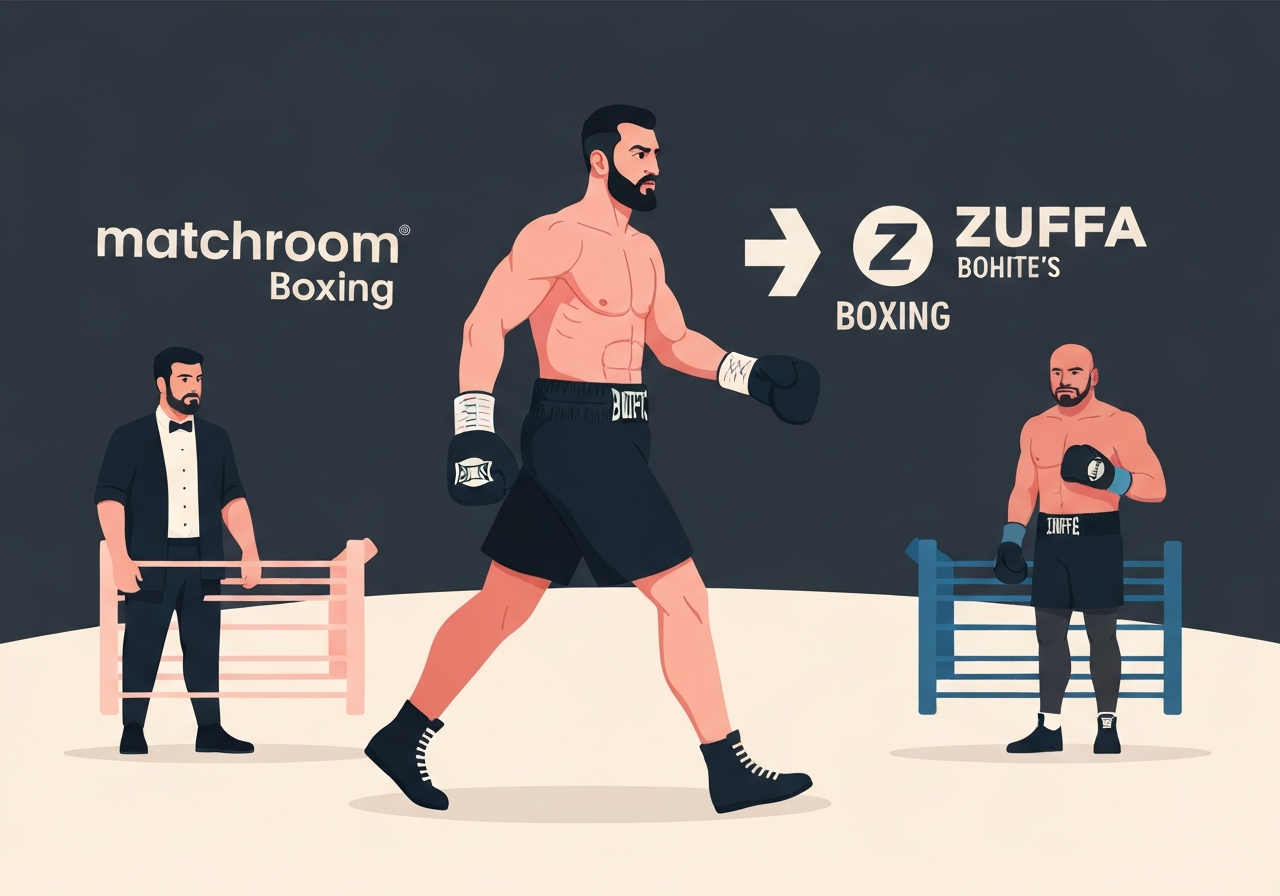
Conor Benn has formally departed Eddie Hearn’s Matchroom stable to sign with Dana White’s Zuffa Boxing, a move that immediately reshapes his path toward a world title and intensifies a budding promotional rivalry. Benn arrives at Zuffa with a record cited as 24 wins in 25 professional fights and is positioned as a leading contender after a November victory over Eubank Jr that put him within range of world-title contention. Zuffa Boxing — backed by UFC boss Dana White and Saudi capital — held its first event in January and has announced ambitions to establish its own top-tier world championship. The transfer comes amid public sparring between White and Hearn and raises immediate questions about Benn’s mandatory status and future opponents.
- Benn’s record is reported as 24 wins from 25 professional bouts; his only recorded loss is listed against an Eubank, while a November win over Eubank Jr is credited with moving him close to a title fight.
- Zuffa Boxing staged its inaugural event in January and is financed in part by Saudi interests; the venture is led publicly by Dana White.
- Zuffa’s stated objective is to supplant the four established sanctioning bodies (WBO, WBC, IBF, WBA) and make a Zuffa belt — alongside the Ring Magazine title — a premier world crown.
- Benn remains the mandatory challenger for the winner of Mario Barrios v Ryan Garcia, a status that complicates how Matchroom-era plans will be honored following his move.
- Zuffa recently signed reigning cruiserweight champion Jai Opetaia, signaling an early push to build recognized titleholders within its ranks.
- Dana White called Benn a “superstar” and framed the signing as a statement in his campaign to disrupt boxing’s power structure.
- Eddie Hearn had supported Benn through a recent doping controversy and had been guiding him toward a world-title opportunity before the switch.
- The signing produced unusually little prior public hinting, marking a surprising and abrupt change for industry observers and fans.
Background
Professional boxing has long been organized around a mix of promoters, broadcast partners and multiple sanctioning bodies that award separate world titles. Promoters such as Matchroom, led by Eddie Hearn, and networks have historically negotiated fighters’ routes to belts sanctioned by the WBO, WBC, IBF and WBA. In recent years, new entrants with deep pockets have sought to alter that landscape; Zuffa Boxing, fronted by Dana White and supported by Saudi investment, launched publicly this year with the explicit aim of creating an alternative top-tier championship.
Conor Benn emerged as a commercial attraction in the U.K. market and was being positioned by Matchroom for a rapid move into world-title contention. That trajectory was complicated by a doping controversy that kept him out of competition and fueled debate about his standing among peers and regulators. Matchroom maintained public support for Benn during that period, while boxing’s fragmented governance meant multiple potential routes to a belt — some tied to sanctioning bodies, others to promotional alliances.
Main Event
The signing was announced without the usual run-up of rumors or pre-release statements from the outgoing promoter, leaving many industry figures surprised. Zuffa described Benn as a marquee addition and framed the deal as part of a broader strategy to attract mainstream boxers into a new competitive ecosystem. Dana White, speaking after the announcement, emphasized Benn’s drawing power and readiness for world-level opposition, portraying the move as a competitive and public-relations coup.
Benn’s own public comments stressed ambition and continuity: he said he still hoped Eddie Hearn could be involved in future match nights while stressing his desire for “legacy fights” and the biggest possible stages. The fighter’s mandatory position for the Barrios v Garcia winner complicates immediate matchmaking, because that route is tied to the traditional sanctioning pathways that Zuffa has said it intends to circumvent over time.
The transfer also escalated an already-heated exchange between White and Hearn. Over the past week White publicly questioned Hearn’s credentials in a dismissive tone and joked that Hearn “worked for his father Barry,” a comment to which Hearn responded by pointing to Zuffa’s Saudi-linked backers and calling out Turki Alalshikh’s influence. The public spat underscores how talent movement can quickly become part of broader jockeying for control of marquee events and market share.
Analysis & Implications
Zuffa’s acquisition of Benn serves both symbolic and practical aims. Symbolically, signing a fighter with mainstream name recognition and recent high-profile wins signals to other athletes and broadcasters that Zuffa intends to compete for top talent. Practically, Benn’s presence gives Zuffa leverage in negotiating broadcast deals and event placements, especially in the U.K. market where Matchroom has been a dominant promoter.
If Zuffa succeeds in establishing its own recognized world title, the traditional four-belt system could lose centrality, altering how fighters pursue championship lineage. That would reshape rankings, mandatory challenger rules, and purse dynamics; fighters who align early with Zuffa could gain expedited access to marquee bouts under a single promotional umbrella, while others may remain tied to established sanctioning paths.
Saudi financial involvement and the relationship with Ring Magazine ownership add geopolitical and commercial complexity. Backing from deep-pocketed patrons shortens the time needed to build a stable of champions and global events, but it also raises questions about long-term legitimacy and the willingness of networks and boxing commissions to recognize new belts as equivalent to longstanding sanctioning titles.
Comparison & Data
| Organization | Role |
|---|---|
| WBO / WBC / IBF / WBA | Traditional sanctioning bodies awarding separate world titles |
| Zuffa Boxing | New promoter-backed championship aiming to create a single premier belt |
| Ring Magazine | Recognized boxing title and ranking publication; cited as allied to Zuffa ambitions |
The table outlines structural differences rather than numerical measures: traditional bodies are federated organizations with their own ranking and mandatory systems; Zuffa is a promoter-led initiative seeking to concentrate prestige under a single branded belt. How commissions, networks and the wider boxing community treat a Zuffa title over time will determine whether it achieves comparable standing to the established belts.
Reactions & Quotes
Zuffa’s chief framed the signing as evidence of momentum and talent acquisition strategy. His brief remarks emphasized Benn’s drawing power and readiness for a title step-up.
“Conor Benn is an absolute beast and a superstar. He shows up every time and destroys people… He’s ready for a world title next.”
Dana White / Zuffa Boxing (statement)
Benn spoke to ambition and the desire to secure high-profile matchups, while leaving the door open to collaborations with his former promoter.
“I want the legacy fights, the biggest nights, the biggest stages. I fear no man at any weight and I’m ready to give the fans the fights they’ve been calling for.”
Conor Benn (fighter comment)
Eddie Hearn’s camp had publicly supported Benn through his recent difficulties; the change of promoter prompted terse public exchanges between Hearn and White about who ultimately holds influence. Observers regard the back-and-forth as part PR, part leverage in a larger contest over fighters and broadcast position.
Unconfirmed
- Whether Eddie Hearn or Matchroom will retain any promotional role for Benn on a fight-by-fight basis is not confirmed and remains subject to future agreements.
- How Zuffa will reconcile Benn’s mandatory challenger status for the Barrios v Garcia winner with its stated aim to operate outside traditional sanctioning structures is not yet clear.
- The timeline and opponent plans for Benn’s next bout, including a potential first Zuffa welterweight title match, have not been finalized publicly.
Bottom Line
Conor Benn’s move from Matchroom to Zuffa Boxing is both a personal career pivot and a signal in a larger industry struggle over talent, titles and commercial control. For Benn, the switch accelerates a narrative of immediate world-title potential while introducing contractual and sanctioning questions that will need resolution before a definitive path to a belt is set.
For boxing as a whole, Zuffa’s recruitment of recognizable fighters like Benn demonstrates that new, well-funded promoters can rapidly alter competitive dynamics. Whether Zuffa’s belt will attain the legitimacy of the WBO/WBC/IBF/WBA titles depends on acceptance by commissions, fighters and broadcasters — a process that will unfold over many high-profile matchups and regulatory encounters.