
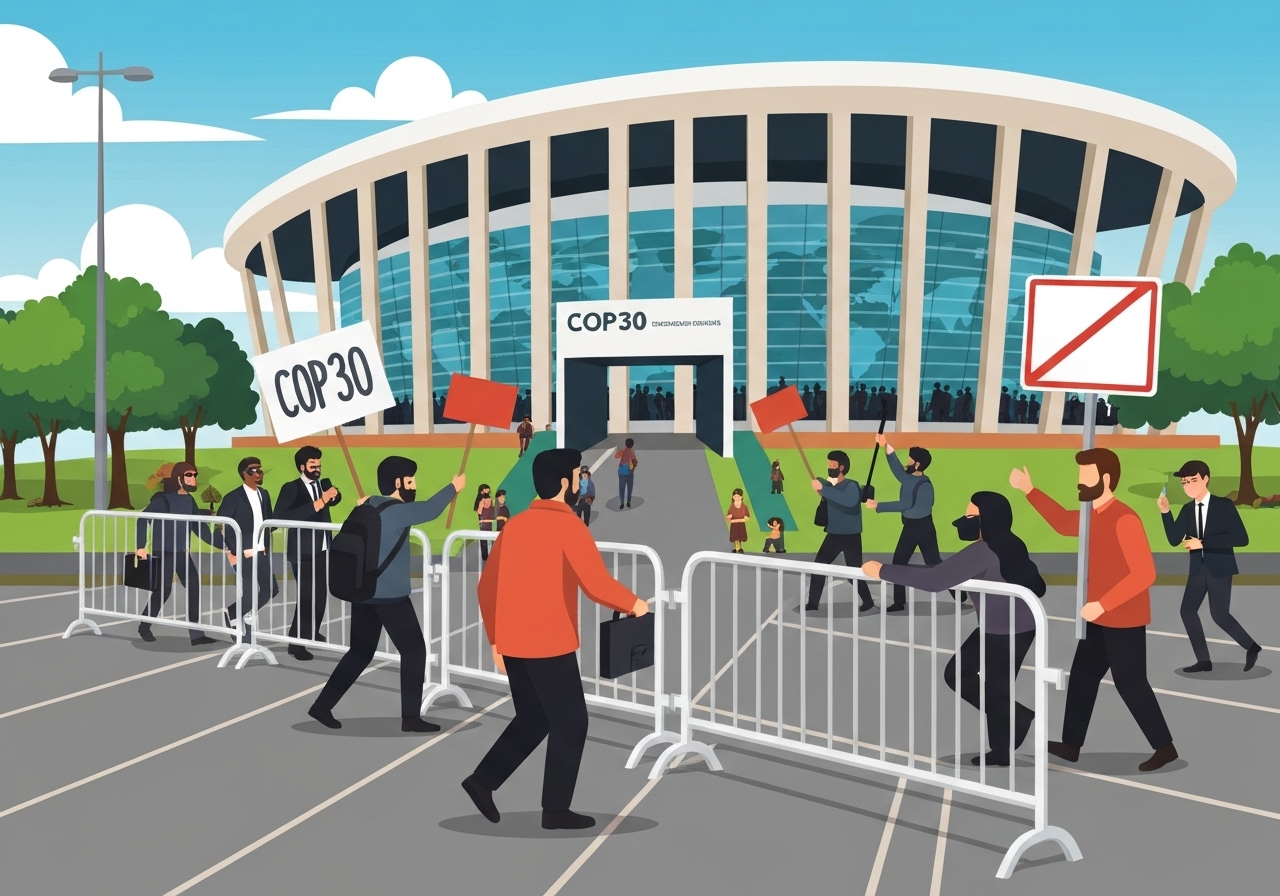
Lead: Protesters forced their way past initial security lines at the COP30 climate talks in Belém, Brazil, on the night of Tuesday, prompting UN and Brazilian authorities to intervene. Videos and eyewitness accounts show demonstrators — including people identifying as Indigenous and youth activists — confronting guards, breaching an outer barrier and causing limited property damage. The UN reported two security staff suffered minor injuries; delegates were directed to leave parts of the venue. Officials opened an investigation into what they described as an unusual breach at a highly controlled summit.
Key takeaways
- Protesters breached the COP30 venue in Belém, Brazil, late on Tuesday, crossing initial security barriers before being stopped; two UN security staff sustained minor injuries, according to the UN.
- Videos circulating on social media showed participants in traditional Indigenous dress and flags associated with a left-wing youth group called Juntos.
- Delegates from nearly 200 countries are attending COP30, which runs from 10 November to 21 November and marks the 10th anniversary of the Paris Agreement.
- The summit is the first COP hosted in Brazil and took place on the edge of the Amazon, a location that has been politically and socially contested.
- Brazilian organisers promoted this COP as centering Indigenous peoples; officials estimated roughly 3,000 Indigenous attendees from around the world were present.
- A UN report cited during the talks noted Indigenous peoples help protect approximately 80% of remaining global biodiversity while receiving under 1% of international climate finance.
- Brazilian and UN authorities have launched investigations; Reuters reported a security guard said he was struck by a drum thrown by a protester.
Background
The COP30 conference convened in Belém from 10–21 November, bringing representatives from almost 200 nations to discuss next steps on global emissions, adaptation and climate finance. Brazil’s selection of Belém — a gateway to the Amazon rainforest — was intended to highlight the biome’s centrality to climate solutions but has also spurred controversy among local communities and environmental advocates. Many Indigenous organisations and Amazon residents have long protested land-granting, deforestation and resource extraction policies that they say drive ecological loss and undermine livelihoods.
Domestic political debates in Brazil have included continued licensing for oil and gas exploration, even as the nation positions the Amazon as a carbon and biodiversity asset. The Lula administration framed COP30 as an opportunity to confront climate denial and misinformation; President Luiz Inácio Lula da Silva told delegates the summit must counter falsehoods and elevate scientific evidence. Organisers also marketed the gathering as a space to spotlight Indigenous rights and participation, pledging enhanced visibility and representation at negotiation tables.
Main event
Late on Tuesday night, groups of protesters approached the COP30 entrance and pushed past the first line of security, according to eyewitness footage and the UN’s account. Videos show demonstrators chanting and attempting to force doors before being contained by additional security layers; Brazilian soldiers were present and UN security personnel were seen urging delegates to vacate certain areas. The UN said the incident led to limited physical damage to the venue and two security staff sustaining minor injuries.
Social media footage identified some demonstrators as Indigenous people and others waving flags linked to a youth movement named Juntos. A Reuters report cited a security guard who said he was hit in the head by a drum thrown by a protester; the UN confirmed initial injury reports but described all casualties as minor. Organisers and security teams prevented deeper penetration into the complex, and normal proceedings resumed in secured zones while investigations commenced.
Protesters’ stated grievances, captured in on-site chants and interviews, focused on land rights, new oil and gas licensing and the influence of agribusiness and illegal extractive activities in the Amazon. One Indigenous leader from the Tupinamba community told reporters he and others were angry about development in the forest and used the phrase “we can’t eat money” to summarise their position. Organisers had anticipated broad Indigenous participation: Brazil’s Minister of Indigenous Peoples, Sônia Guajajara, described the event as historic and estimated about 3,000 Indigenous attendees.
Analysis & Implications
The breach highlights tensions between the diplomatic formality of COP negotiations and the lived realities of communities most affected by climate policy. While COPs are designed to produce multilateral commitments — often focused on emissions, finance and technological cooperation — they can feel distant to Indigenous and local groups who face immediate threats from deforestation, mining and agribusiness expansion. The choice of Belém brought those tensions to the fore: placing negotiators at the Amazon’s edge created political symbolism but also concentrated protest activity.
Politically, the incident could complicate Brazil’s attempt to position itself as a steward of the Amazon while also pursuing domestic economic development that includes fossil-fuel licensing. International delegates may press for stronger protections or funding for Indigenous stewardship — a point underscored by reports that Indigenous territories hold a disproportionate share of biodiversity yet receive minimal climate finance. That mismatch is likely to be a negotiating flashpoint during COP30’s finance and adaptation sessions.
Security and operationally, the episode raises questions about how large climate summits balance openness with protection. COP venues typically deploy layered security protocols; a breach that reaches the media spotlight may prompt organisers to tighten access rules, potentially constraining public-facing programming that many civil society groups rely on to influence discussions. For Indigenous delegations, stricter controls could make presence and visibility harder at precisely the moments organisers pledged to amplify their voices.
Comparison & Data
| Item | Value |
|---|---|
| COP30 dates | 10–21 November |
| Participating countries | Nearly 200 |
| Estimated Indigenous attendees | ~3,000 (organisers’ estimate) |
| People in Amazon biome | ~50 million |
| Indigenous groups in Brazil | ~400 groups |
| Share of biodiversity protected by Indigenous lands | ~80% (UN-cited estimate) |
| Share of international climate finance to Indigenous peoples | <1% (reported) |
The table contextualises numbers referenced throughout the summit: attendance and participation figures, biological stewardship estimates and finance disparities. These data points help explain why Indigenous representation and funding are recurrent themes at the negotiations. The contrast between the Amazon’s population and stewardship role versus the low share of targeted finance underscores a core grievance driving the protests. Delegates and negotiators will likely return to these metrics when discussing funding mechanisms, safeguards and recognition of Indigenous land rights.
Reactions & quotes
UN and Brazilian officials responded quickly to the breach, emphasising investigation and the safety of participants. Before the investigation’s findings are public, authorities framed the incident as limited in scope but serious in principle.
“The incident caused minor injuries to two security staff and limited damage to the venue; we are investigating the circumstances.”
United Nations (official statement)
The UN statement aimed to confirm injury reports while signalling an inquiry into how protesters crossed outer barriers. The comment sought to balance transparency with an effort to avoid inflaming tensions among delegates and civil society representatives.
Local Indigenous leaders framed their actions as a deliberate confrontation with policies they say endanger forests and livelihoods. Their statements reiterated longstanding demands for land protection and an end to extractive licenses.
“We can’t eat money.”
Indigenous leader, Tupinamba community (reported to Reuters)
This concise, emotive line summarised protesters’ grievance: that market-oriented development and resource concessions directly threaten subsistence and territorial integrity. Organisers had announced increased Indigenous representation, but protesters argued representation alone does not solve immediate territorial pressures.
Brazil’s president used the summit platform to push back against misinformation and to argue for the Amazon’s role in mitigation. His public remarks aimed to reassure international partners about Brazil’s climate commitments while defending the domestic policy mix.
“COP30 will be the COP of truth,” alongside calls to “defeat” climate denialism and combat fake news.
President Luiz Inácio Lula da Silva (opening remarks)
The president’s comments were framed as both a political signal to international audiences and a domestic message about the administration’s priorities. How the government responds to the breach and to Indigenous demands will shape perceptions of its credibility on conservation and climate finance.
Unconfirmed
- Precise affiliation of all protesters: some accounts identify Indigenous participants and youth activists, but a comprehensive roster of groups involved has not been published.
- Scale of damage beyond “limited” reports: official statements describe only limited venue damage; independent verification of repair costs or structural impact is pending.
- Whether any arrests were made: public reports confirm containment and investigation but have not released a full account of detentions or subsequent legal actions.
Bottom line
The intrusion at COP30 in Belém underscores a widening gap between formal diplomatic processes and grassroots demands from communities on the front lines of environmental change. Holding the summit at the Amazon’s edge amplified symbolic tensions: organisers intended to spotlight the biome, but critics say venue selection also highlighted unresolved conflicts over land, extraction and who benefits from climate action.
Expect negotiators to confront these rifts over the coming days as finance and adaptation debates continue. The incident increases pressure on Brazil and the UN to deliver clearer protections, funding commitments and measurable steps that address Indigenous land rights and the disproportionate burdens those communities face from deforestation and extractive projects.
Sources
- BBC News (international media report — original article on the incident)
- Reuters (international news agency — reporting cited for on-the-ground quotes)
- United Nations (official statements and reports referenced by organisers and UN briefings)