
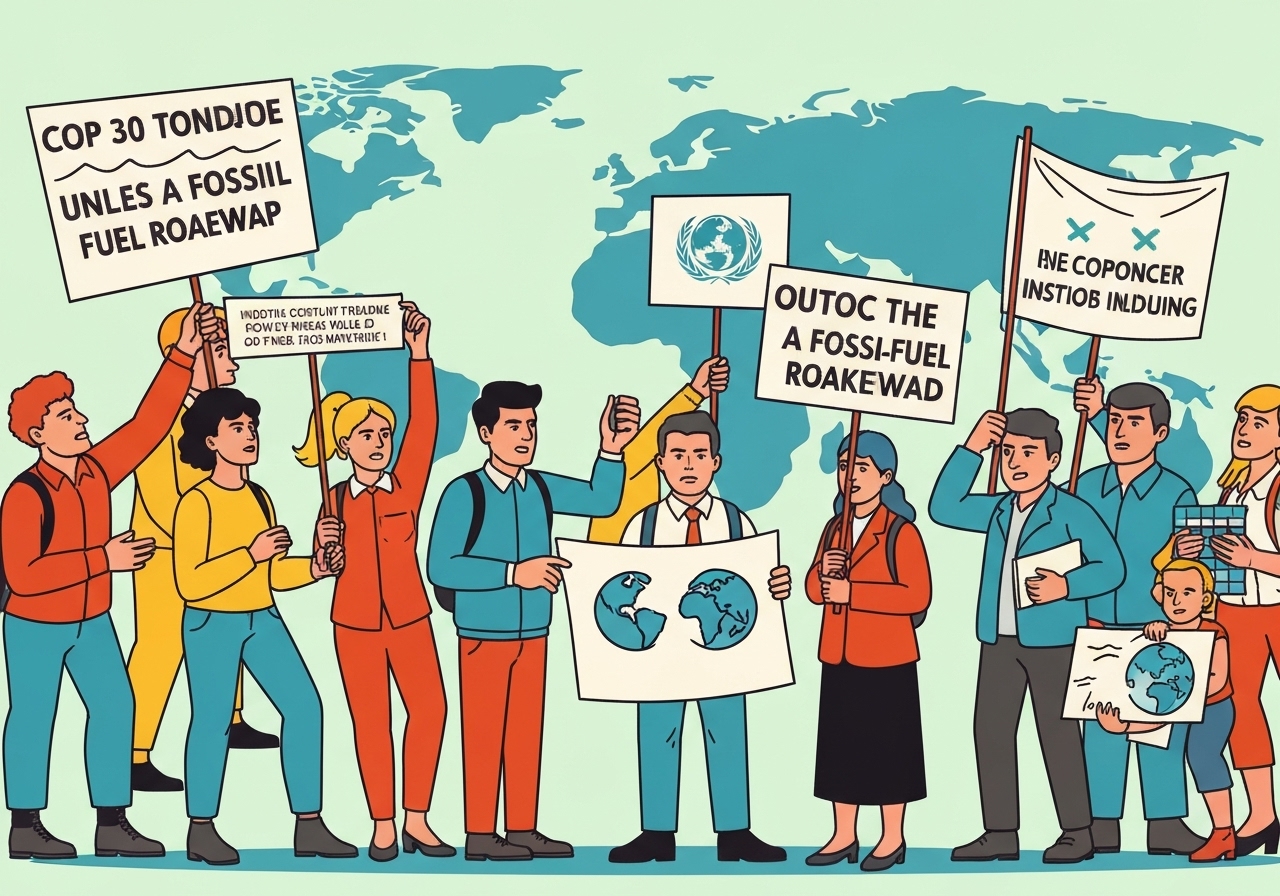
Lead: At the Cop30 climate summit in Belém, Brazil, a coalition of countries has threatened to block any final outcome that does not include a roadmap to phase out fossil fuels, escalating tensions as talks run into overtime. The escalation centers on a leaked letter signed by at least 29 governments that set the inclusion of a transition roadmap as a red line for agreement. The Brazil presidency had signalled it might drop the roadmap language after opposition from petro-states and major consumers, triggering a rare collective warning from coalition members. Talks were already disrupted by a fire at the conference centre that forced a suspension of negotiations for more than six hours.
Key takeaways
- At least 29 countries formally signed a letter to the Brazil presidency demanding a roadmap for a just, orderly and equitable phase-out of fossil fuels; more than 80 countries have joined the broader initiative to develop such a process.
- The roadmap option appeared in an early draft outcome published on Tuesday but was later at risk of removal amid opposition from countries including Saudi Arabia, Russia and India.
- The coalition of supporters framed the roadmap as continuity from the Cop28 Global Stocktake (Dubai, 2023), which for the first time asked all Parties to transition away from fossil fuels without setting timelines.
- Negotiations were paused for over six hours after a fire broke out in part of the conference centre near delegations’ offices; no injuries were reported but the delay compressed already tight schedules.
- Opposition is led in part by members of the so-called “like-minded developing countries” group (including Saudi Arabia, Egypt, Iran and Bolivia), who view a roadmap or forum as an imposition or a political step they cannot accept.
- Supporters argue the roadmap forum would not bind countries to a fixed deadline but would create a space for multilateral planning over one or more years following Cop30.
- Other unresolved issues at Cop30 include the adequacy of national climate plans to meet the 1.5C goal, climate finance quality and accountability, adaptation funding and transparency mechanisms.
Background
The demand for a fossil-fuel phase-out roadmap traces back to the Cop28 Global Stocktake outcome in Dubai in 2023, which for the first time included a collective call for a transition away from fossil fuels but did not prescribe timelines or instruments. That ambiguity left room for competing interpretations: some countries saw the language as a mandate for accelerated action, while others sought to limit or reinterpret the commitment. At Cop29 in 2024, efforts to reconfirm or clarify the language encountered sustained resistance and ultimately failed to achieve consensus.
In 2025, supporters changed tactics by proposing a multi-party forum to design a roadmap collaboratively rather than imposing fixed phase-out dates. The proposed forum aims to allow countries to choose national pathways while building shared technical and political approaches over a longer timeframe; proponents say the work would extend beyond Cop30 and require at least a year or more to articulate. Opposition stems from countries with large fossil revenue streams or heavy fossil reliance, which view any roadmap process as potentially prejudicial to national development and energy security considerations.
Main event
The flashpoint at Cop30 came on Thursday night when a group of at least 29 governments delivered a sharply worded letter to the Brazil presidency, setting the roadmap as a non-negotiable item for an acceptable outcome. The letter — leaked to the press and seen by multiple delegations — warned that failing to include the roadmap would be interpreted as a backward step after the Global Stocktake. Signatories included a mix of EU states, Latin American governments, small island states and others.
Brazil’s presidency had initially contained an option to begin work on a roadmap in the draft outcome published earlier in the week. According to negotiators, the presidency then considered removing the provision amid pushback from petro-states and several large fossil-consuming countries, prompting the coordinated response from supporters. Some opponents of the roadmap reportedly threatened to walk out of negotiations before the fire-related suspension interrupted proceedings.
On the ground in Belém, the atmosphere hardened as delegations reiterated red lines and sought assurances. Supporters held a press event announcing the initiative with more than 80 countries reportedly supportive of starting roadmap discussions; opponents accused them of attempting to force an outcome beyond the narrow mandate of the current text. Delegates described intense bilateral lobbying, closed-door consultations and repeated textual revisions as the presidency tried to thread a consensus between the two camps.
Analysis & implications
The standoff highlights a deepening geopolitical split over how to operationalize the Global Stocktake’s call to transition away from fossil fuels. For proponents, a roadmap forum represents a pragmatic, multilateral path to translate broad commitments into technical steps without imposing legally binding timelines. It would create venues for sharing policy tools, phasing strategies, finance mechanisms and social-protection measures required for a just transition.
For opponents, even a non-binding forum raises sovereignty and economic concerns: countries reliant on fossil revenues or lacking large-scale alternatives fear political pressure and potential market consequences. The dispute exposes broader tensions between emissions-responsibility debates and immediate development and energy-security priorities, particularly in regions where fossil fuels are central to state budgets and industrial policy.
Diplomatically, the threat to block the outcome increases the chance that Cop30 will conclude with either an elevated package that preserves the roadmap option or a compromised, minimalist text that satisfies neither side. A blocked or very weak outcome would signal eroding consensus on fossil-fuel transition language and could slow collective momentum ahead of subsequent Cops and implementation forums.
Domestically, capitals on both sides will use the Cop30 outcome to shape national politics. Supporter governments may face pressure at home to show they pursued stronger climate action, while opponents will emphasize energy affordability and jobs. Financial negotiations — including adaptation funding and loss-and-damage contributions — could become bargaining chips in any final deal, tying fossil-fuel language to concrete money for vulnerable countries.
Comparison & data
| Item | Figure/Year |
|---|---|
| Leaked letter signatories demanding roadmap | At least 29 countries (2025) |
| Countries joining the roadmap initiative | More than 80 countries (2025) |
| Cop28 Global Stocktake decision calling transition | Dubai, 2023 (no timeline) |
| Cop29 reconfirmation attempt | Failed, 2024 |
The table shows the gap between a core coalition (29 formal signatories) and the broader initiative backing (80+), underlining that while a vocal bloc set a red line, broader multilateral support for further work exists. Past attempts — notably at Cop29 — demonstrate the durability of opposition, suggesting that technical design of the roadmap and the framing of its non-binding nature will be critical to any compromise.
Reactions & quotes
Supporters framed their move as defending multilateral credibility and the continuity of the Global Stocktake; opponents warned against imposing processes that could constrain national choices. Each quoted excerpt below is brief and contextualised to reflect the speaker’s stance and the immediate diplomatic setting.
“We cannot accept a final text that omits a pathway for phasing out fossil fuels; that would be a backward step for people and science,”
Irene Vélez Torres, Environment Minister of Colombia
Colombia’s environment minister described the presidency’s draft as insufficient and said the letter was a response to a perceived “take-it-or-leave-it” approach. Her remarks framed the demand as both a scientific and intergenerational responsibility, and she emphasized that success should be measured by outcome quality, not by merely adopting any text.
“The coalition is pushing for an integrated package: adaptation finance, accountability, and direct action on fossil fuels and deforestation,”
Catherine Abreu, Director, International Climate Politics Hub
An NGO and policy expert highlighted that supporters view the roadmap as one of four pillars required for an ambitious Cop30 package, tying the roadmap to finance and accountability in order to broaden appeal and implementation prospects.
“Some countries have signalled they might walk out if the roadmap remains, creating a high-stakes bargaining dynamic,”
Senior negotiating delegate (anonymous)
A negotiator speaking on condition of anonymity described intensive backroom lobbying, with the potential for walkouts increasing leverage and complicating the presidency’s task of producing a consensual text.
Unconfirmed
- Whether the roadmap will be formally adopted at Cop30 remains unresolved; proponents say it is a process that would likely extend beyond this summit.
- The precise number of delegations prepared to walk out or the specific thresholds that would trigger a collapse of the final text have not been independently verified.
- Details about the cause of the conference-centre fire and any potential connection to the protests or negotiation disputes remain under investigation.
Bottom line
The Cop30 standoff over a fossil-fuel phase-out roadmap crystallizes a broader geopolitical and development struggle at the heart of climate diplomacy: how to reconcile a globally shared goal of phasing fossil fuels with uneven national circumstances and vested economic interests. The insistence by a coalition of at least 29 signatories on a roadmap marks an escalation intended to preserve the spirit of the Cop28 Global Stocktake, while opponents treat the same proposal as a step too far.
Outcomes in the final hours will hinge on whether the Brazil presidency can broker text that preserves a credible forum for roadmap development without triggering a walkout by dissenting delegations. Observers should watch linkage to finance and adaptation provisions closely: money and accountability may determine whether the roadmap becomes a workable tool or another point of fracture in multilateral climate cooperation.
Sources
- The Guardian (media report based on leaked letter and direct reporting)
- UNFCCC — COP28 documentation (official UNFCCC materials on the Global Stocktake and Cop28 outcomes)
- UNFCCC — COP30 information (official conference information and schedule)