
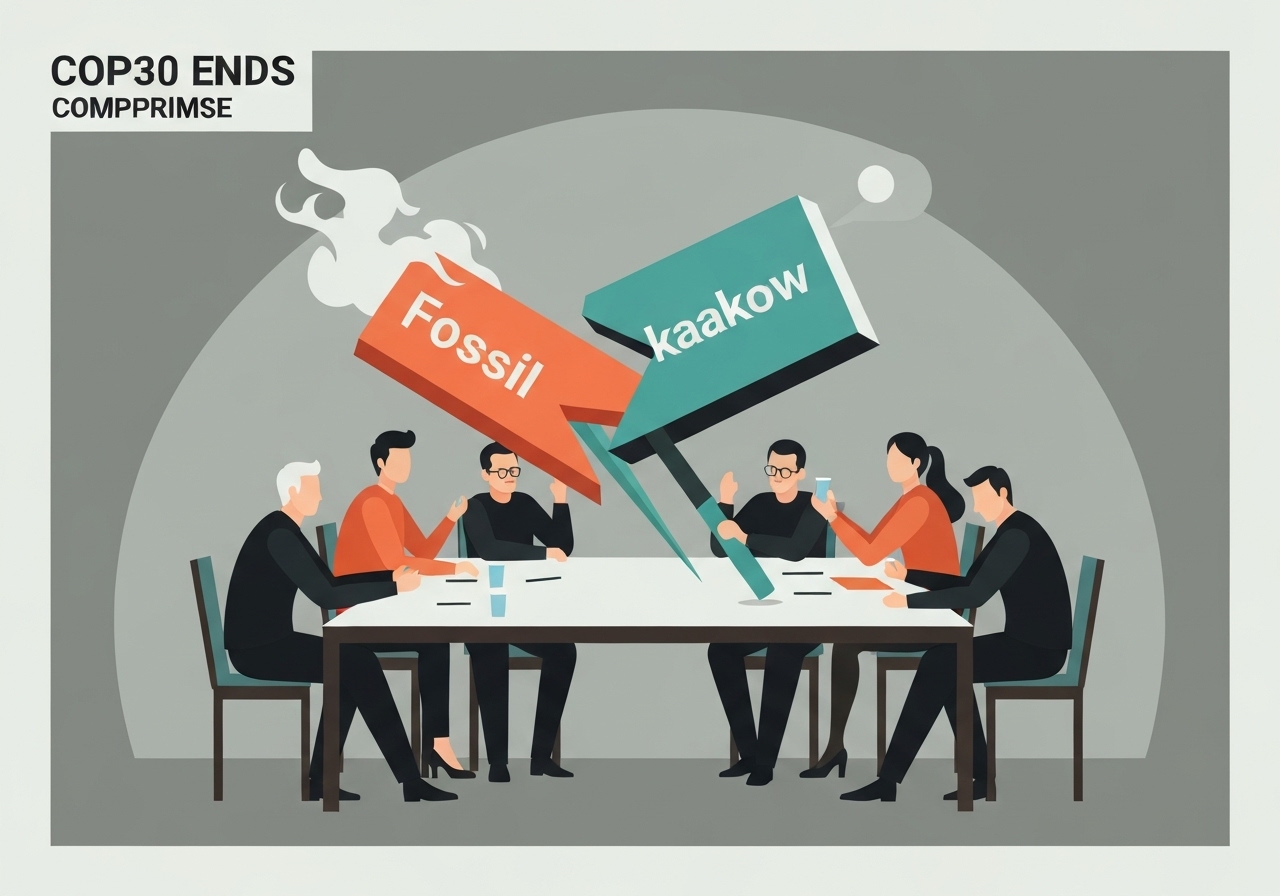
After two weeks of marathon negotiations in Belém, Brazil, COP30 closed with a compromise many delegates called weaker than needed: no binding road map to phase down oil, gas and coal, the absence of the United States in key moments, high-profile Indigenous protests and a venue evacuation after a fire shaped the summit’s chaotic finale. Delegates agreed instead on voluntary initiatives to speed up national climate plans and an annual dialogue to track progress toward the Paris goal of limiting warming to 1.5°C. The conference produced a new Tropical Forests Forever Facility aiming to mobilize $125 billion and a pledge to at least triple adaptation finance from today’s estimated $40 billion a year to 2035. Critics said linking fossil-fuel action to adaptation finance and the lack of a clear fossil-fuel phaseout left the summit short of the decisive outcome many had demanded.
Key takeaways
- Negotiators at COP30 in Belém, Brazil, failed to include a binding roadmap to phase out fossil fuels; instead the final text endorses voluntary initiatives and cooperation.
- COP30 President Andre Correa do Lago announced two voluntary roadmaps—one on a just fossil-fuel transition and one to halt and reverse deforestation—and a first-ever conference on ending reliance on oil, gas and coal to be held in Colombia in April.
- Wealthy countries agreed to a call to at least triple adaptation finance from about $40 billion annually today to 2035; UNEP estimates developing countries will need roughly $310 billion per year by 2035 for adaptation projects.
- The Tropical Forests Forever Facility (TFFF) was launched to raise $125 billion—about $25 billion in public guarantees to leverage $100 billion in private capital—backed by pledges including €1 billion from Brazil, Indonesia and Germany and roughly €3 billion from Norway.
- African negotiators, led by Tanzania’s Richard Muyungi, rejected perceived linkages that conditioned adaptation finance on fossil-fuel acceptance; Africa emits roughly 4% of global greenhouse gases but faces growing climate impacts.
- The final agreement establishes an annual dialogue to monitor progress toward keeping the 1.5°C target viable, while scientists say current national plans leave the world on track for roughly 2.6–2.8°C of warming by 2100.
- Trade concerns entered the COP text: parties agreed dialogues involving bodies such as the World Trade Organization to address possible covert trade barriers created by green policies like the EU’s Carbon Border Adjustment Mechanism (CBAM).
Background
The two-week summit in Belém took place amid heightened tensions over fairness, geopolitics and economic stakes. Host-country proximity to the Amazon rainforest intensified focus on deforestation, Indigenous land rights and financing for forest protection. Delegates arrived after a decade since the Paris Agreement, with scientists warning that existing national commitments (NDCs) are well short of the reductions needed to hold warming to 1.5°C.
Parties entered talks split over how far to go on fossil fuels. More than 80 countries pressed for a clear roadmap to transition away from coal, oil and gas, arguing fossil-fuel combustion remains the single largest source of greenhouse emissions. Opposition came from groups led by China and several petro-states in the Arab Group, which resisted language that would single out fossil fuels for a formal phaseout in the COP decision text.
Finance was a parallel fault line. Developing nations, already facing mounting climate impacts, demanded rapid scaling of adaptation funding. Donor countries and blocs warned that public money should be used to leverage private investment, and debates over conditionality—whether finance should be tied to other outcomes—became particularly contentious, shaping the final compromise language.
Main event
Early in the closing plenary a fire at or near the venue forced an evacuation, undercutting momentum and adding to a sense of disorder that had been fueled by protests from Indigenous groups pressing for land rights. The US was notably less visible in negotiation floor battles at times, a factor some delegates said weakened prospects for a stronger fossil-fuel commitment given the country’s role as the world’s second-largest emitter.
Negotiators debated for days over text that would either include a roadmap for phasing out fossil fuels or leave it off the formal agreement. The draft insisting on a roadmap faced sustained pushback from China, the Arab Group, and other delegations; in the end, negotiators moved to a softer formulation that calls for voluntary acceleration of national climate plans—Nationally Determined Contributions (NDCs)—and collaborative initiatives to implement the Paris Goal.
COP30 President Andre Correa do Lago framed the outcome as pragmatic: he pledged to lead two voluntary roadmaps—one focused on a just, orderly, equitable fossil-fuel transition and another on stopping and reversing deforestation. He also announced that Colombia will host a conference in April devoted to ending reliance on oil, gas and coal, and invited all countries to participate in these voluntary processes outside the formal UNFCCC decision text.
On forests and Indigenous rights there were tangible, if partial, advances: the TFFF was unveiled with public and private commitments and several governments—including Brazil, Indonesia, Germany and Norway—pledged funds to the initiative. Brazil announced plans to create 10 new Indigenous territories, a step that requires presidential ratification and came after sustained demonstrations by Indigenous groups at the site of the talks.
Analysis & implications
The omission of a binding fossil-fuel roadmap illustrates how geopolitical and economic calculations can blunt multilateral climate ambition. China and major oil-producing states argued that naming fossil fuels for phaseout would penalize countries at different stages of development and risked undermining energy security for nations still expanding access to power. That resistance made a legally binding or prescriptive global phaseout politically unachievable at COP30.
Relying on voluntary roadmaps and convening fora shifts the burden of action back to national and regional politics. Voluntary processes can generate buy-in and tailored pathways—but they lack enforceable timelines and common metrics. If major emitters do not convert voluntary pledges into stronger NDCs and domestic policies, the annual dialogue could track continued shortfalls rather than trigger course correction.
Financial pledges for adaptation and the TFFF are important steps, but scale and conditionality matter. A stated aim to triple adaptation funding from $40 billion annually is significant, yet UNEP’s $310 billion-per-year estimate for adaptation needs by 2035 shows a wide gap between current commitments and projected requirements. How much of the TFFF will actually flow to communities on the front line of deforestation—rather than to intermediaries or to financial returns for investors—will determine its climate effectiveness.
Regional politics will shape the next phase. African negotiators’ objections to conditional finance reflect legitimate concerns about equity: Africa contributes roughly 4% of global emissions yet faces disproportionate climate impacts. Meanwhile, EU moves such as the CBAM will keep trade and climate linked, raising diplomatic friction with countries that view carbon levies as extraterritorial penalties rather than environmental leveling tools.
Comparison & data
| Item | Current/Committed | Estimated Need/Goal |
|---|---|---|
| Adaptation finance (annual) | $40 billion (current) | $310 billion by 2035 (UNEP estimate) |
| Tropical Forests Forever Facility | $125 billion target; ~$25 billion public guarantees pledged | Leverage $100 billion private capital |
| Forest pledges (selected) | Brazil, Indonesia, Germany: €1bn each; Norway: ~€3bn | Long-term forest protection and Indigenous land recognition |
| Projected warming with current policies | — | 2.6–2.8°C by 2100 (scientific projections) |
The table summarizes finance flows and gaps highlighted at COP30. The adaptation funding gap is particularly stark: even a tripling of today’s $40 billion would leave most of the estimated $310 billion annual need unmet. The TFFF’s structure—mixing public guarantees with private bonds—is intended to mobilize capital at scale, but practical results will depend on transparency, safeguards and conditionality tied to deforestation reduction outcomes.
Reactions & quotes
Delegations and civil-society groups delivered mixed assessments. Panama’s lead negotiator framed the outcome as proof of systemic failure, arguing negotiators protected the fossil-fuel economy instead of vulnerable populations.
“The COP and the UN system are failing people at a historic scale; negotiators are defending the very industries that created this crisis.”
Juan Carlos Monterrey Gomez, Panama chief negotiator
The EU acknowledged disappointment but framed financing announcements as progress toward equity and resilience financing for poorer nations.
“We would have liked a more ambitious deal, but the decisions on adaptation finance represent a very significant step forward.”
Wopke Hoekstra, EU climate commissioner
Environmental campaigners welcomed the TFFF but warned that banks and investors must stop financing deforestation to make the facility effective.
“The fund cannot succeed while banks and investors remain free to bankroll deforestation.”
Rainforest Action Network statement
Unconfirmed
- Whether the voluntary roadmaps led by the COP30 president will translate into binding national policies remains unclear and depends on follow-up commitments and domestic politics.
- The effectiveness of the Tropical Forests Forever Facility in delivering $100 billion in private capital is unproven until detailed instruments and investor commitments are publicly disclosed and tracked.
- Brazil’s announcement to create 10 Indigenous territories requires presidential ratification; the timing and legal finalization of those decrees remain to be confirmed.
Bottom line
COP30 closed with some concrete financing steps and novel instruments for forest conservation, but it stopped short of the legally anchored fossil-fuel phaseout many countries and campaigners sought. By anchoring key outcomes in voluntary roadmaps and dialogues, the conference prioritized political feasibility over binding global timelines—leaving the success of these measures dependent on national follow-through and private finance performance.
The summit underscored a widening gap between scientific urgency and geopolitical reality: current national plans still point to 2.6–2.8°C of warming by 2100 absent much stronger action. The coming months—particularly the Colombia conference on ending reliance on oil, gas and coal and the scheduled annual dialogue on 1.5°C progress—will be decisive in determining whether COP30’s compromises can be converted into accelerated domestic policies and measurable emissions cuts.
Sources
- DW – coverage of COP30 (media)
- UN Environment Programme (UN agency; adaptation finance analysis)
- UNFCCC (official UN climate body; COP30 documents)
- Rainforest Action Network (NGO; statement on TFFF and finance)