
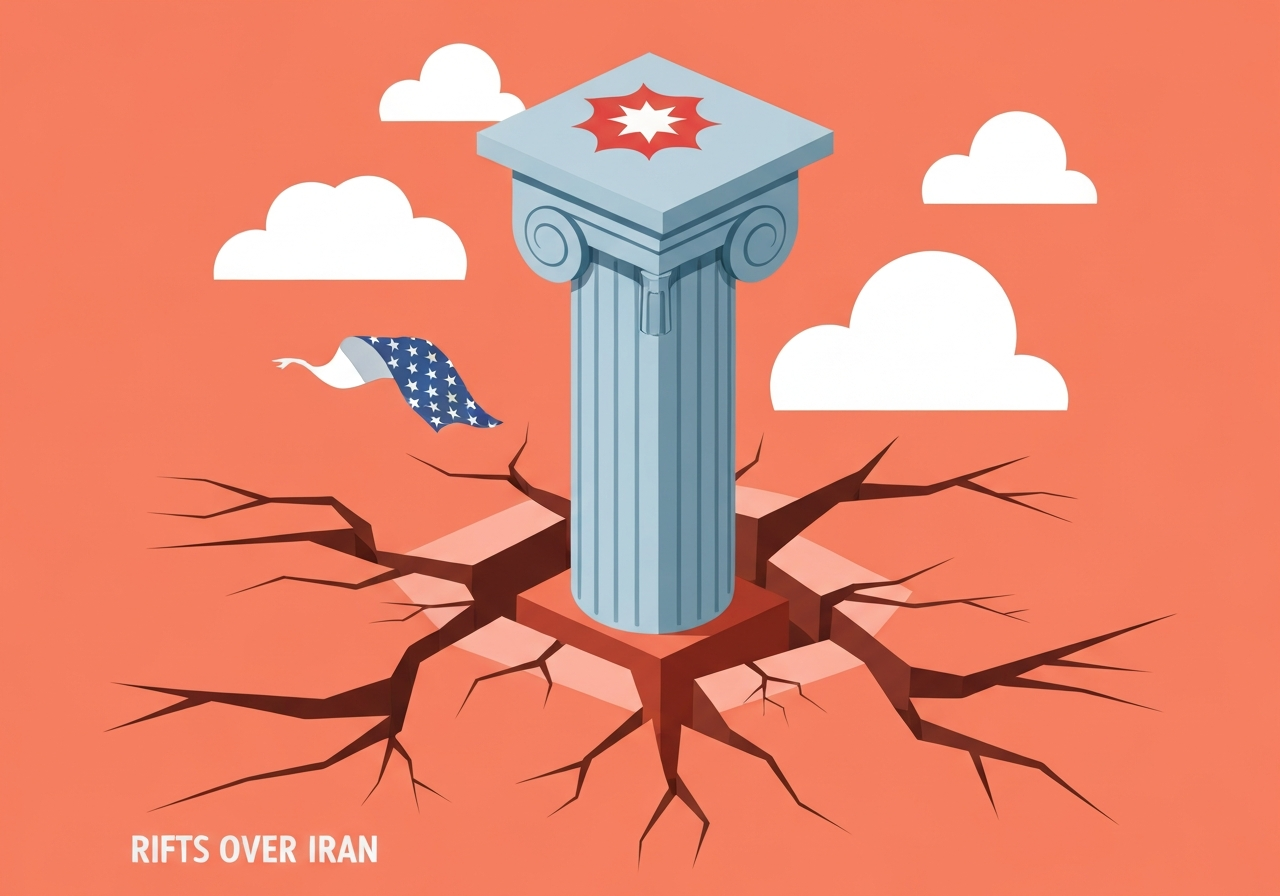
Conservative activists and politicians gathered in Dallas on the final day of the Conservative Political Action Conference (CPAC) as Republicans parsed fractures over U.S. strikes on Iran and rallied around former President Donald Trump’s agenda. The conference, held Saturday, took place one month after the United States began strikes against Iran and marked the first time in about a decade that Trump did not appear in person. Attendees and speakers signaled both strong institutional loyalty to Trump’s priorities and visible dissent—especially among younger conservatives—over the war and its domestic costs. The mix of absence, new faces and foreign speakers left CPAC at a crossroads about party unity heading into the 2026 midterm season.
Key Takeaways
- Trump did not attend CPAC for the first time in roughly ten years; his absence framed the event and raised questions about who can hold the coalition together.
- Saturday’s conference occurred one month after U.S. strikes against Iran began, a policy move that has split parts of the Republican base.
- A Pew Research Center survey found nearly eight in 10 Republicans approve of Trump’s handling of the war, though support is substantially weaker among younger Republicans and conservative-leaning independents.
- Some attendees voiced strong backing for Trump’s actions; others, including veterans and younger voters, said they felt betrayed by new military action after promises of “no new wars.”
- High-profile conservatives such as Tucker Carlson and Megyn Kelly were absent; the roster featured more recent conservative personalities and international figures like Liz Truss and Eduardo Bolsonaro.
- Only a small number of midterm candidates used CPAC as a campaign stop; Michael Whatley, running for Senate in North Carolina, framed the midterms as determinative for Trump’s remaining agenda.
- Critics of escalation, including former Rep. Matt Gaetz, warned a ground invasion of Iran would raise prices and harm U.S. security and prosperity.
- CPAC programming retained a heavy focus on culture-war themes and immigration, even as debate over the Iran strikes dominated conversation.
Background
CPAC has been a central organizing and messaging venue for the conservative movement and the MAGA-aligned wing of the Republican Party for more than a decade. Traditionally, it functions as both a networking forum for activists and a high-profile stage for political celebrities and presidential allies. In previous years, appearances by top Trump surrogates and media figures reinforced a cohesive public front; this year’s lineup was noticeably different, with several long-standing voices absent and newer figures elevated.
The geopolitical context is central to understanding the conference dynamics: the U.S. initiated strikes in Iran one month before CPAC, a development that has divided opinion within the GOP coalition. Polling from research organizations shows broad base approval among Republicans overall, but that aggregate figure conceals sharp generational and independent-leaning splits that were visible among attendees. Domestic concerns—rising prices and economic strain—were frequently raised by skeptics of further military escalation.
Organizers also signaled an outward-looking ambition: CPAC included international conservative figures and programming aimed at exporting MAGA-style messaging beyond U.S. borders. That international presence underscores both the movement’s expanding reach and the question of whether a post-Trump leadership or a broader roster of influencers can sustain the current coalition.
Main Event
The conference’s tenor was shaped early by the conspicuous absence of Donald Trump, who for years has closed CPAC rallies. Organizers and speakers repeatedly folded his agenda into discussions without his physical presence, and many sessions doubled as reaffirmations of Trump-era priorities: immigration enforcement, cultural issues, and a hardline posture on foreign adversaries. Attendees described the event as both a celebration of those policy themes and a venue for airing disagreements, notably over the Iran strikes.
Voices on the ground reflected this split. Supporters such as Jeff Hadley, who traveled from Raleigh, North Carolina, said they trusted Trump more than conventional politicians to act decisively. At the same time, younger conservatives and veterans like 30-year-old Joseph Bolick from Tyler, Texas, expressed disillusionment, citing a promise of “no new wars” and arguing the administration should prioritize domestic economic struggles.
Speakers ranged from established names to emerging personalities. Former Rep. Matt Gaetz used his platform to oppose a ground invasion, warning of higher gas and food prices and questioning the strategic payoff of deeper military engagement. Meanwhile, fewer declared candidates used the stage as a campaign stop; Michael Whatley, a Senate hopeful in North Carolina, emphasized the stakes of the 2026 midterms for sustaining the administration’s agenda.
The roster spotlighted new influencers: 23-year-old content creator Nick Shirley received the program’s final slot one evening after gaining viral attention, and international guests such as former British prime minister Liz Truss and Eduardo Bolsonaro signaled CPAC’s global ambitions. At the same time, notable previous fixtures—media personalities and some top surrogates—were absent, changing the event’s rhetorical balance and exposing fault lines within the coalition.
Analysis & Implications
Trump’s nonappearance is significant beyond personality: it tested the organizational cohesion of a movement long centered on his brand. The conference demonstrated that while Trumpism remains a dominant force in messaging and priorities, the absence of a unifying figure in person amplifies intra-party debates, particularly over foreign policy and generational priorities. That tension could influence turnout and persuasion in key midterm and primary contests.
The Iran strikes have become a litmus test for intra-GOP alignment. Aggregate approval among Republicans is high, but the drop-off among younger Republicans and conservative independents suggests vulnerability in demographics that proved decisive in 2024. If that trend widens, Republican strategists may face a trade-off between sustaining hawkish national security messaging and retaining the new voters who supported Trump on noninterventionist promises.
Economically, opponents of escalation flagged immediate domestic consequences—higher fuel and food prices—that could erode public support. Even if the administration frames strikes as limited or targeted, perceptions of prolonged conflict or a ground invasion would likely amplify economic anxieties and provide opposition messaging leverage in midterm campaigns. That dynamic elevates the importance of clear communication from party leaders about objectives, costs and timelines.
Internationally, CPAC’s inclusion of foreign conservative figures shows an effort to institutionalize a transnational network of like-minded movements. This could strengthen diplomatic and ideological coordination among right-leaning parties abroad but also risks importing foreign controversies into domestic politics. For the GOP, the event signaled both reach and fragility: reach through global alliances, fragility because domestic splits remain unresolved.
Comparison & Data
| Indicator | Reported Value / Note |
|---|---|
| Time since U.S. strikes on Iran | 1 month (as of CPAC weekend) |
| Republican approval of Trump’s handling of the war | Nearly 8 in 10 (Pew Research Center survey) |
The table highlights two anchor data points that framed discussion at CPAC: the one-month timeline since strikes began and the Pew Research Center finding that nearly eight in 10 Republicans approve of Trump’s handling of the war. Organizers and speakers repeatedly referenced these measures while acknowledging the survey’s limits—particularly its aggregation that masks age and independent-leaning subgroup variation.
Reactions & Quotes
Speakers on stage and attendees in the halls offered contrasting perspectives that captured the conference’s tensions. Supporters framed decisive action as a mark of strong leadership, while dissenters warned of domestic fallout and broken campaign promises.
“I think a lot of people feel more confident in [Trump] doing it than a lifelong politician that wants to follow the rules of their party.”
Jeff Hadley, CPAC attendee
Hadley’s comment, delivered on the convention floor, encapsulated a common refrain among older and more established attendees who prioritized perceived strength over process. His view contrasted with younger voices who said foreign engagements undermined trust in Trump’s earlier pledges.
“A ground invasion of Iran will make our country poorer and less safe.”
Former Rep. Matt Gaetz
Gaetz used his platform to argue that escalation would have direct economic and security costs, urging caution and emphasizing domestic priorities. His remarks were among the clearest public critiques of current policy from within the conservative movement at CPAC.
Unconfirmed
- Any specific plan or timeline for a U.S. ground invasion of Iran remains unconfirmed and no definitive operational details were announced at CPAC.
- Claims about the precise size or composition of factional blocs within the GOP at CPAC are provisional, based on on-site impressions rather than comprehensive membership data.
- Allegations discussed by some speakers and viral content creators—such as the claims referenced by Nick Shirley—have varying degrees of verification and were not adjudicated on the CPAC stage.
Bottom Line
CPAC 2026 showcased a movement at once unified around core Trump-era policy themes and divided over the costs of recent military action in Iran. Trump’s absence underscored a central issue for the conservative coalition: his presence has long served as the focal point of party cohesion, and without him physically on stage the movement’s internal disagreements were more visible. Organizers leaned into new personalities and international speakers, indicating a deliberate effort to broaden the movement’s reach even as core domestic debates continue to simmer.
Looking ahead, the midterms will be a practical test of which CPAC impulses—hawkish security posture, culture-war mobilization, or a younger, more restrained foreign-policy cohort—carry sufficient weight with voters. Party strategists will need to reconcile short-term political advantages with longer-term coalition stability if they intend to translate CPAC energy into electoral success.