
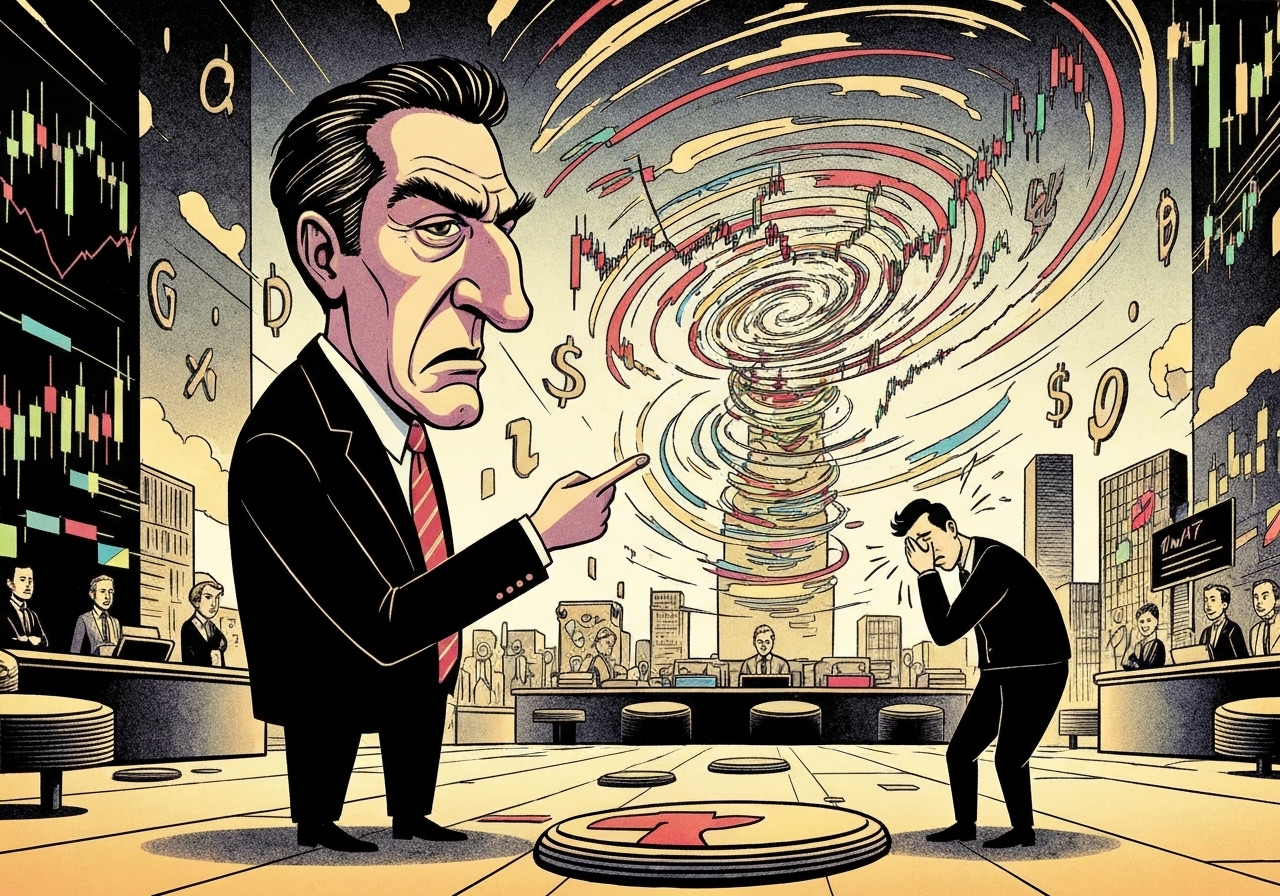
— Jim Cramer told viewers on “Mad Money” that a fresh wave of speculative buying has flooded U.S. markets to open the year, and he urged investors to lock in gains on names that have run parabolic. He pointed to more than 30 U.S.-listed companies with market capitalizations above $1 billion that were up at least 50% year to date as of Friday’s close, arguing many of those gains are only on paper. Cramer recommended trimming large positions in such stocks and moving proceeds to cash to preserve realized profits while staying invested selectively.
Key takeaways
- CNBC’s Jim Cramer warned on Jan. 20, 2026 that speculative buying has re-emerged after the new year opening.
- He identified over 30 U.S.-listed stocks (market cap > $1B) that had risen at least 50% year to date as of Friday’s close.
- Cramer said many of the highfliers lack earnings and have limited sales, resembling last summer’s froth in areas like crypto and quantum plays.
- He advised investors to “ring the register” on a meaningful portion of gains and park proceeds in cash as a risk-management step.
- Earlier warnings in late September preceded sharp selloffs for several speculative names, including nuclear firm Oklo, which remains well below its prior highs.
- The remarks came amid a broader market pullback that followed escalated rhetoric and tariff threats related to Greenland from President Donald Trump.
Background
The U.S. market began 2026 with strong momentum in a subset of smaller growth and thematic stocks, driven by retail flows and speculative interest. Those flows produced rapid price moves in companies with limited revenue or earnings, a pattern that market watchers—and Jim Cramer—had flagged during late 2025. In September 2025 Cramer publicly urged profit-taking in certain red-hot names; several of those stocks subsequently suffered steep declines in the autumn. That episode has become the reference point for his current counsel: when gains become detached from fundamentals, realize some profits.
Macro and political developments also help shape near-term market swings. In this instance, heightened geopolitical rhetoric and tariff talk around Greenland contributed to a broader pullback that reduced risk appetite across sectors. Combined with concentrated gains in a group of speculative stocks, the environment raised alarms for commentators who worry about cluster risk—many positions moving together because of sentiment rather than fundamentals. Retail participation and social-media-driven trading remain significant drivers of these short-term moves.
Main event
On the Jan. 20 “Mad Money” broadcast, Cramer reiterated his long-standing position that paper gains only count once they are realized. He said investors who hold large, single-stock exposures in names that have soared should sell a meaningful portion of those holdings and move proceeds into cash. That recommendation was not a blanket sell-everything order; instead, Cramer framed it as prudent risk management: preserve a chunk of profit while retaining optional upside.
Cramer quantified the recent cohort by highlighting more than 30 U.S.-listed stocks above $1 billion in market value that had gained at least 50% year to date as of Friday’s close. He described the group as largely composed of companies with little or no earnings and limited sales, likening the pattern of enthusiasm to prior speculative runs in areas such as cryptocurrencies, quantum computing plays and some alternative-energy names. He cautioned investors that these dynamics often precede sharp reversals when sentiment cools.
The host recalled his September warnings and argued the market had behaved as predicted then: several names that had been bid up collapsed in the autumn, leaving late buyers nursing losses. Cramer used Oklo—a nuclear-focused company that fell sharply after the earlier froth—as an example of a once-hot stock now well off its highs. He closed by urging viewers to “take something off the table” in the fastest-rising names and convert a sizable portion to cash to reduce downside risk.
Analysis & implications
The immediate implication is a heightened need for position sizing and liquidity management. When a small group of stocks accounts for outsized market moves, portfolios concentrated in those names face elevated drawdown risk if sentiment shifts. Realizing gains reduces concentration and converts volatile upside into cash that can be redeployed or used as a buffer in a correction.
For broader markets, speculative bursts can amplify volatility and distort risk premia. If retail-driven flows chase a theme across multiple listings, correlations among those stocks rise and sector-specific shocks can transmit to indices. That increases the chance of disorderly price action during headlines or policy shocks, making intraday liquidity a concern for market-makers and larger institutional players.
From a strategic perspective, investors should separate short-term momentum trades from long-term allocations. Holdings in firms without earnings require different sizing rules and exit plans than core positions in profitable, cash-flowing companies. Cramer’s advice effectively recommends a two-tier approach: take profits on speculative winners while keeping a diversified, fundamental core intact.
Comparison & data
| Metric | Value/Example |
|---|---|
| Stocks up ≥50% YTD (market cap > $1B) | >30 as of Friday’s close |
| Illustrative prior outcome | Oklo — significant decline in autumn; still well below prior highs |
The table summarizes the count Cramer cited and a prior example to show how speculative gains can reverse. While the headline count signals breadth in the rally, the Oklo case illustrates that even single-name momentum can evaporate quickly, underscoring the value of staged profit-taking.
Reactions & quotes
“You haven’t made a profit unless you ring the register on some of your gains,” Cramer said, stressing that paper gains do not protect investors from subsequent declines.
Jim Cramer, Mad Money (media commentator)
“Back then, I excoriated those who failed to take profits. I was loud and noisy about it and I’m doing the same right now tonight,” he added, referencing his September 2025 warnings.
Jim Cramer, Mad Money (media commentator)
Unconfirmed
- The exact list of the more than 30 stocks Cramer referenced and their individual metrics were not published in full on-air and require verification.
- The direct causal impact of President Trump’s Greenland-related rhetoric on the specific pullback in these speculative names has not been proven; it is a contemporaneous factor but not necessarily the primary driver.
- Whether every stock in the flagged cohort lacks sustainable earnings or sales varies by company and must be confirmed through their latest financial filings.
Bottom line
Jim Cramer’s recommendation is a pragmatic reminder about crystallizing gains after rapid rallies, not an admonition to avoid risk entirely. For many investors, selling a meaningful slice of an outsized winner converts volatile upside into durable capital and reduces exposure to sentiment-driven reversals.
Portfolio managers and individual investors should review position sizes in the fastest-rising names, confirm fundamental drivers, and consider a staged approach to profit-taking. Holding a diversified core and using realized proceeds as liquidity to rebalance or redeploy can help preserve capital while maintaining optionality for future gains.