
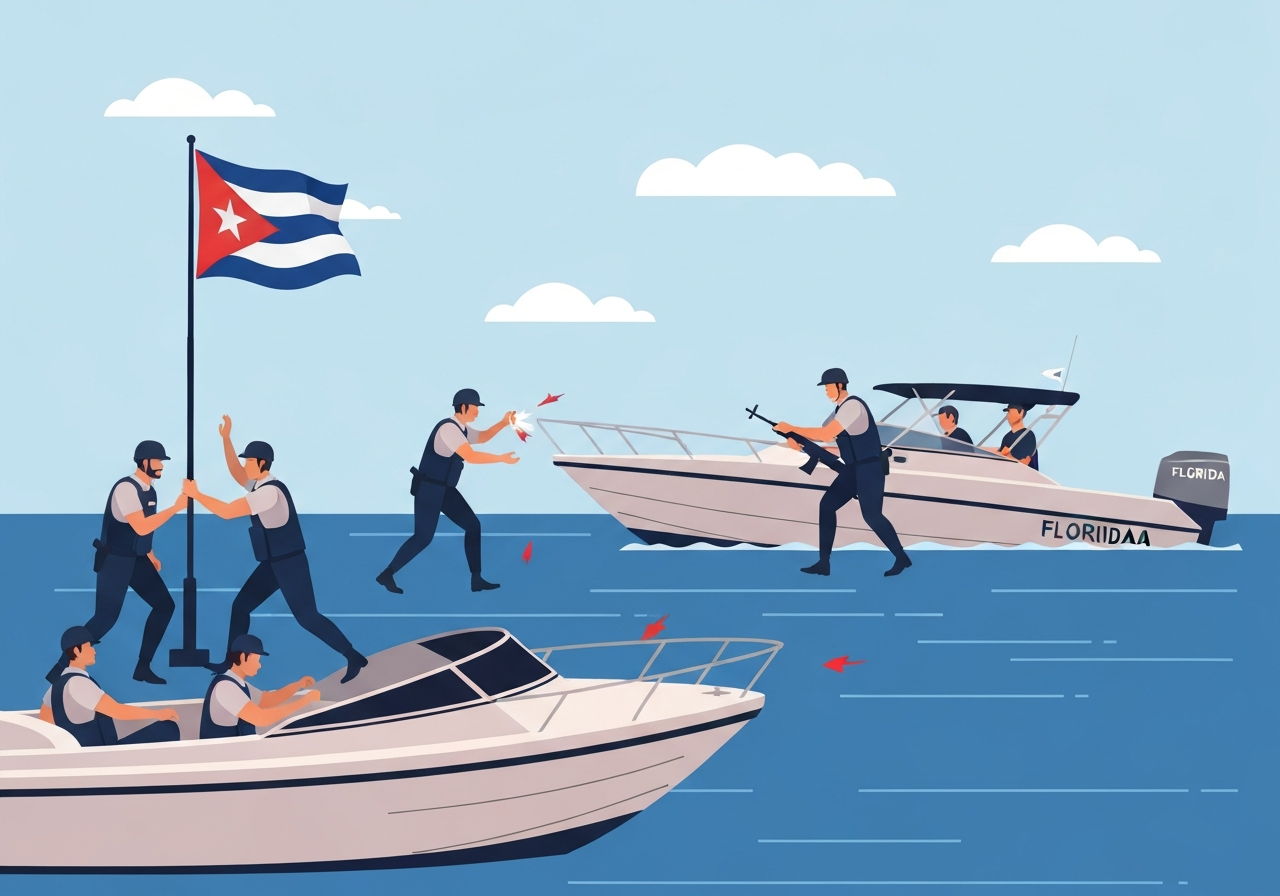
Lead: On Feb 25, 2026, Cuba’s Ministry of the Interior said its maritime border patrol exchanged gunfire with a speedboat bearing Florida registration offshore Cayo Falcones, north‑central Villa Clara province. The ministry reported that four people on the foreign vessel were killed and six wounded, and that a Cuban commander was injured. Cuban officials said the speedboat opened fire first; an investigation is under way. The identities of those aboard the boat and the craft’s precise purpose remain unconfirmed.
Key takeaways
- Cuban Interior Ministry reported the incident occurred on the morning of Feb 25, 2026, off Cayo Falcones in Villa Clara province.
- The ministry said four people aboard the speedboat were killed and six injured; one Cuban vessel commander was wounded.
- Authorities described the boat as carrying a Florida licence plate; the Florida peninsula lies roughly 145 km (90 miles) from Cuba.
- Cuban officials assert the speedboat fired first, prompting return fire by border patrol; this account has not been independently verified.
- The ministry framed the action as defence of territorial waters and national sovereignty amid heightened US‑Cuba tensions.
- Past incidents of violence at sea have occurred: two June 2022 confrontations left one Cuban officer wounded and another person on a speedboat dead.
Background
Maritime encounters between Cuban authorities and small, fast vessels have a long history tied to migration, smuggling and geopolitical friction. Cuba says it patrols its territorial waters to prevent irregular departures and protect sovereignty; critics note such operations can be lethal and opaque. The United States and Cuba have experienced strained relations for decades, including trade and travel restrictions and political disputes that color how each government frames incidents.
Recent diplomatic tensions have escalated in the weeks before this incident, with Cuban officials and US policymakers trading sharp rhetoric and measures affecting trade and energy. Cuba’s Interior Ministry placed the exchange in that broader context, saying the action was part of defending national stability. Activist networks in South Florida and other exile communities have historically organised and assisted departures from Cuba, and some past operations have ended in violence or diplomatic fallout.
Main event
According to the Cuban Interior Ministry’s social media statement, border patrol vessels intercepted a speedboat flagged with a Florida licence plate on the morning of Feb 25, 2026, off Cayo Falcones. The ministry said the speedboat’s crew fired first, wounding the commander of the Cuban vessel and triggering an exchange of gunfire. Cuban authorities reported four deaths and six injuries among those aboard the speedboat; the ministry did not publish identities.
It remains unclear what the speedboat’s mission was — whether it was carrying migrants, engaging in smuggling, conducting a rescue, or performing another activity. No US government statement confirming ownership or affiliation of the craft had been reported publicly at the time of this article. Cuban officials described the response as a defensive measure to enforce their maritime borders.
Cuban state media and the Interior Ministry emphasised sovereignty and territorial defence in their accounts. Independent verification on the scene, including forensic details and witness statements from the speedboat, has not been available in initial reporting. Cuban authorities said a formal investigation is underway, without providing a timeline or external oversight mechanism.
Analysis & implications
The deaths raise immediate legal and diplomatic questions. If the vessel was operating from the United States or carrying US citizens, the incident could prompt inquiries from US authorities, consular contacts, and demands for transparent investigations. Conversely, if the boat was engaged in irregular migration or illicit activity, Cuba is likely to argue its response was lawful under domestic rules for maritime defence.
Politically, the event occurs against a backdrop of intensified rhetoric and measures between Havana and Washington. Such incidents can inflame domestic politics on both sides, influence policy debates in South Florida, and become focal points for exile communities and human rights advocates. International observers will watch whether either government escalates legal or diplomatic actions.
Operationally, the confrontation spotlights gaps that often surround fast‑moving maritime incidents: real‑time identification of craft, rapid communication between navies and coast guards, and independent verification. Without impartial observers or cooperative investigation mechanisms, competing narratives tend to harden, complicating accountability and limiting confidence in official findings.
Comparison & data
| Year | Location | Reported outcome |
|---|---|---|
| 1996 | Miami‑Havana corridor | Brothers to the Rescue plane shot down; four killed |
| 2022 (June 18) | Cuban waters | Cuban officer wounded after speedboat clash |
| 2022 (June 27) | Cuban waters | One person on speedboat reported killed |
| 2026 (Feb 25) | Off Cayo Falcones, Villa Clara | Four people on Florida‑tagged speedboat killed; six injured |
The table is a concise record of notable violent incidents involving Cuban forces and aircraft or small boats. While each case differs in context and scale, the pattern shows repeated lethal outcomes when state forces and foreign or irregular craft meet at sea. Statistical clarity is limited because many encounters are sparsely documented or reported only by state sources.
Reactions & quotes
“The crew of the violating speedboat opened fire on the Cuban personnel, resulting in the injury of the commander of the Cuban vessel,”
Cuban Ministry of the Interior (official statement)
The ministry used this statement to justify the border patrol’s response as defence of territorial waters. The wording reflects the official narrative that the speedboat initiated hostilities.
“An investigation is ongoing; independent verification is essential before drawing final conclusions,”
Regional security analyst
Analysts urge caution given the absence of independent, on‑scene corroboration and call for transparent inquiries that include forensic and witness evidence.
Unconfirmed
- Whether the speedboat’s Florida licence indicates US ownership or merely a registration number; ownership and passenger identities have not been released.
- The precise activity of the speedboat prior to the exchange (smuggling, migrant transport, rescue, or other) remains unverified.
- Independent confirmation that the speedboat fired first is not yet available; the claim currently comes from Cuba’s Interior Ministry.
Bottom line
The Feb 25, 2026 maritime shooting off Cayo Falcones resulted in four deaths and heightens an already tense US‑Cuba relationship. The Cuban government frames the action as defence of territorial waters, but the lack of independent verification leaves key facts unresolved. How both governments handle the investigation and any consular or diplomatic follow‑up will determine whether the incident becomes a flashpoint or a contained bilateral dispute.
Observers should watch for transparent investigative steps: publication of forensic findings, corroborating witness accounts, and any engagement with international observers or neutral third parties. Without those elements, competing narratives are likely to persist, increasing the risk of diplomatic escalation and domestic political consequences on both sides.
Sources
- Al Jazeera — international media report summarising Cuban Interior Ministry statement and background reporting