
Lead
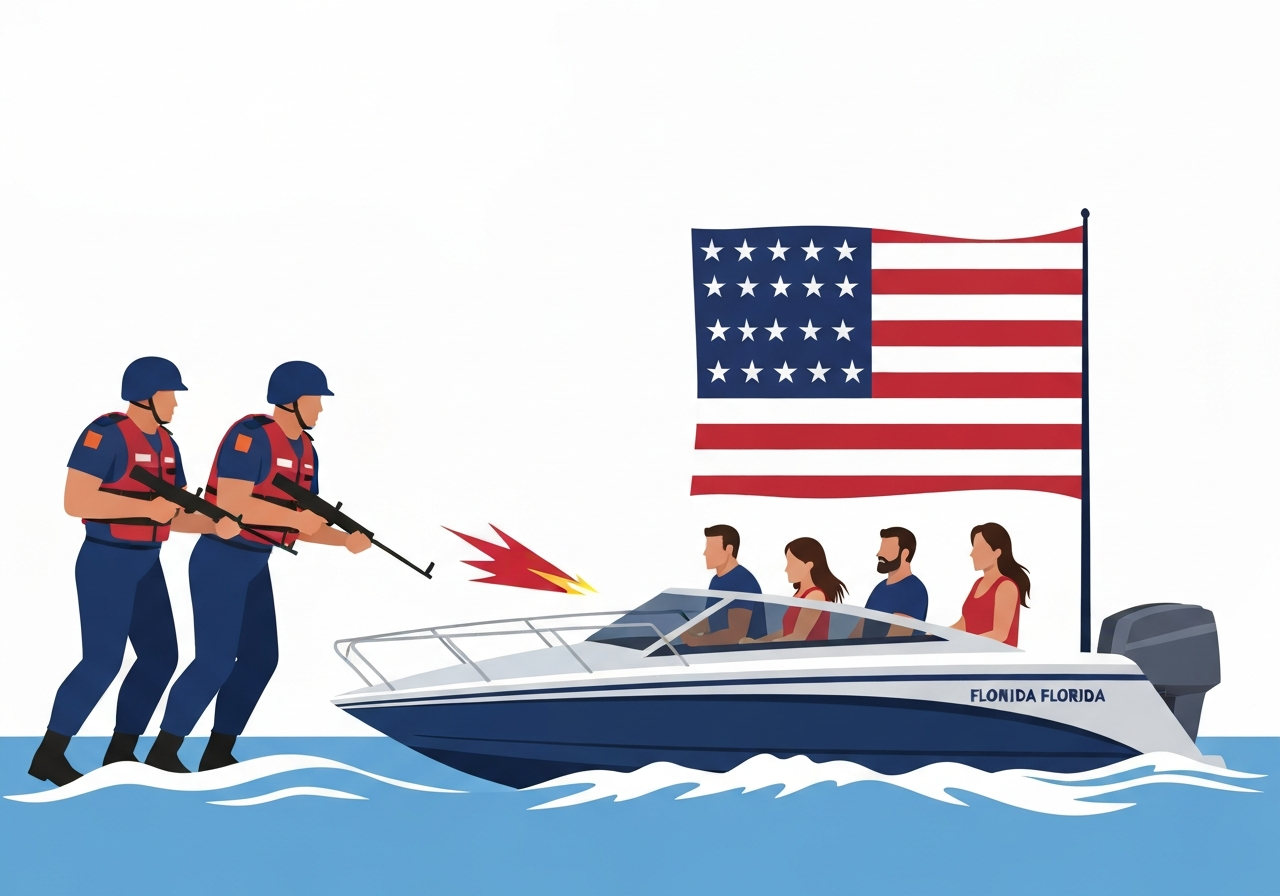
On Feb. 25, 2026, Cuba’s Interior Ministry reported that its coast guard killed four people aboard a speedboat that had entered Cuban waters from Florida and alleged the vessel’s occupants intended to carry out a terrorist infiltration. The ministry said the craft was one nautical mile northeast of the El Pino canal in Cayo Falcones and bore a Florida registration number. Cuban authorities said the 10 occupants were armed and that the confrontation began when those aboard opened fire as Border Guard Troops approached for identification. The United States says it has no independent confirmation of Cuban claims and has deployed embassy and federal resources to investigate.
Key Takeaways
- The Cuban Interior Ministry reported 10 people aboard a Florida-registered speedboat; it said four were killed and six were injured during the incident on Feb. 25, 2026.
- Cuban officials alleged the occupants were armed with assault rifles, handguns, Molotov cocktails, bulletproof vests, telescopic sights and camouflage uniforms.
- The ministry identified one of the dead as Michel Ortega Casanova and named six people allegedly arrested from the vessel; a seventh person, Duniel Hernández Santos, was later arrested on the island.
- U.S. Secretary of State Marco Rubio said U.S. officials, including embassy staff in Havana, are working to verify the Cuban account and determine nationality or immigration status of those involved.
- U.S. agencies including DHS and the Coast Guard said they are looking into the matter; Florida’s attorney general ordered state prosecutors to begin an investigation.
- Several U.S. lawmakers called for immediate inquiries; some described the event as an unfolding and alarming situation, while others urged careful verification of facts.
- Cuba framed the incident as an attempted terrorist infiltration against the island; the U.S. has not corroborated the motive or many of the Cuban-issued details.
Background
Maritime incidents between Cuba and craft departing from Florida have a long and often tense history, shaped by waves of migration, political activism and periodic clandestine operations. Cuba enforces strict controls on its territorial waters and has routinely intercepted small vessels it deems a security risk. In recent months bilateral tensions have been elevated, including U.S. sanctions and tariff measures linked to regional events such as operations against the Maduro government in Venezuela.
The Cuban government has publicly emphasized sovereignty and maritime security in its messaging to domestic and international audiences, and has invoked past episodes of anti-government attacks to justify robust coastal patrols. U.S. authorities routinely state they seek consular access when U.S. nationals are involved, and federal agencies typically coordinate with host-nation counterparts when incidents occur in foreign waters or when vessels are traced to U.S. registries.
Main Event
According to the Cuban Interior Ministry, the speedboat bearing a Florida registration approached Cayo Falcones and was intercepted approximately one nautical mile northeast of the El Pino canal. Five members of Cuba’s Border Guard Troops moved to identify the craft, and Cuban officials say those aboard opened fire, injuring the commander of the Cuban boat. The ministry said its forces returned fire; four people aboard the speedboat were killed and six were wounded and taken ashore for medical treatment.
The ministry listed the vessel’s occupants as Cuban nationals living in the U.S. and provided a roster of names for six people allegedly arrested from the boat, plus the identity of one of the deceased, Michel Ortega Casanova. Authorities later said a seventh person, Duniel Hernández Santos, was arrested on the island and had confessed to being sent from the U.S. to facilitate the landing.
Cuban officials asserted the boat carried a cache of weapons and tactical gear. The Interior Ministry described the episode as an attempted armed infiltration for “terrorist purposes,” and said most of those on board had known histories of criminal or violent activity. Cuban state media and official channels circulated photographs and lists provided by authorities.
Analysis & Implications
If verified, the Cuban account would represent a major security incident with cross-border implications: it involves a U.S.-registered vessel, alleged armed actors resident in the U.S., and lethal force by Cuban forces inside Cuban territorial waters. That combination raises pressing consular, legal and diplomatic questions, including the nationality of those aboard and whether U.S. law enforcement had prior knowledge of any plot or suspects.
The U.S. response so far emphasizes verification rather than confirmation. Secretary of State Marco Rubio said embassy staff in Havana are engaged and federal agencies including DHS and the Coast Guard are reviewing records tied to the vessel registration. A careful bilateral fact-finding process will be required to reconcile Cuban claims with intelligence, maritime records and witness accounts.
Domestically in the United States, the incident has triggered immediate political reactions and calls for investigations. Lawmakers from Florida and other states urged swift federal action to determine whether U.S. citizens or legal residents were involved and whether any U.S.-based networks facilitated the voyage. The event could prompt new scrutiny of small-vessel monitoring and registration controls in South Florida.
Regionally, the episode risks further straining U.S.-Cuba ties. If Cuba’s allegation of a coordinated armed infiltration proves accurate, Havana may press for stronger international measures against networks it deems hostile. Conversely, if key Cuban claims cannot be corroborated, Washington may press for accountability over the use of lethal force and demand transparent investigations.
Comparison & Data
| Item | Number (reported by Cuban Interior Ministry) |
|---|---|
| People aboard | 10 |
| Killed | 4 |
| Wounded | 6 |
| Named arrests from vessel | 6 |
| Additional arrest on island | 1 |
The table above summarizes Cuban ministry figures released on Feb. 25, 2026. Reported counts indicate 10 people were aboard, with four killed and six wounded; the ministry named six arrested from the vessel and said a seventh person was detained on the island. U.S. officials have not independently verified these numbers, and the extra island arrest raises questions about how the ministry aggregated those detained versus those aboard the speedboat.
Reactions & Quotes
“We have our embassy on the ground in Havana working this as we speak. We’re going to find out exactly what happened here and we’ll respond accordingly.”
Secretary of State Marco Rubio (U.S. Department of State, reported remarks)
Rubio framed U.S. activity as an on-the-ground verification effort, noting federal partners were reviewing vessel registration and residency records.
“Hopefully it’s not as bad as we fear it could be. But can’t say more, because I just don’t know more.”
Vice President JD Vance (White House remarks)
Vance described uncertainty in initial reporting and urged caution while investigations proceed.
“I am calling for an immediate investigation into this massacre.”
Rep. Carlos Giménez (statement)
Some U.S. lawmakers characterized the event in stark terms and demanded prompt federal inquiries into nationality and the use of lethal force.
Unconfirmed
- Nationality and immigration status of every individual aboard: the U.S. has not confirmed who was a U.S. citizen or legal resident.
- Whether the full list of weapons and tactical gear reported by Cuba was present on the boat; independent verification is pending.
- Who fired first in the encounter and the precise sequence of force used by both sides remain unverified by neutral investigators.
- Whether the seven names provided by Cuban authorities correspond to U.S. criminal records or prior investigations; U.S. authorities have not publicly confirmed matches.
Bottom Line
The incident on Feb. 25, 2026, poses immediate diplomatic and investigative challenges. Cuban authorities describe an armed attempt to infiltrate the island from a Florida-registered boat that resulted in four deaths; U.S. officials say they are working to verify the Cuban account and determine the identity and status of those involved. Until independent evidence is shared or a joint investigation yields corroboration, key elements of the narrative should be treated as claims rather than established fact.
Watch for three developments that would clarify the picture: consular and forensic confirmation of identities, U.S. verification of the vessel registration and chain-of-custody for any weapons, and any formal joint or third-party investigation into the use of lethal force. The outcome will influence U.S.-Cuba relations and potential policy or legal actions on both sides.
Sources
- CBS News — Media report summarizing Cuban Interior Ministry statements and U.S. reactions (news).
- Cuban Interior Ministry — Official Cuban government statements reported by state agencies (official announcement).
- U.S. Embassy in Havana — U.S. embassy presence and consular channels in Cuba (U.S. government).
- Department of Homeland Security — U.S. federal agency cited as reviewing the incident and vessel records (U.S. government).