
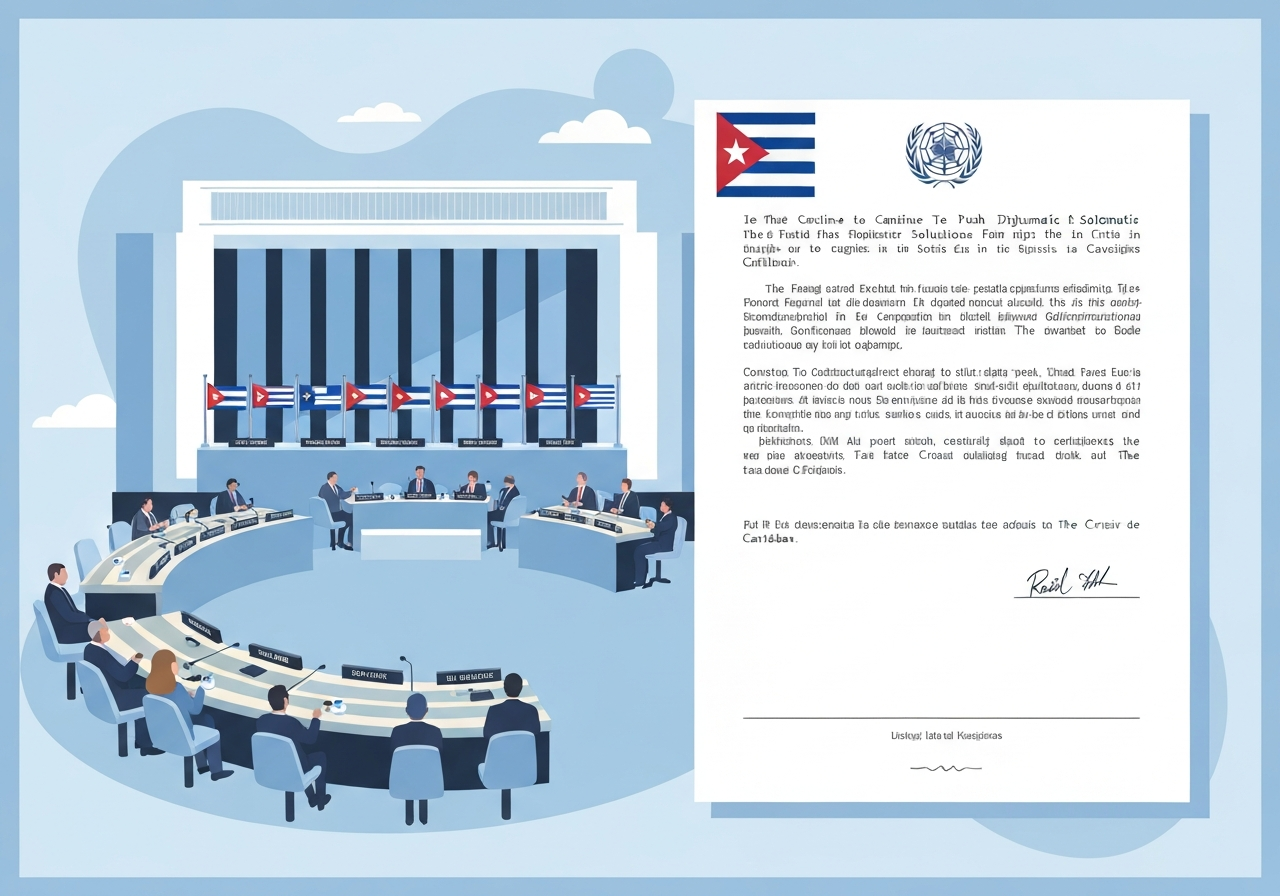
President Miguel Díaz-Canel announced on Friday that Cuba has been conducting talks with the United States even as the island faces an acute fuel shortage that has left large sections of the country in prolonged darkness. In a 90-minute press conference carried on state media, Díaz-Canel framed the exchanges as limited, respectful dialogues aimed at finding practical solutions while rejecting political concessions. He confirmed that two key power plants have exhausted their fuel, that Cuba has imported no oil in three months, and that a government announcement on Monday would ease participation by Cubans abroad in the national economy. The disclosure was the first formal acknowledgment from Havana that discussions with U.S. officials are underway.
Key Takeaways
- President Díaz-Canel held a 90-minute news conference on Friday confirming talks with U.S. officials and describing them as focused on practical issues, not political change.
- Cuba has imported no oil in three months, and two major power plants have exhausted fuel, leading to longer blackouts and grid instability.
- The government said it will soon release 51 prisoners and plans an announcement on Monday to allow expanded economic participation by Cubans living abroad.
- Nearly 7,000 homes are connected to solar power and about 700 bakeries have switched to wood- or charcoal-fired ovens amid fuel shortages.
- More than two million Cubans have emigrated in the past five years, according to demographers cited by officials, and Havana says it has been in talks with expatriates about economic involvement.
- An FBI team is expected to be welcomed to Cuba to assist with an investigation into the Feb. 25 firefight involving 10 Cubans who had lived in the United States.
- President Trump publicly signaled optimism about an eventual Cuba deal and hinted at easing some travel restrictions, while continuing to stress pressure on Havana.
Background
Cuba’s energy system has long depended on foreign oil, with officials estimating about 60 percent of the island’s fuel needs met by imports. For decades Venezuela was Havana’s main supplier; Cuban officials now attribute part of the present crisis to changes in Caracas and external pressure. Recent months have seen escalating U.S. measures that Cuba describes as an energy blockade, and Havana says those measures have sharply reduced fuel deliveries.
The economic squeeze has forced public transportation reductions, postponed elective surgeries and curtailed other fuel-dependent services. Cubans inside the country and in the diaspora have advocated for remittance and investment channels that could send money and hardware to support infrastructure projects. At the same time, U.S.-Cuban relations have been strained for years by political differences, sanctions, and competing regional interests, complicating any negotiation over humanitarian or economic relief.
Main Event
Díaz-Canel’s Friday address was framed as a candid update from the government. He acknowledged the talks with U.S. interlocutors were intended to explore concrete measures, saying they were conducted on terms of mutual sovereignty and without preconditions about Cuba’s internal political model. He declined to detail specific concessions and said immediate breakthroughs were unlikely, characterizing the discussions as in early stages.
Officials said two critical power plants had run out of fuel and that a significant portion of previously available megawatts was lost, especially during peak and nighttime hours, destabilizing the grid. To adapt, the government is accelerating solar deployments and small-scale alternatives: Díaz-Canel reported roughly 7,000 homes now connected to solar panels and said some bakeries have reverted to wood or charcoal ovens. Electric vehicles have been repurposed in some areas to transport dialysis patients.
Havana also announced the imminent release of 51 prisoners, an apparent gesture toward easing tensions with the United States. Díaz-Canel said a Monday announcement would ‘‘greatly facilitate’’ the participation of Cubans abroad in economic programs, strongly implying new legal or administrative channels for diaspora investment. Separately, authorities said they would receive an FBI team to assist in the probe of the Feb. 25 maritime incident involving 10 Cubans who had lived in the United States.
Analysis & Implications
The public confirmation of talks marks a significant — if cautious — shift in Havana’s posture. For the Cuban leadership, engaging with Washington may be a pragmatic response to a looming humanitarian and economic shock rather than an ideological concession. Allowing diaspora investment could inject cash and technical expertise into stalled projects, but it risks intra-elite and social tensions if benefits are unevenly distributed.
Politically, any arrangement that materially eases shortages may buy the government breathing room, but it would likely fall short of the sweeping civic and political reforms many international observers and exile communities demand. Analysts note that U.S. pressure could continue to be used as leverage to press for changes in political rights, though Havana’s statements suggest it will resist terms that appear to threaten one-party rule.
Regionally, the unfolding negotiations intersect with developments in Venezuela and broader U.S. strategy in Latin America. If Washington relaxes some restrictions in exchange for concrete steps from Havana, it could reshape economic networks and migration dynamics. Conversely, a failure to reach usable agreements risks worsening humanitarian conditions and could spur higher emigration and destabilizing social unrest.
Comparison & Data
| Metric | Reported Value |
|---|---|
| Imported oil (no shipments) | 3 months |
| Dependence on foreign oil | 60 percent |
| Homes on solar | ~7,000 |
| Bakeries converted to wood/charcoal | ~700 |
| Emigrants in past five years | > 2 million (demographers’ estimate) |
| Black market gasoline price | $8–$10 per liter (~$35 per gallon) |
These figures underline the scale: an energy sector that lacks reliable imports, a partial but growing pivot to decentralized renewables, and an already-large diaspora that the government is attempting to engage. The reported three-month gap in imports correlates with extended outages and the shutdown of generating units, amplifying operational challenges for the national grid and public services.
Reactions & Quotes
Havana emphasized the talks were pragmatic and framed by sovereignty. Government messaging sought to reassure citizens while signaling to international partners that negotiations would not include forced political change.
“It’s the fault of the energy blockade that has been imposed on us.”
Miguel Díaz-Canel, President of Cuba
Díaz-Canel repeatedly blamed external pressure for the shortages and stressed that Cubans must adapt while officials seek routes to secure fuel and alternative energy sources. He called for engagement with expatriates and said the government hoped to open channels for diaspora investment.
The White House and President Trump made public comments expressing optimism about an eventual transformation in Venezuela and a consequential change in Cuba, framing continued pressure as a path to political change.
“Cuba’s at the end of the line. They have no money. They have no oil.”
President Donald J. Trump
Trump also suggested some travel restrictions could be eased and told a Cuban-American sports owner that travel to Cuba would become easier, remarks that signal potential tactical shifts but stop short of confirmed policy changes. Observers caution that rhetoric and policy actions can diverge.
“The Vatican has taken the necessary steps, always with a view to a dialogue-based solution to the problems that exist.”
Cardinal Pietro Parolin, Vatican Secretary of State
The Vatican described its role as facilitative, after meetings involving Cuba’s foreign minister and U.S. diplomatic representatives in Havana. Church officials framed their engagement as promoting dialogue and humanitarian relief rather than negotiating political settlements.
Unconfirmed
- The characterization that the United States “attacked Venezuela, arrested its president and took control of its state oil industry” is presented in some accounts; the precise nature and attribution of those events require independent verification and are contested.
- Details about what concessions, if any, Washington or Havana will accept in talks and whether the U.S. will formally ease specific sanctions remain unannounced and unconfirmed.
- The extent, timing and mandate of the FBI team’s participation in the Feb. 25 investigation have been described by Cuban officials but have not been fully confirmed by U.S. authorities.
- Proposals to open formal investment channels for the Cuban diaspora are reported as imminent by Havana; the legal mechanisms and timeline for such measures were not specified and remain to be verified.
Bottom Line
Cuba’s public acknowledgment of talks with the United States signals an urgent, pragmatic turn driven by a severe fuel shortage that has strained everyday life and critical services. The government is seeking immediate relief — through releases, diaspora engagement and talks with foreign partners — while asserting that its political model will not be a bargaining chip. For Washington, any tactical easing to alleviate humanitarian stress will have to be weighed against broader policy goals concerning human rights and governance.
Outcomes remain uncertain: limited technical agreements could reduce outages and economic strain, but they are unlikely on their own to resolve structural political disagreements. Observers should watch whether concrete measures on fuel, remittances and investment are implemented, how transparent the terms will be, and whether regional players such as Venezuela or mediators like the Vatican play sustained facilitative roles.