
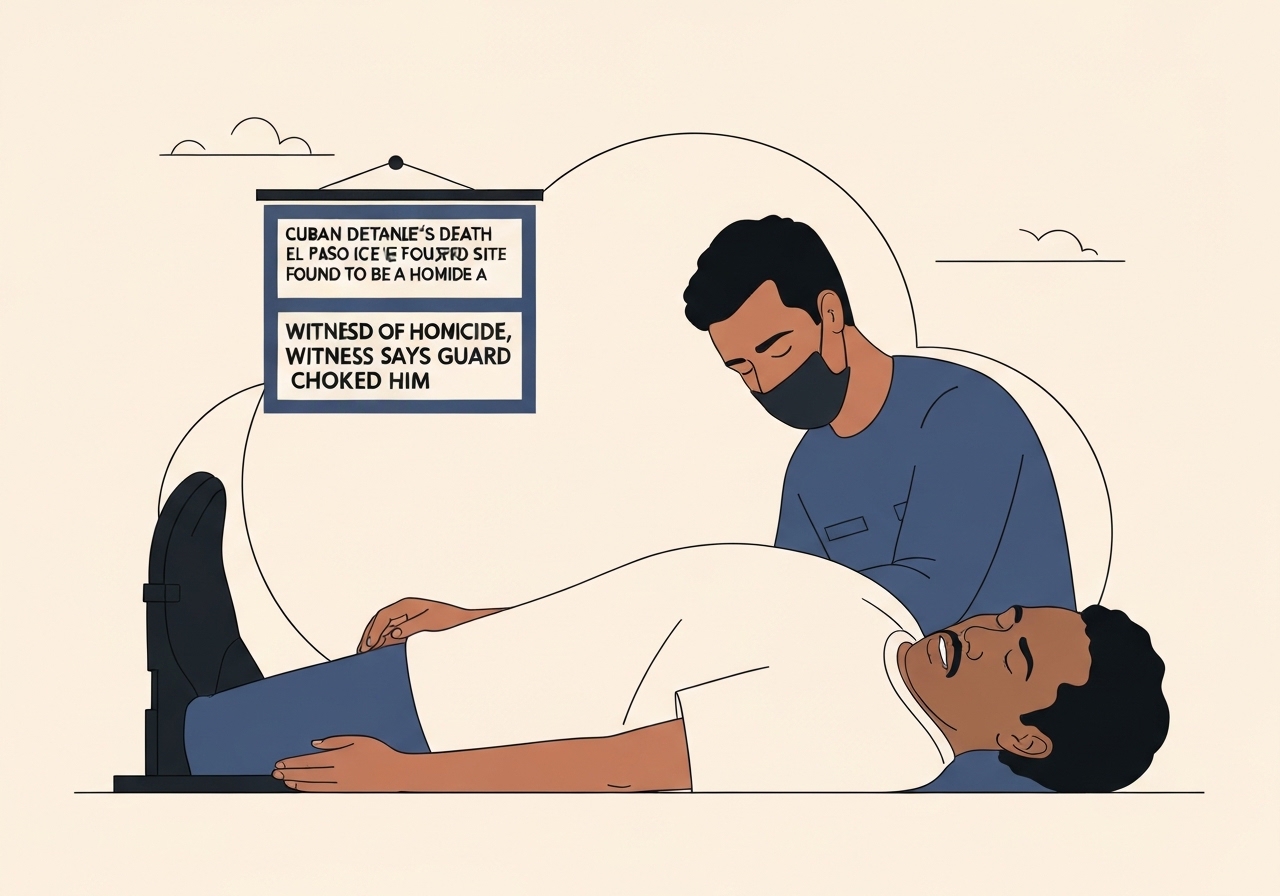
On Jan. 3, 2026, 55-year-old Cuban immigrant Geraldo Lunas Campos died at Camp Montana East, an Immigration and Customs Enforcement (ICE) detention site on the Fort Bliss Army base in El Paso, Texas. The El Paso County Medical Examiner’s Office told the family a preliminary autopsy indicates homicide by asphyxia from chest and neck compression. ICE and the Department of Homeland Security (DHS) initially reported that staff tried to save Lunas Campos after an apparent suicide attempt; a cellmate who witnessed the episode says guards handcuffed, tackled and put him in a chokehold until he lost consciousness. The conflicting accounts have amplified scrutiny of conditions at the large, privately run tent complex where the detainee was being held.
Key Takeaways
- Geraldo Lunas Campos, 55, died Jan. 3, 2026, at Camp Montana East, an ICE facility on Fort Bliss in El Paso, Texas; the El Paso medical examiner’s preliminary finding cites homicide from chest and neck compression.
- ICE first reported the death without describing an altercation; DHS later said Lunas Campos attempted suicide and staff performed lifesaving measures before he stopped breathing.
- A detainee witness, Santos Jesús Flores, 47, said Lunas Campos was handcuffed, pinned by at least five guards and placed in a chokehold; Flores said multiple detainees watched and cameras should have recorded the event.
- Lunas Campos arrived at Camp Montana East in September after an ICE arrest in July; he was legally admitted to the U.S. in 1996 and had past convictions in New York from 2003 and 2009.
- Camp Montana East is a $1.2 billion tent complex built on Fort Bliss and operated by a private contractor, Acquisition Logistics LLC, which previously had no corrections experience according to reporting.
- The medical examiner’s homicide determination could be decisive for any criminal or civil actions, but the base location and jurisdictional rules may complicate local probes.
Background
Camp Montana East is a sprawling tent detention complex constructed on the grounds of Fort Bliss as part of a rapid expansion of ICE capacity. The project, reported to cost about $1.2 billion, was developed to hold large numbers of migrants and has been managed by a private contractor, Acquisition Logistics LLC, which reporting found had limited prior corrections experience. The facility has been central to a broader enforcement push that moved many detainees from across the country into Texas in recent months.
Geraldo Lunas Campos was among the first detainees transferred to the site after ICE apprehended him in July during a targeted enforcement operation. Records show he was admitted to the United States in 1996; New York court files indicate a 2003 conviction for sexual contact with an individual under 11 that led to a one-year jail term and placement on the state sex-offender registry, and a 2009 conviction for attempting to sell a controlled substance that resulted in a five-year sentence and three years’ supervision, completed in January 2017. ICE identified him in a Jan. 9 notice as a 55-year-old registered sex offender who died in custody.
Main Event
ICE initially said Lunas Campos became disruptive while waiting for medication, refused to return to his dormitory and was moved to segregation. According to the agency’s Jan. 9 statement, while in segregation staff observed him in distress, medical personnel responded, lifesaving measures were initiated and emergency medical services were called; he was later pronounced dead.
That official account changed after a detainee witness described a different sequence. Santos Jesús Flores told reporters he saw the incident through a cell window: Lunas Campos was already handcuffed when several guards pinned him to the floor and at least one applied pressure to his neck. Flores said Lunas Campos told officers he could not breathe; within about five minutes he stopped moving and the handcuffs were removed.
DHS spokesperson Tricia McLaughlin later characterized the event as a suicide attempt, saying staff encountered violent resistance while trying to prevent Lunas Campos from hurting himself and that he then stopped breathing. DHS also said medical staff initiated lifesaving measures. The department has described the matter as an active investigation and said more details would be forthcoming.
The El Paso County Medical Examiner’s Office told the detainee’s family by phone that a preliminary autopsy ruled the death a homicide caused by asphyxia due to chest and neck compression. Officials at the medical examiner’s office declined further public comment pending completion of toxicology and other testing. It remains unclear whether the guards involved were federal employees or employees of the private contractor operating the site.
Analysis & Implications
A medical examiner’s homicide finding is consequential because it typically prompts closer scrutiny of whether use of force was lawful or excessive and can influence whether prosecutors pursue criminal charges or families file civil suits. For deaths in custody, a homicide classification means the examiner believes the actions of others were the proximate cause, though it does not address intent. Legal pathways are complicated here by the facility’s location on an Army base, which can limit state and local jurisdiction and shift investigative authority toward federal agencies.
This case underscores long-standing concerns about restraint methods that involve prone positioning or pressure across the back and neck. Forensic specialists have documented numerous deaths where compression and positional asphyxia were factors; preliminary findings pointing to neck and chest compression align with those patterns. Experts caution that institutions must have clear training and oversight to prevent lethal outcomes during restraints, and that camera review, independent autopsy access and timely interviews of witnesses are essential for accountability.
The involvement of a private contractor with limited corrections experience raises questions about staffing, training and oversight at a facility built rapidly to expand bed capacity. Contract management, transparency about contractor personnel versus federal staff, and the mechanism through which contractor employees are supervised will likely draw scrutiny from lawmakers, oversight bodies and civil-rights advocates. Policy debates over immigration enforcement capacity and detention conditions may intensify as details emerge.
| Date | Event |
|---|---|
| 1996 | Geraldo Lunas Campos legally admitted to the United States. |
| 2003 | Convicted in New York of sexual contact with an individual under 11; sentenced to one year. |
| 2009 | Convicted for attempted sale of a controlled substance; five-year sentence, supervision completed Jan. 2017. |
| July 2025 | ICE arrested Lunas Campos during an enforcement operation. |
| September 2025 | Arrived at Camp Montana East, Fort Bliss. |
| Jan. 3, 2026 | Died at Camp Montana East; El Paso medical examiner later preliminarily ruled death a homicide. |
The timeline above compiles the verifiable dates described in public records and agency statements. While criminal convictions and prior history appear in court and corrections records, the cause and manner of death rest on the ongoing forensic work and agency investigations.
Reactions & Quotes
Multiple parties have spoken publicly or to family members; the quotes below are short excerpts placed in context.
“The last thing he said was that he couldn’t breathe.”
Santos Jesús Flores, detainee witness
Flores told reporters he witnessed guards pinning Lunas Campos and applying pressure to his neck while the detainee remained handcuffed.
“Campos violently resisted the security staff and continued to attempt to take his life.”
Tricia McLaughlin, DHS spokesperson
DHS used this phrasing to describe the department’s account that staff intervened during an apparent suicide attempt and that medical personnel performed lifesaving measures before Lunas Campos stopped breathing.
“I just want justice, and his body here.”
Jeanette Pagan-Lopez, partner and mother of two of Lunas Campos’ children
Pagan-Lopez, who lives in Rochester, said she was told by the medical examiner’s office that the body was at the county morgue and has pressed ICE and federal officials for more information and for the return of his remains.
Unconfirmed
- Whether the staff who restrained Lunas Campos were federal ICE employees or employees of the private contractor has not been publicly confirmed.
- It is unconfirmed whether facility surveillance cameras captured the incident or whether those recordings have been preserved or reviewed by independent investigators.
- Investigative authorities that will lead or participate in any criminal probe—federal, state or military—have not been publicly identified.
Bottom Line
The preliminary medical examiner ruling of homicide elevates the case beyond a routine in-custody death: it raises questions about use of force, training and oversight at a rapidly expanded detention complex on federal land. Whether prosecutors bring charges, whether civil suits follow, and how agencies reform practices will depend on forensic results, camera evidence and independent investigations.
For policymakers and advocates, this episode reiterates longstanding tensions between expanded detention capacity and accountability for deaths in custody. The case is likely to prompt renewed calls for clearer oversight of contractor-run facilities, transparent investigations, and federal clarity on jurisdiction when incidents occur on military installations.