
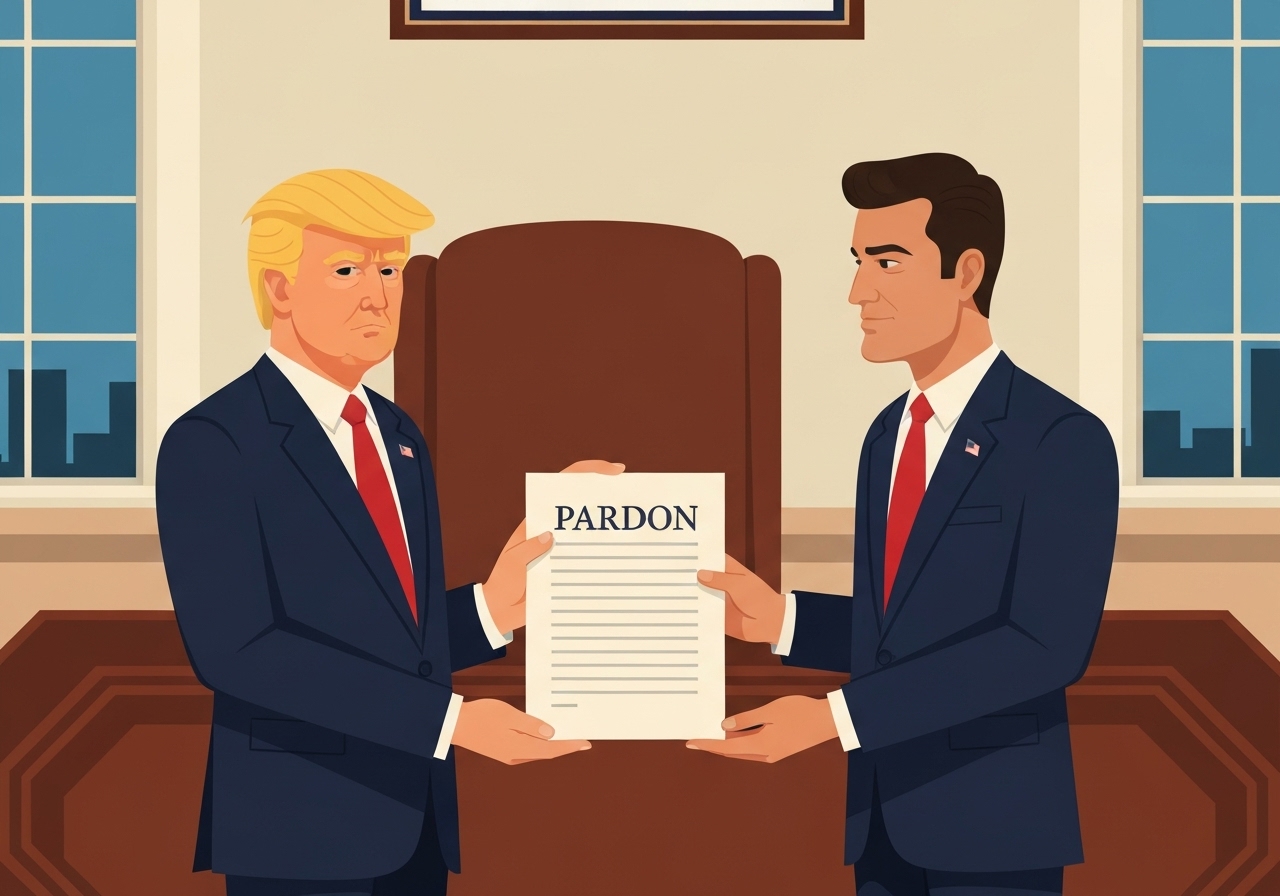
President Donald Trump announced he would grant a “full and unconditional” pardon to Democratic Representative Henry Cuellar of Texas and to his wife, Imelda Cuellar, after federal charges last year accused the couple of accepting about $600,000 in illicit payments. The announcement came on social media alongside claims that the prosecution was politically motivated; Cuellar and his wife have pleaded not guilty and posted bail. On the same morning as the pardon claim, Cuellar filed for re-election as a Democrat, dismissing speculation he might switch parties and alter the House balance. The move is the president’s third act of clemency this week, following separate actions in high-profile international and financial cases.
Key Takeaways
- President Trump said he will issue a “full and unconditional” pardon to Rep. Henry Cuellar and his wife, Imelda Cuellar, after their 2024 indictment.
- The Justice Department alleged last year that the couple accepted roughly $600,000 (£478,000) from an Azerbaijani state-owned oil company and a Mexican bank to influence U.S. policy.
- The indictment lists purchases paid with those funds, including $58,000 in credit-card payments, $18,000 at wholesale stores and $12,000 for a custom gown.
- Charges against the Cuellars include conspiracy, bribery, wire fraud, money laundering and acting as agents of a foreign organization.
- Cuellar has represented Texas’s 28th congressional district since 2005 and is known for more conservative stances within the Democratic caucus, including a pro-life position.
- Cuellar filed for re-election as a Democrat on Wednesday, undercutting speculation he would switch parties to boost the Republican House majority.
- This reported pardon follows two other clemency actions by the president this week: a pardon for ex-Honduran president Juan Orlando Hernández and a commutation for David Gentile.
Background
Henry Cuellar, first elected to the U.S. House in 2004 and serving since 2005 for Texas’s 28th district, has long occupied a centrist-to-conservative lane within the Democratic caucus. Known for his emphasis on border security and for socially moderate positions, Cuellar has frequently broken with party leadership on immigration and abortion policy. Federal prosecutors brought charges against him and his wife in 2024, alleging a multi-faceted scheme in which payments from foreign-linked entities were funneled to the family and used for personal and household expenses.
The indictment detailed a network of transactions and named an Azerbaijani government-owned oil company and a Mexican bank as sources of funds. Prosecutors alleged the payments were exchanged for Cuellar’s efforts to influence U.S. foreign policy in directions beneficial to those payors. The case drew attention because it intersects with broader political debates—congressional ethics, foreign influence, and partisan claims about selective enforcement.
Main Event
On social media, President Trump posted that he would pardon Cuellar and his wife, saying the congressman could “sleep well tonight” and framing the prosecution as retaliatory because Cuellar had voiced support for stronger border controls. The White House statement cited no new evidence; the announcement was a presidential declaration of intent to use clemency powers rather than a court action. Cuellar and his wife remain under indictment and have entered not-guilty pleas, having posted bail after the charges were filed.
Cuellar’s re-election filing on Wednesday clarified his political plans at a moment when some commentators speculated he might change parties—an outcome that would affect the razor-thin House majority. The congressman’s daughters wrote to President Trump asserting their father’s positions on immigration and character as reasons he was targeted, a personal appeal echoed in the president’s social-post commentary. Prosecutors maintain the factual claims in the indictment about payments and purchases tied to the alleged scheme.
The Department of Justice’s allegations include concrete financial figures and transaction details: approximately $600,000 in suspected illicit payments, with specific line items cited by the indictment. The criminal counts span bribery, conspiracy, wire fraud and money-laundering statutes, as well as allegations of acting on behalf of a foreign organization without proper disclosure—charges that carry both legal penalties and political consequences for an elected official.
Analysis & Implications
A presidential pardon for a sitting member of Congress raises immediate legal and political questions. Legally, a pardon removes federal criminal liability for specified offenses but does not erase facts found in an indictment or civil exposure; it also cannot undo state-level charges. Politically, the optics of clemency for an indicted lawmaker can spark debate about norms governing executive power and whether pardons are being used to reward allies or to reverse perceived politicized prosecutions.
For the Democratic caucus, the pardon complicates intra-party dynamics. Cuellar is a high-profile moderate whose policy stances already set him apart from many colleagues; the president’s action could deepen fractures or prompt calls for internal accountability. For Republicans, a pardon that keeps a Democrat in office may be a double-edged sword: it spares the party the short-term gain of a potential defection while inviting criticism over the president’s use of clemency.
Internationally, the underlying allegations about foreign payments touch on U.S. concerns about external influence in domestic politics. If prosecutors’ claims were proven in court absent a pardon, they would underscore vulnerabilities in campaign-finance and lobbying enforcement. The pardon sidesteps a judicial determination, leaving many factual and policy questions unresolved and potentially prompting renewed calls for stronger disclosure laws and enforcement mechanisms.
Comparison & Data
| Name | Alleged Offense / Conviction | Clemency Action | Timing |
|---|---|---|---|
| Henry Cuellar | Indicted for bribery, conspiracy, wire fraud, money laundering (alleged ~$600,000) | President announced intent to grant a full pardon | Announcement this week |
| Juan Orlando Hernández | Convicted March 2024 of conspiring to import cocaine | Pardoned | Earlier this week |
| David Gentile | Convicted of financial fraud; serving a seven-year sentence | Sentence commuted | Earlier this week (Monday) |
The table places the Cuellar announcement alongside two other recent clemency actions involving foreign and financial crimes. That comparison highlights the president’s recent focus on cases tied to drug trafficking and financial offenses as well as the political sensitivity of pardoning an active member of Congress.
Reactions & Quotes
“Henry, I don’t know you, but you can sleep well tonight — your nightmare is finally over!”
Donald J. Trump (Truth Social)
Trump framed the action as relief for the Cuellars and portrayed the indictment as politically motivated. Legal and ethics observers cautioned that a presidential pardon eliminates federal criminal exposure but does not adjudicate underlying facts or prevent other legal consequences.
“My father always believed in securing the border; his independence and honesty may have made him a target,”
Daughters of Henry Cuellar (letter)
The family letter asked for clemency on personal and political grounds and was cited by the president in his posts. Independent ethics experts said such appeals are common in clemency campaigns but do not alter the legal standards used by prosecutors.
Unconfirmed
- Whether formal pardon paperwork has been signed and filed with the Department of Justice — the president announced intent on social media but administrative steps may still be pending.
- The claim that the prosecution was initiated by President Biden in retaliation for Cuellar’s policy views — that assertion has been made by the president and family members but is not supported by independent evidence in the public record.
- Any immediate effect on potential state-level investigations or civil suits remains unclear and is not resolved by a federal pardon.
Bottom Line
The president’s public pledge to pardon Representative Henry Cuellar and his wife short-circuits a federal criminal process that included detailed allegations about roughly $600,000 in payments tied to foreign entities. Legally, a federal pardon would remove federal criminal exposure for the named offenses but would not erase the underlying allegations or eliminate state or civil avenues of inquiry.
Politically, the action is likely to intensify debate over the use of clemency for politically sensitive figures and could deepen divisions within and between parties—while leaving many factual questions unanswered. Observers and lawmakers should watch the administrative follow-through and any subsequent legal or congressional steps that address foreign influence, disclosure rules and executive clemency norms.
Sources
- BBC News (media — original report summarizing the indictment, presidential post and related developments)