
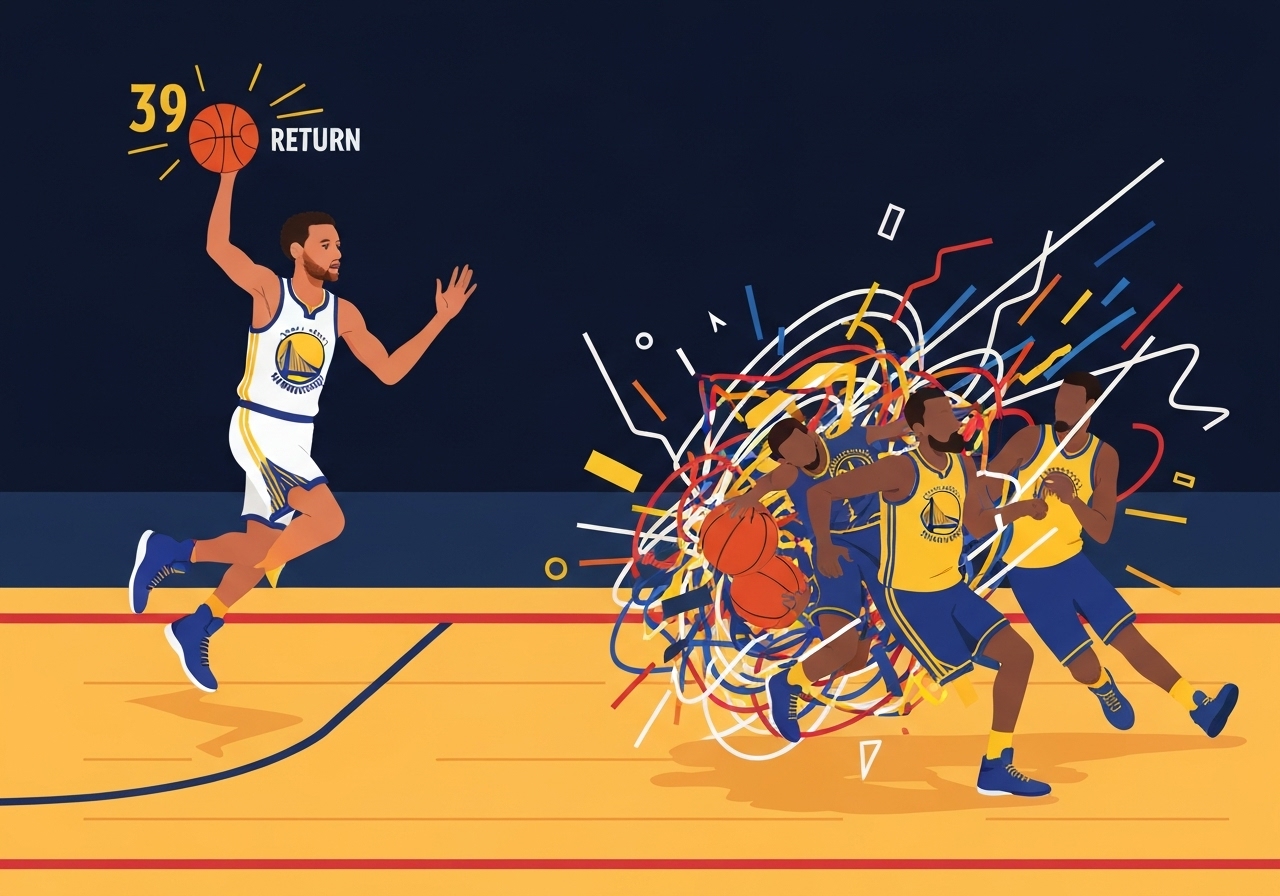
Stephen Curry returned from a two-week, five-game absence on Dec. 13, 2025, in San Francisco and scored 39 points in 32 minutes, yet the Golden State Warriors fell 127-120 to the Minnesota Timberwolves. Minnesota was playing without Anthony Edwards, and Rudy Gobert and Julius Randle combined for 51 points and 23 rebounds, key contributions in a game decided by a 39-point fourth quarter for the visitors. The loss dropped Golden State to 13-13 and exposed roster gaps with Draymond Green away for personal reasons and Al Horford sidelined by sciatica. Curry’s strong individual performance did not prevent the team from surrendering late runs and missing an opportunity to gain ground in the Western Conference.
Key Takeaways
- Stephen Curry scored 39 points in 32 minutes in his first game back from a quad injury, shooting 28 times and delivering 14 points in the fourth quarter.
- The Warriors lost 127-120 to the Timberwolves on Dec. 13, 2025, falling to a 13-13 record and 3.5 games behind Minnesota for the No. 6 seed in the West.
- Minnesota played without Anthony Edwards while Rudy Gobert and Julius Randle combined for 51 points and 23 rebounds, anchoring the Timberwolves’ interior advantage.
- Golden State gave up 39 fourth-quarter points, a decisive stretch after holding four of its previous five opponents under 100 points.
- With Draymond Green away for personal reasons and Al Horford out with sciatica, the Warriors’ frontcourt depth was exposed on both ends of the floor.
- Golden State ranks 22nd in offensive rating but entered the game with the NBA’s third-best defensive rating before Friday’s collapse.
- Curry’s return was managed carefully; he did not travel on the recent road trip and logged a planned scrimmage Wednesday before returning Friday.
Background
The Warriors have been navigating a season of uneven availability and offensive inconsistency. Stephen Curry missed two weeks and five games with a quad injury, and the team tried to compensate with defensive focus, holding most recent opponents under 100 points in several outings. Golden State entered Friday’s game with a strong defensive profile—ranked third in defensive rating—despite offensive struggles that have left the team 22nd in offensive rating leaguewide. Personnel disruptions have compounded the challenge: Draymond Green’s temporary absence for personal reasons and Al Horford’s ongoing sciatica have thinned interior defense and veteran matchup versatility.
On the other side, Minnesota has shown resilience even when short-handed. Anthony Edwards missed the matchup, but the Timberwolves leaned on established interior play from Rudy Gobert and Julius Randle, who produced a combined 51 points and 23 rebounds. That production filled a scoring and rebounding need and helped Minnesota control the paint when Golden State lacked its usual frontcourt anchors. The game also carried standings implications: a Warriors win would have tightened the Western Conference race, but the loss widened the gap for Golden State.
Main Event
Curry’s reappearance was energetic and efficient to a degree: he scored 10 points in his first eight-minute stint and finished with 39 points on 28 shots across 32 minutes, including three 3-pointers and a 14-point fourth quarter rally. The Warriors tried to pace his minutes; he returned after a targeted scrimmage and a weekend of treatment intended to restore conditioning. Coach Steve Kerr noted Curry’s movement and flow looked strong early, and Curry himself said he ‘started to feel normal again’ after getting his lungs back.
Despite Curry’s impact, Golden State could not contain Minnesota in the final period. The Timberwolves erupted for 39 fourth-quarter points, swinging the game’s momentum after Golden State had kept previous opponents largely in check. Minnesota’s interior tandem of Gobert and Randle created consistent second-chance opportunities and deterred Warriors drives, compounding the visitors’ late scoring surge. The absence of Draymond Green and Al Horford contributed to mismatches and rebounding deficits that Minnesota exploited.
The game’s pivotal stretch came down the final quarter when Golden State twice trimmed deficits but failed to sustain stops or convert enough high-percentage shots. Curry’s late scoring kept the game competitive, but Minnesota’s late offensive efficiency and rebounding sealed the outcome. The loss prevented the Warriors from moving within 1.5 games of the Timberwolves for the sixth seed and instead pushed Golden State further from short-term seeding goals.
Analysis & Implications
Golden State’s season remains precarious because the team’s offensive inefficiency has not yet recovered even with Curry available. Ranking 22nd in offensive rating, the Warriors are not generating consistent shot quality beyond Curry’s individual scoring bursts; role players and bench scoring have lagged, leaving a heavy burden on their star. When Curry is out or limited, the team has shown it can hold opponents under 100 points, but that defensive edge is fragile without regular frontcourt contributors.
The current absences—Draymond Green’s personal leave and Al Horford’s sciatica—have tangible consequences. Both players provide floor spacing, screening, and defensive communication that stabilize matchups; without them, Golden State struggles against teams with size and interior presence. The Minnesota game illustrated how the Warriors’ paint protection and rebound containment erode when their defensive anchors are unavailable, forcing more possessions into iso-heavy or contested perimeter offense.
Looking ahead, the Warriors’ ability to maintain a playoff push hinges on a few variables: the timeline for Green’s return, Horford’s recovery, and whether supporting scorers can lift the offensive rating closer to league average. Curry’s conditioning and minutes management will be central to that plan—the team must balance his scoring uplift with sustained defensive cohesion. If Curry remains healthy and the frontcourt returns, Golden State can realistically stabilize its defense and gradually improve offense; if absences persist, the team may slip further in the standings despite isolated star performances.
Comparison & Data
| Metric | Warriors | Timberwolves (this game) |
|---|---|---|
| Final score | 120 | 127 |
| Top contributors | Curry 39 (32 min) | Gobert + Randle 51 combined |
| Fourth-quarter points allowed | 39 | 39 |
| Season record after game | 13-13 | Not specified |
| Offensive rating (season) | 22nd in NBA | Not specified |
| Defensive rating entering game | 3rd in NBA | Not specified |
The table above summarizes boxscore and season-profile items extracted from the game narrative: Curry’s 39 points in limited minutes, Minnesota’s interior production, and the disruptive 39-point fourth quarter that decided the contest. Golden State’s season metrics—especially a low offensive rating versus a top-three defensive rating—highlight a season split between defensive strength and offensive struggles. The immediate statistical takeaway is that one elite performance from Curry does not close the gaps created by missing role players and interior defenders.
Reactions & Quotes
Coach Steve Kerr framed the outcome around a late defensive breakdown and roster availability: he emphasized the team’s responsibility to stop late runs and noted the impact of absent veterans.
“Our defense let us down tonight.”
Steve Kerr, Golden State Warriors coach
Curry acknowledged the absence of key teammates and framed his return as a personal step forward while recognizing the collective shortfall. He highlighted both the value of missing players and the team’s need to adapt.
“Draymond and Al understand how to make their impact, make their presence felt. But we didn’t have them.”
Stephen Curry, Warriors guard
From the Timberwolves’ perspective, the interior duo’s performance drew attention as a decisive factor in a game played without their primary scorer. The result underlined Minnesota’s depth and ability to win under altered rotations.
“We found ways to score and close it out despite not having Anthony.”
Minnesota team spokesman / postgame summary
Unconfirmed
- The exact timeline for Draymond Green’s return is unconfirmed beyond a general ‘away for personal reasons’ designation.
- Horford’s recovery timetable from sciatica has not been formally detailed by team medical staff and remains uncertain.
- Longer-term effects of Curry’s quad issue on his conditioning and minutes distribution are not yet fully verified and will depend on follow-up evaluations.
Bottom Line
Curry’s individual return was encouraging—39 points in 32 minutes demonstrated he can still produce at an elite level after a short absence—but basketball is a team game and Golden State’s supporting pieces were insufficient on Friday. The loss exposed how fragile the Warriors’ balance is when key interior defenders are unavailable; defensive lapses and rebound shortcomings allowed Minnesota to seize the late advantage. Restoring depth through the returns of Draymond Green and Al Horford, or improved bench scoring, will be crucial if the Warriors are to convert Curry’s scoring into consistent wins.
In the near term, monitor availability updates and lineup adjustments: if the frontcourt stabilizes and role players lift offensive efficiency, the Warriors can recover ground in the West. If absences persist and offensive ratings stay low, the team risks slipping further despite intermittent star performances from Curry.