
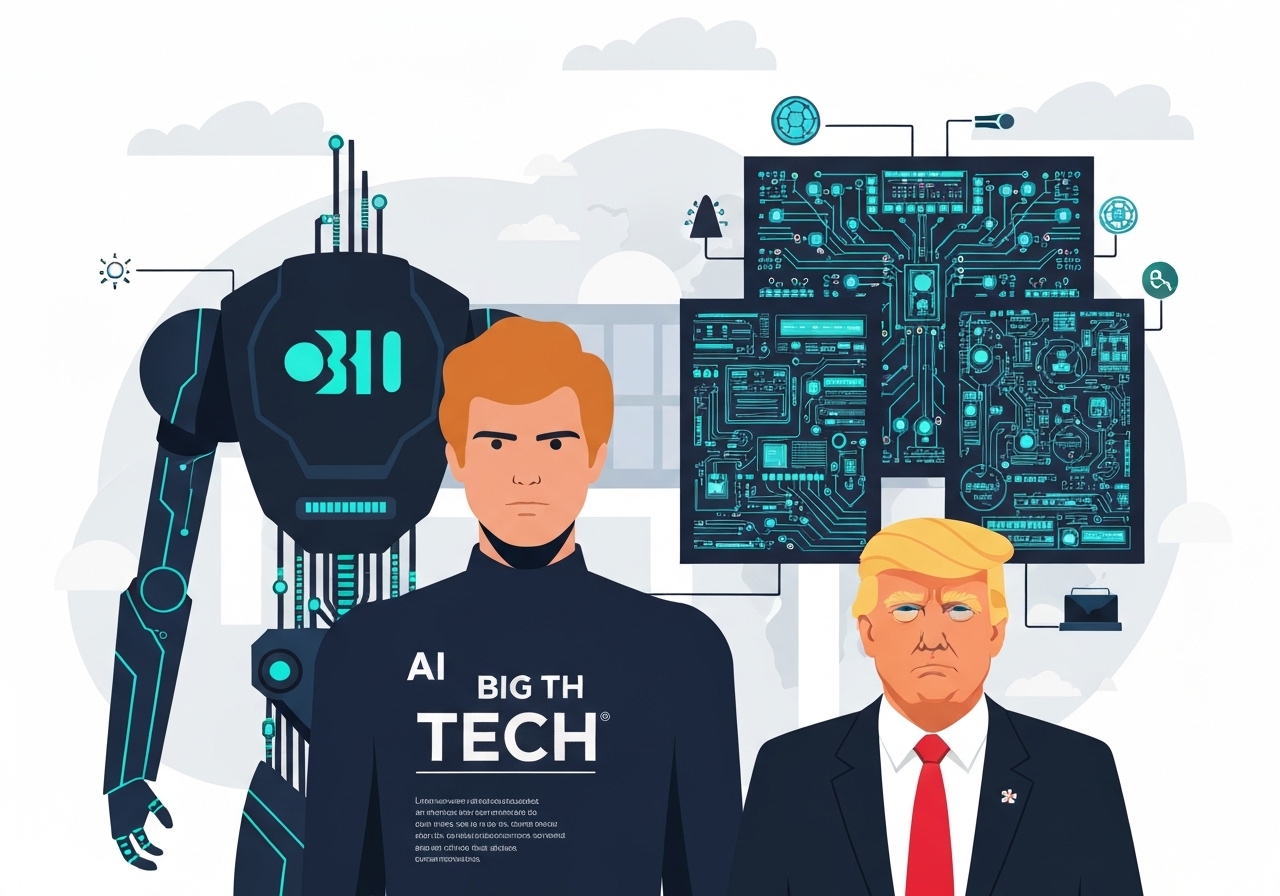
Lead: At the World Economic Forum in Davos on Jan. 20, 2026, technology firms and their offerings — especially artificial intelligence platforms — dominated the visible conversation and social scene. Long lines formed at AI-focused events such as the nonprofit AI House and an Axios-hosted forum on AI and cybersecurity, while other initiatives drew comparatively little attention. The atmosphere blended policy conversation and corporate promotion, with high-profile political figures, including attention around former President Donald Trump, amplifying media focus. The result was a forum where commercial tech interests frequently outshone traditional governance and public-policy topics.
Key Takeaways
- Timing and place: The 56th World Economic Forum convened in Davos, Switzerland, on Jan. 20, 2026, drawing global business and political leaders.
- Visible tech focus: More than four dozen people queued early at the AI House, reflecting intense interest in AI programming and networking at Davos.
- Media-led events: An Axios session on AI and cybersecurity drew an even longer line, signaling strong demand for tech-centered discussion forums.
- Uneven attention: The Alliance for Global Good—Gender Equity and Equality, launched by the Indian government in 2024, saw little foot traffic compared with sponsored tech lounges.
- Social programming: Cryptocurrency firms and A.I. companies funded high-profile parties and lounges that attracted significant attendee time and media coverage.
- Political spotlight: Coverage and side events related to Donald Trump increased press and delegate attention on political narratives alongside tech themes.
- Policy risk: The concentration of tech actors raised questions about agenda-setting influence and whether public-interest topics receive equivalent visibility.
Background
The World Economic Forum began as a gathering of business, political and academic leaders to discuss global challenges, and over decades it became a hub for deal-making, networking and soft diplomacy. Historically, Davos combined plenary sessions on broad issues—climate, health, migration—with side events and bilateral meetings where corporate and state actors pursued agendas. In recent years, the rise of digital platforms and AI investment has shifted sponsor priorities and the types of events that draw crowds.
Tech firms now deploy flashy activation spaces and invite-only salons to shape narratives and court clients, investors and policymakers at Davos. Nonprofit and government initiatives, including the Alliance for Global Good—Gender Equity and Equality launched by India in 2024, continue to attend, but often in smaller venues and with less media amplification. That asymmetry highlights long-standing tensions over whose expertise and concerns set the forum’s public agenda.
Main Event
On the opening evening, the AI House attracted a line of more than four dozen participants eager for programming and networking with AI developers and advocates. A few doors away, Axios’s panel on artificial intelligence and cybersecurity showed even greater demand, with attendees trading tips about accessing private parties and corporate gatherings. The scene underscored how discussion of AI now blends technical briefing, commercial pitching and social signaling.
Along the promenade in Davos, small storefront activations ranged widely in turnout. A rented space for the Alliance for Global Good—intended to elevate women’s health and education—was notably quiet compared with neon-lit lounges financed by cryptocurrency firms and immersive experiences paid for by AI vendors. Observers said the contrast was striking: policy-driven exhibits struggled to compete with the spectacle offered by deep-pocketed tech sponsors.
Panels on climate change, refugee policy and health care continued in parallel, typically in less publicized rooms or streaming channels. Delegates described a dual Davos experience: substantive plenaries and sudden pockets of commercial hype. Several attendees and organizers noted that high-profile political figures, including media attention on former President Donald Trump, amplified the event’s spectacle and media cycle during the opening days.
Analysis & Implications
The prominence of AI and major technology firms at Davos signals a recalibration of influence: companies with capital and product road maps can shape both public conversation and policy priorities. That dynamic raises questions about regulatory attention—will governments match rhetorical interest with binding rules to govern AI, data, and digital finance? If not, norms may be set informally through industry-led standards and partnerships.
For public-interest agendas—gender equity, climate resilience, refugee welfare—the sponsorship and publicity imbalance risks crowding out visibility and fundraising opportunities. Stakeholders representing disadvantaged communities may find it harder to attract attention, which could slow momentum for policy solutions requiring broad international cooperation and funding.
Geopolitically, the Davos tilt toward tech intersects with strategic competition over AI governance between major powers. Firms and states seeking advantage in AI may use Davos for signaling and coordination, complicating efforts to craft multilateral rules. Economically, the emphasis on AI and crypto reflects investor bets on profitable platforms, but it also invites scrutiny over market concentration and systemic risk.
Comparison & Data
| Item | Fact |
|---|---|
| WEF edition | 56th annual forum (2026) |
| AI House queue | More than four dozen people |
| Alliance for Global Good | Launched by the Indian government in 2024 |
The simple tabulation above highlights a few verifiable data points from the opening day: the forum’s edition, the unusually visible queue at the AI House, and the founding year of the Alliance initiative. These figures are modest but illustrative: they show where attention clustered and where institutional initiatives competed for space. A fuller quantitative assessment would require sponsorship and attendance data from WEF organizers and individual events.
Reactions & Quotes
“The scene feels different this year — it’s as much about product showcases as it is about policy debate,”
an attendee at Davos
That remark captured a common sentiment among delegates who moved between formal sessions and sponsor-driven activations. Many said the line between public-interest discussion and corporate marketing felt blurrier than in past years.
“When deep-pocketed firms amplify their presence, they effectively set the rhythm of conversation,”
a policy researcher in digital governance
Experts warned that without explicit rules and transparency around sponsorship and agenda-setting, corporate influence could translate into softer regulatory outcomes. The researcher urged clearer disclosure from event hosts and sponsors.
Unconfirmed
- Extent of behind-the-scenes dealmaking between tech firms and governments at Davos remains unclear and is not independently verified.
- Precise attendance counts for private sponsor events, and the monetary scale of those activations at Davos 2026, have not been publicly disclosed.
- Reports about any specific, formal coordination between political figures and technology sponsors at the forum have not been corroborated with documentary evidence.
Bottom Line
Davos 2026 opened with a visible tilt toward artificial intelligence and major technology companies, as demonstrated by long lines at tech-focused events and the prominence of sponsor-funded social programming. That orientation risks sidelining public-policy topics that lack comparable commercial backing, even as it concentrates influencers and capital in ways that could shape global governance.
For observers and policymakers, the key questions are whether this pattern will accelerate regulatory reform for digital technologies or yield a governance gap filled by industry-led norms. Monitoring sponsorship transparency, strengthening multistakeholder representation and pushing for clearer rules on public-interest agenda time will be central to ensuring the forum serves its stated purpose as a convening for global problem-solving.