
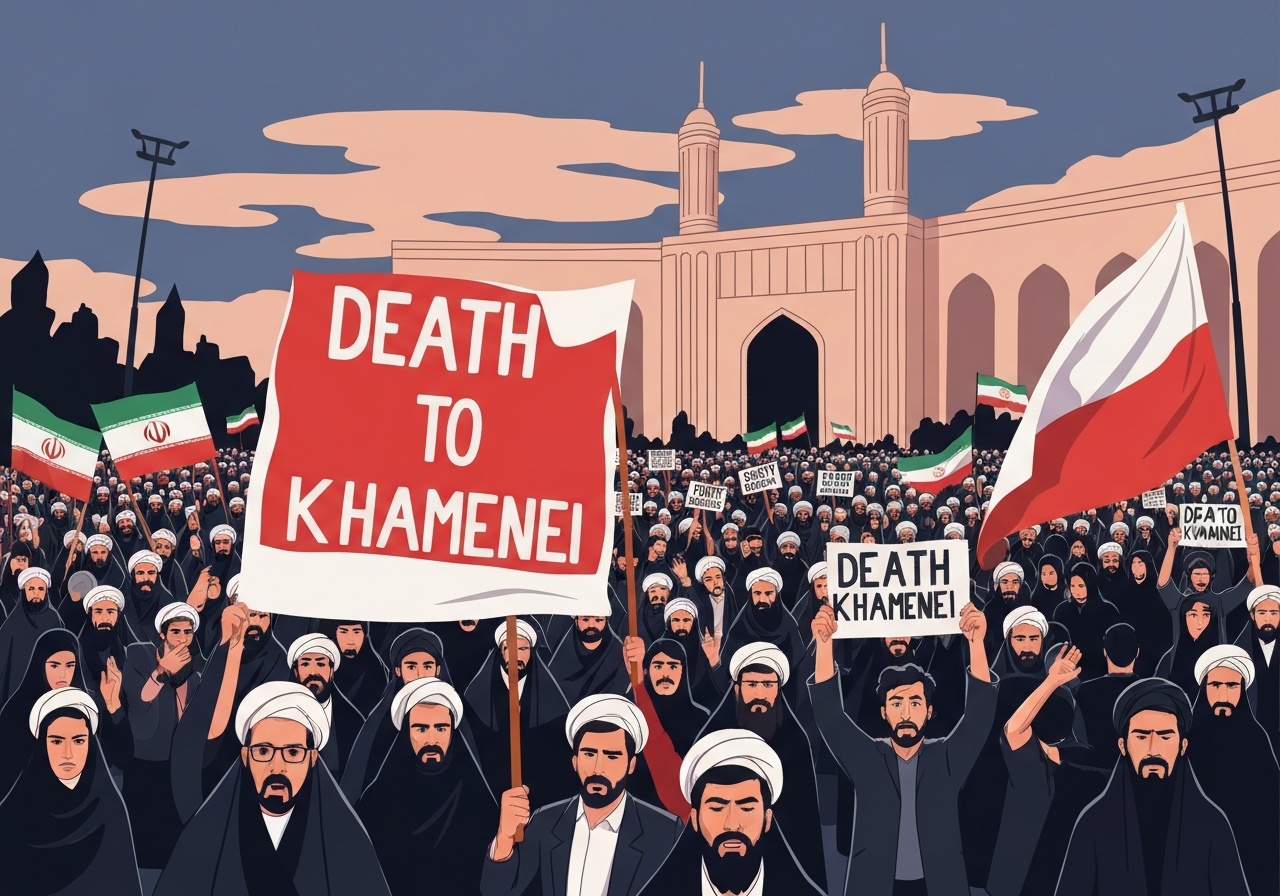
On the eve and day of Iran’s 47th Islamic Revolution anniversary, videos from Tehran captured people shouting “death to Khamenei” and “death to the dictator,” alongside state-led rallies and fireworks. The clips, which BBC teams geolocated to neighbourhoods in west Tehran, contrast with official calls for crowds to chant “Allahu Akbar.” The footage arrived after weeks of nationwide anti-government protests and a severe security crackdown that rights activists say left thousands dead. State media and released recordings show both pro-government displays and visible dissent audible in public and from private balconies.
Key takeaways
- Videos verified by analysts include chants of “death to Khamenei” from multiple locations in west Tehran during the 47th anniversary celebrations on Tuesday night and Wednesday.
- The state encouraged people to shout “Allahu Akbar” during the celebrations, but at least several verified clips instead captured anti-regime slogans and insults.
- BBC teams matched landmarks and road layouts to confirm the geolocation of the footage; fireworks in the background were used as time and place markers.
- Human rights activists cited to international media say at least 6,400 protesters have been killed since December; this figure remains contested and was reported by activists, not by Iranian official tallies.
- The reports come amid a recent internet blackout that restricted independent coverage; some restrictions have since been eased, enabling new video circulation.
- State-affiliated broadcaster Fars News recorded material in which dissenting voices are audible, a rare feature on tightly controlled domestic media.
Background
Iran observes the anniversary of the 1979 Islamic Revolution each year with state-organised ceremonies, flag-waving rallies and televised events that typically emphasise loyalty to the leadership. This year’s observance follows months of mass protests that began late last year, sparked by socio-political grievances and a heavy-handed security response. International human rights groups and activist networks have reported thousands of deaths and widespread arrests during the crackdown; Iranian authorities dispute many of these claims or have offered lower counts.
For weeks, authorities restricted internet access and communications in many areas, curtailing independent reporting and the flow of eyewitness material. When connectivity returned in parts, analysts and media groups began cataloguing video clips and satellite imagery to verify locations and timelines. State media urged displays of religio-political unity — including calls for people to shout “Allahu Akbar” — while some footage showed voices on the ground expressing opposition to the supreme leader instead.
Main event
On Tuesday night and into Wednesday, footage surfaced from multiple neighbourhoods across Tehran showing celebratory fireworks and public gatherings tied to the anniversary. In a number of verified clips taken from streets and residential terraces, participants can be heard chanting anti-regime slogans such as “death to Khamenei” and “death to the dictator.” Analysts used visible landmarks and road patterns to place these videos in the west of the city.
State broadcasters aired staged celebrations and asked crowds to chant religious slogans; in at least one clip released by Fars News, an audible exchange between celebrants revealed dissenting comments being told to “shut up.” The simultaneous presence of pro-regime spectacle and audible opposition underlines a tense, divided public atmosphere during the official events.
Independent correspondents who entered Tehran under restrictions reported that international journalists were allowed to operate with explicit limits on material shared with Persian-language services. BBC reporting from Tehran noted these curbs and said some reporting was permitted only under conditions limiting Persian-language distribution.
Analysis & implications
The chanting of “death to Khamenei” during state celebrations is symbolically significant: it signals that, for some protesters, public dissent has penetrated occasions the state intends to present as unified displays of loyalty. Whether these chants represent isolated, spontaneous acts or a broader shift in public willingness to vocalise opposition remains unclear, but their appearance on video suggests pockets of defiance persist despite repression.
Politically, audible anti-leader slogans during a state-led anniversary may complicate Tehran’s messaging at home and abroad. The government aims to use the anniversary to demonstrate authority and popular support; visible dissent weakens that narrative and could fuel further internal frictions. Internationally, images of mixed crowds, dissenting chants and the government’s prior internet restrictions add to scrutiny of Iran’s human rights record and could inform diplomatic responses.
There are also operational implications: the authorities’ earlier internet blackout hindered timely verification and reporting, and the partial restoration of service has allowed analysts to geolocate and date footage more readily. That increased visibility enhances the capacity of international observers and newsrooms to cross-check claims, but it also raises risks for those filmed if reprisals follow.
Comparison & data
| Item | Date/Detail |
|---|---|
| Anniversary | 47th Islamic Revolution anniversary — events on Tuesday night and Wednesday |
| Protest deaths (reported by activists) | At least 6,400 since December (reported by human rights activists) |
| Internet access | Weeks-long blackout preceding celebrations; partial restoration allowed new video circulation |
These figures provide context for why the anniversary coverage has drawn intense attention. The activist death toll is a contested figure reported by rights groups; official state numbers differ. The table is intended to juxtapose the formal occasion, the scale of reported unrest, and the communications environment that shaped what evidence could be gathered and shared.
Reactions & quotes
Official state outlets emphasised unity and piety during the celebrations, while some public-facing state media broadcasts incidentally captured dissenting voices.
“Allahu Akbar” was repeatedly encouraged by organisers as the official chant for the events.
State media (broadcast excerpt)
Independent and international reporters spotlighted the audible anti-leader slogans and the limits placed on foreign correspondents operating in Iran.
“We are reporting from Tehran under strict conditions; material cannot be used on Persian services,”
International correspondent reporting from Tehran
Human rights campaigners framed the events within the broader protest movement and its reported toll.
“Thousands have been killed since December,”
Human rights activists (reported figure)
Unconfirmed
- Whether the chants captured represent a coordinated campaign across Tehran or isolated, spontaneous incidents remains unverified.
- The exact number of participants who voiced anti-leader slogans at the anniversary events has not been independently confirmed.
- Any link between the anniversary chants and organised opposition groups has not been substantiated by open-source evidence.
Bottom line
The appearance of “death to Khamenei” chants during a state-organised anniversary underscores persistent, visible pockets of dissent despite a sustained government crackdown and communications restrictions. Verified video and landmark-based geolocation show these incidents occurred in west Tehran and were recorded amid official displays of loyalty and firework celebrations.
Going forward, the balance between state-managed ceremonies and public expressions of opposition will be a key indicator of Iran’s domestic stability. Analysts and journalists will continue to rely on geolocation, open-source verification and independent reporting to assess whether such chants remain isolated or signal a broader, more sustained shift in public behaviour.
Sources
- BBC Live reporting — media coverage and verified clips (news media)
- BBC report from Tehran — on reporting restrictions and anniversary coverage (news media)
- Institute for Science and International Security (ISIS) — satellite analysis referenced for related nuclear-site imagery (think tank)
- Fars News — state-affiliated broadcaster footage referenced in verification (state-affiliated media)