
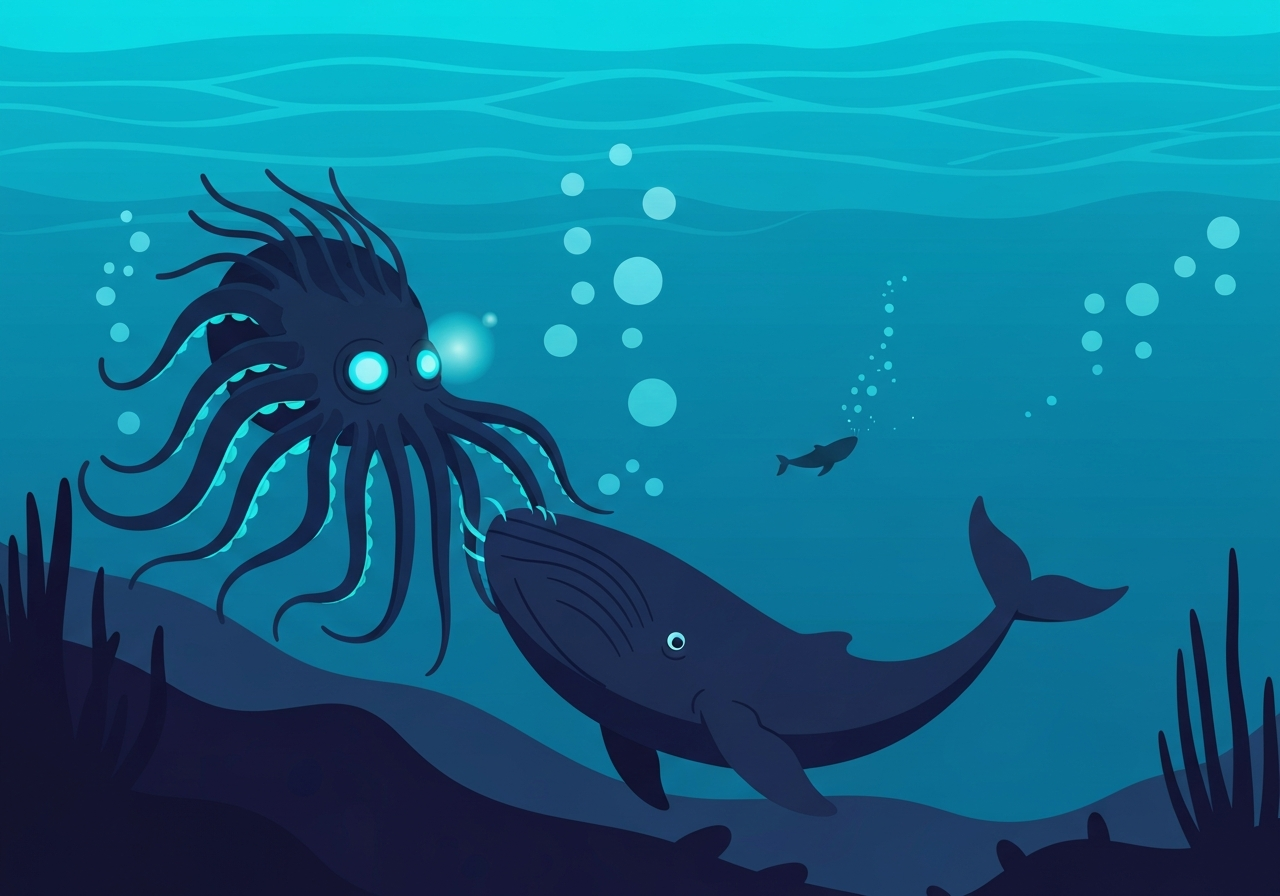
In the pitch black of the deep ocean, specialized scavengers and worms turn whale carcasses into ephemeral oases. Rattail fish — blue‑eyed, whiskered predators that can reach about 1 metre and live as deep as 4,000 metres — detect faint bioluminescence, chemical cues and movement to feed on carrion and smaller prey. After larger scavengers strip soft tissue, dense aggregations of Osedax polychaete worms bore into bone, sustain populations for years and release larvae to colonize future whale falls. Together these organisms drive a multi‑stage recycling process that can support entire communities for up to a decade around a single carcass.
Key takeaways
- Rattail fish (grenadiers) can reach roughly 1 metre (3.2 ft) in length and are recorded down to 4,000 m (13,100 ft), using vision, barbels and smell to locate prey and carrion.
- Bioluminescence is the primary visual cue in these depths; rattails’ large blue eyes detect even faint flashes from other organisms.
- Osedax worms (bone‑eating polychaetes), including Osedax mucofloris first recorded in 2005, colonize whale bones and use acids and bacterial symbionts to extract nutrients.
- Whale‑fall communities progress through stages: mobile scavengers, enrichment‑opportunists (including many amphipods and worms), then bone‑specialists such as Osedax; the bone stage can persist for around a decade.
- Osedax populations complete local lifecycles on a single carcass and release pelagic larvae that disperse on currents to locate new falls.
- These localized hotspots concentrate carbon and nutrients on the seafloor, sustaining unique biodiversity not seen in surrounding abyssal plains.
Background
Discoveries of whole whale carcasses on the deep seafloor transformed scientists’ view of the abyss from a nutrient‑poor desert into a landscape of transient, high‑productivity patches. Whale falls deliver a massive, concentrated pulse of organic matter to otherwise sparsely resourced benthic ecosystems. Researchers have documented recurring ecological stages at falls, each dominated by different taxa and physiological strategies for exploiting the resource.
Deep‑sea research has expanded in recent decades through submersibles, remotely operated vehicles (ROVs) and baited cameras, but the abyss remains difficult and costly to study. That means many specialized species — including some described only from whale falls — were unknown until opportunistic sampling or targeted deep‑sea missions took place. Stakeholders range from academic marine biologists and conservation groups to policymakers concerned about deep‑sea mining and fisheries that could disturb these communities.
Main event
When a whale carcass descends to the seafloor, large scavengers such as hagfish, sleeper sharks and amphipod swarms often arrive first and remove most soft tissue. Once exposed, the skeleton becomes a substrate and nutrient source for a succession of smaller organisms. Researchers record a phase in which enrichment‑opportunist species proliferate in the enriched sediment and surrounding water column.
At a later stage, bone specialists arrive. Osedax worms bore into bone using acidic secretions and host symbiotic bacteria in root‑like tissues that help metabolize bone lipids and proteins. Some species — Osedax mucofloris among them — were first observed on whale bones in the early 21st century and display specialized morphologies, including feathery plumes that extract oxygen from surrounding water.
Rattail fish operate both as predators of smaller benthic fauna and as opportunistic scavengers on carrion. Their sensory toolkit — large photoreceptive eyes tuned to bioluminescence, chin barbels that detect substrate movement, and a keen olfactory sense — allows them to find food over large, dark expanses. After the bone specialists exhaust the available resources, Osedax release larvae that drift with currents; the local population then dies out until another fall arrives.
Analysis & implications
Whale falls illustrate how episodic, high‑density inputs can structure deep‑sea biodiversity and sustain specialized lineages. By concentrating carbon and nutrients in a single spot, falls create microhabitats that support organisms otherwise rare or absent on the surrounding abyssal plain. Understanding these processes refines carbon‑cycle models for the deep ocean and highlights previously underappreciated pathways for benthic energy transfer.
The specialized adaptations of Osedax and other bone users — bacterial symbioses, acid secretion and larval dispersal strategies — raise questions about the evolutionary pressures unique to patchy, ephemeral resources. Such traits may parallel adaptations seen at hydrothermal vents and cold seeps, where chemosynthesis supports dense, endemic communities. Comparative work could reveal convergent solutions to life in isolated, high‑resource islands on the seafloor.
There are also conservation and policy implications. Deep‑sea mining, trawling and other human activities could remove or disturb whale‑fall habitats or the broader species pools they depend on. Because some taxa appear to be known only from whale falls, disturbance risks losing unique biodiversity before it is documented. Better mapping of fall distribution, larval connectivity and species ranges would help assess vulnerability and guide protective measures.
Comparison & data
| Organism | Max recorded size | Typical depth | Role at whale fall | Notable date |
|---|---|---|---|---|
| Rattail (grenadier) | ~1 m (3.2 ft) | to 4,000 m (13,100 ft) | Predator/scavenger, locates carrion via bioluminescence, barbels, smell | — |
| Osedax (bone‑eating worm) | small plumed females; males microscopic | deep benthos (observed on whale bones) | Bore into bone, host bacterial symbionts, consume lipids/proteins | Osedax mucofloris reported 2005 |
| Community lifespan | — | — | Bone stage can persist ~10 years | Observed in longitudinal studies |
The table summarizes published observations: rattails are large, deep‑dwelling fish that use multiple senses to exploit patchy resources, while Osedax represent a convergent specialization for extracting nutrients directly from bone. Longitudinal benthic studies and repeat ROV visits have provided the timelines used here, but many falls remain unobserved and durations vary by carcass size and local conditions.
Reactions & quotes
Scientists who study whale‑fall communities emphasize both the strangeness and the scientific value of these systems. Their comments underline how each fall can yield surprises about adaptation and connectivity in the deep sea.
“Osedax — the ‘bone‑eating worms’ — arrive in large numbers,”
Dr. Karen Rouse, marine biologist (commenting on enrichment‑opportunist stage)
Researchers also highlight the unusual anatomy and behavior of certain species that seem to defy expectations about what the deep ocean can support.
“It’s like they’re putting their gut inside the bone and absorbing it directly — quite strange,”
Adrian Glover, deep‑sea researcher
Unconfirmed
- Exact global frequency of whale falls is uncertain; estimates vary and many falls go unobserved.
- Details of long‑range larval survival and settlement rates for Osedax across ocean basins remain incompletely resolved.
- The full taxonomic diversity of organisms restricted to whale falls is likely underestimated due to limited sampling.
Bottom line
Whale falls create isolated, resource‑rich islands on the abyssal seafloor that sustain specialized communities, from large scavengers to bone‑boring worms like Osedax. These systems demonstrate complex ecological succession and evolutionary innovation in extreme, patchy environments.
Because many deep‑sea habitats are still poorly mapped and some species appear tied to transient resources, continued targeted exploration, long‑term monitoring and precautionary management are needed to protect unique deep‑sea biodiversity as human activities expand into the deep ocean.
Sources
- BBC Future — Media (news feature summarizing primary research and interviews)