
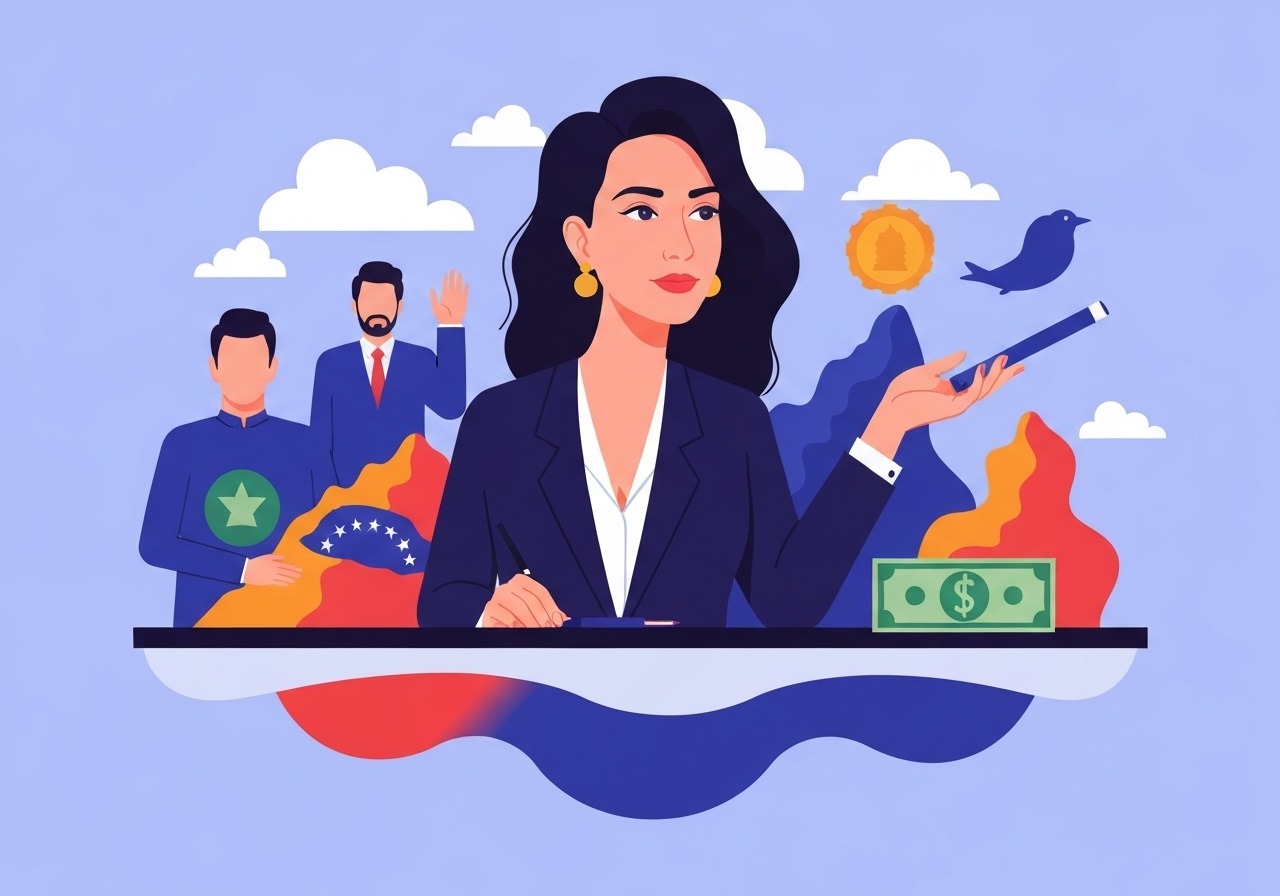
Lead: On Jan. 10, 2026, after U.S. forces captured President Nicolás Maduro and his wife, Cilia Flores, Delcy Rodríguez — a longtime chavista official — emerged as Venezuela’s interim leader with explicit backing from President Donald Trump. Rodríguez, who served as foreign minister during the 2014 protests and later as vice president, has shifted from confrontational diplomacy to a pragmatic role managing economic recovery. Her ascent follows years of sanctions, political stalemate and erosion of state institutions, and it places her at the center of an unprecedented U.S.-led transition strategy. The outcome of her stewardship will shape Venezuela’s short-term stability and the durability of Washington’s interventionist approach.
- Positions: Delcy Rodríguez served as foreign minister in 2014, later as vice president, and was named interim leader following the Jan. 2026 extraction of Nicolás Maduro and Cilia Flores.
- U.S. role: The transition to Rodríguez’s interim leadership occurred with President Trump’s assent after U.S. forces detained Maduro for transfer to New York for trial.
- 2014 unrest: Protests in 2014 left dozens dead amid clashes with paramilitary groups and security forces; Rodríguez publicly defended the government’s actions at the time.
- Diplomatic posture: Rodríguez’s 2014 tactics included blunt confrontations with envoys from the United States and the European Union, a style observers say accelerated international backlash and sanctions under President Barack Obama.
- Economic pivot: Since rising through the ranks, Rodríguez has been portrayed by some allies as a pragmatic manager seeking to revive Venezuela’s devastated economy, a role Washington now sees as useful for post-Maduro governance.
- Regional stakes: Her leadership raises immediate questions about military loyalties, domestic opposition response, and reactions from regional governments historically aligned with Maduro’s administration.
Background
Venezuela’s political crisis has deep roots in the collapse of public finances, hyperinflation and pervasive shortages that accelerated after 2013. Decades of polarized politics, power concentrated in the presidency, and heavy military involvement in state institutions created a fragile balance that unraveled during repeated waves of mass protest. In 2014, large street demonstrations met a forceful response from security services and pro-government paramilitary cells; human-rights monitors documented numerous fatalities and alleged abuses during that period.
Delcy Rodríguez emerged from that environment as a prominent chavista loyalist. Reported in contemporary coverage as the daughter of a guerrilla figure, she gained visibility through combative diplomacy and firm public defenses of government actions. Her style resonated within a ruling coalition dominated by military officers and ideological hard-liners, helping secure increasingly senior portfolios. Over time, Rodríguez was recast by some within the regime as a figure capable of navigating both nationalist rhetoric and the technical demands of economic reconstruction.
Main Event
The turning point came in early January 2026, when U.S. forces detained Nicolás Maduro and Cilia Flores and moved them to face charges in New York. With Maduro removed, Washington signaled support for an interim executive, and Delcy Rodríguez — by then a senior figure with experience in foreign policy and the executive branch — assumed leadership. U.S. officials framed the move as part of a legal and political effort to end decades of kleptocratic governance and to create space for economic stabilization.
Rodríguez’s record during the 2014 crackdown is illustrative of her methods. According to witnesses at a closed-door meeting that year, she directly challenged foreign envoys over responsibility for the deaths and defended the administration’s characterization of those events. Observers say that combative episode helped precipitate sanctions from the Obama administration, a punitive approach that hardened Caracas’s international isolation.
In the months before the 2026 transition, Rodríguez publicly signaled a shift in emphasis from confrontation to governance, emphasizing measures to stabilize markets and restore basic services. Supporters argue she can engage both domestic technocrats and international partners to restart trade and investment flows. Critics, however, warn that her past record and close ties to the chavista apparatus could limit genuine reform or reconciliation.
Analysis & Implications
Rodríguez’s elevation under U.S. auspices reframes the debate over foreign intervention and national sovereignty in Latin America. For Washington, installing an experienced chavista who is willing to work with U.S. authorities may appear to be a pragmatic shortcut to restoring order and opening the economy. But the approach risks deepening nationalist backlash among segments of the armed forces and the population who view external meddling as illegitimate.
Economically, Rodríguez faces immediate, high-stakes tasks: stabilize the currency, unblock humanitarian and commercial channels, and persuade creditors and investors that a transition is durable. Success could yield a rapid rebound in essential imports and energy-sector activity; failure could ferment renewed unrest and complicate U.S. legal efforts tied to the Maduro prosecution.
Regionally, governments in Latin America will test their responses. Allies of Maduro may denounce the U.S. role and seek to rally blocs in defense of noninterference, while others may quietly re-engage if tangible stabilization efforts reduce refugee flows and commodity market disruptions. The precedent of a foreign power facilitating a leadership change will be watched closely across the hemisphere.
Comparison & Data
| Year/event | Key fact |
|---|---|
| 2014 | Large protests; dozens killed; Rodríguez served as foreign minister during intense diplomacy |
| 2014–2025 | Sanctions and international isolation under successive U.S. administrations |
| Jan. 2026 | U.S. forces detained Nicolás Maduro and Cilia Flores; Rodríguez named interim leader |
The table above underscores how Rodríguez’s trajectory crosses two eras: the hardline responses and diplomatic clashes of the mid-2010s, and the U.S.-backed transition dynamics of 2026. Contextualizing events across this span helps explain why Washington and regional capitals view her differently — either as a continuation of chavismo or as a pragmatic broker for stabilization.
Reactions & Quotes
Eyewitness accounts and public statements capture the polarized reception to Rodríguez’s style and rise. At a 2014 closed-door meeting, an observer recalled her rebuke of foreign envoys as emblematic of a confrontational phase in Caracas diplomacy.
“Those killed were terrorists, not protesters.”
Delcy Rodríguez, 2014 (reported statement)
“This is not the way a foreign minister acts.”
Imdat Oner, former diplomat (witness to 2014 meeting)
In response to the Jan. 2026 detentions, regional leaders issued a mix of condemnation, guarded endorsement and calls for legal process; international human-rights groups stressed the need for transparency and adherence to due process. Analysts have highlighted that short-term stability under Rodríguez will depend on securing the loyalty of key military commanders and reopening pragmatic channels with international financial actors.
Unconfirmed
- Precise details of the U.S. operation that detained Nicolás Maduro and Cilia Flores remain classified and have not been independently verified.
- The degree to which senior Venezuelan military leaders consented to or resisted the transition is still being investigated and reported in real time.
- The internal negotiating positions between Rodríguez and various opposition factions over a political roadmap have not been publicly disclosed in full.
Bottom Line
Delcy Rodríguez’s rise to interim leadership marks a consequential pivot in Venezuela’s fraught political history: a longtime chavista with a record of confrontation is now positioned as the agent for stabilization under U.S. auspices. Her success will hinge on balancing demands for accountability with pragmatic measures to restore basic services and revive economic activity. Observers should watch military loyalties, the pace of economic normalization, and whether independent institutions can operate without political interference.
For Washington and regional partners, the immediate test is whether Rodríguez can translate international access into tangible improvements that reduce humanitarian distress and shrink irregular migration. If she fails to deliver or if perceptions of externally imposed governance persist, political volatility is likely to return, complicating both domestic reconciliation and international legal efforts tied to the Maduro prosecution.
Sources
- The New York Times — U.S. newspaper, investigative reporting and contemporaneous coverage of events (primary source for this analysis).