
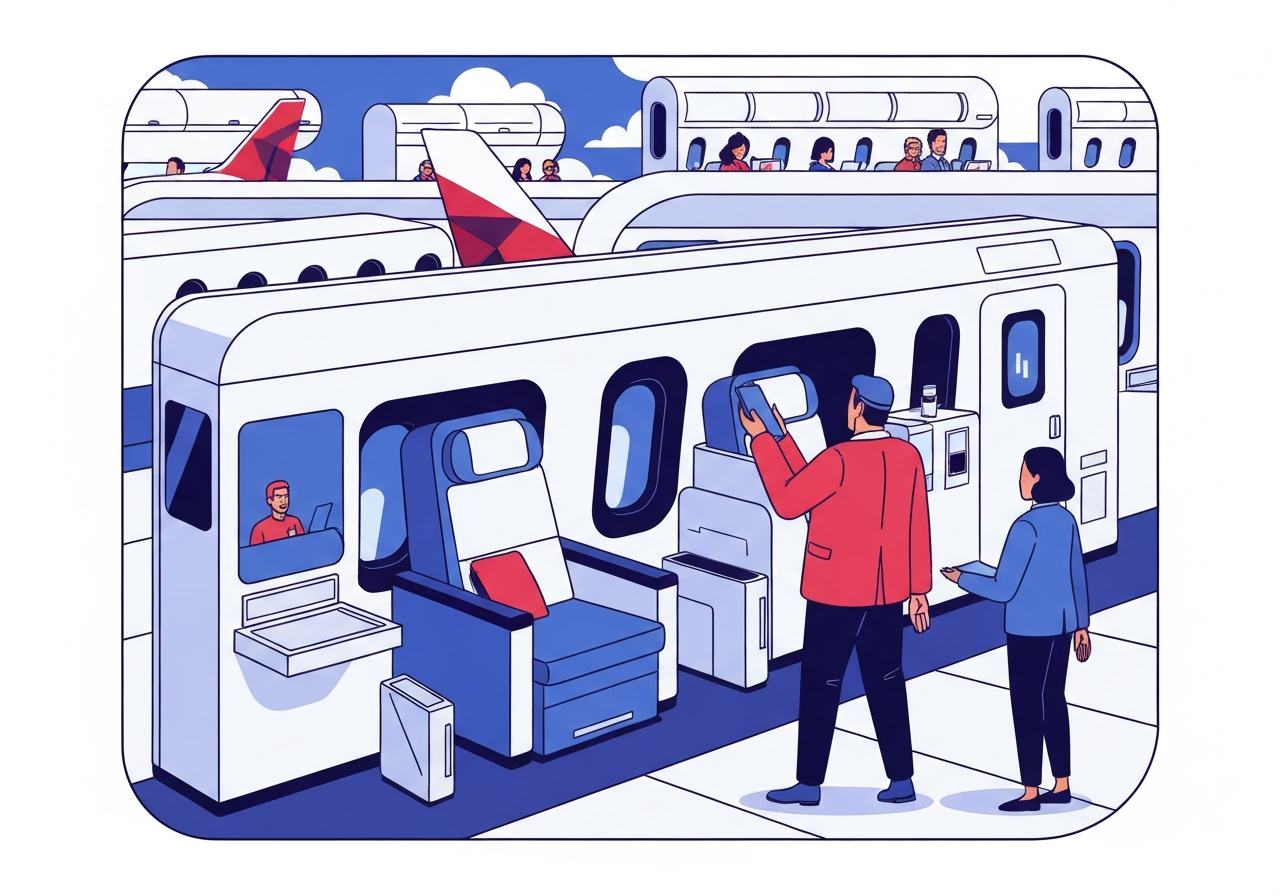
Delta Air Lines on Monday, April 13, 2026, unveiled an updated Delta One suite set to appear on its Airbus A350-1000 long-haul fleet beginning in 2027. The announcement marks the first top-tier cabin refresh in roughly a decade and is framed as part of a broader industry push to capture higher-yield travelers. Delta said the new suites will offer beds three inches longer and a new pillow-top cushion, with cabin layouts designed to increase leg and knee room. The move comes as premium-ticket revenue and competitive pressure from rivals reshape aircraft interiors and airline revenue mixes.
Key takeaways
- Delta’s new Delta One suite will debut on A350-1000 aircraft in 2027 and is the carrier’s first major Delta One update in about ten years.
- The redesign adds beds that are three inches longer and introduces a pillow-top cushion intended to increase sleeping comfort.
- Each A350-1000 will be fitted with 50 of the new suites, Delta says, targeting the carrier’s longest-haul routes.
- Delta reported premium ticket revenue (first class and other premium fare categories) rose 14% in Q1 year-over-year.
- Delta emphasized passenger testing at its headquarters, saying customers tried the new suites for “hours” during product evaluation.
- The carrier noted it was an early mover on enclosed suites, first installing doors on A350 Delta One seats in 2017.
Background
Premium cabin products have become a central battleground for full-service carriers looking to protect margins while leisure travel recovers. Long-haul business and first-class fares generate outsized revenue per seat, and carriers have responded by redesigning cabins to fit more high-yield seats and differentiated suites. Delta introduced the original Delta One arrangement with enclosed doors on some A350s in 2017 and has kept that configuration as a flagship product for flagship international routes.
Since late 2024, airlines have shown a renewed emphasis on premium offerings amid shifting demand and higher operating costs such as jet fuel. Delta’s recent results—showing a 14% rise in premium ticket revenue in Q1 year-over-year and the first increase in main-cabin revenue since late 2024—reflect that premium demand is a critical revenue lever. Rivals including United and American have likewise refreshed long-haul cabins, signaling an industry-wide arms race for affluent and business travelers. The competition is not just about comfort: carriers view premium cabins as a way to improve yields, loyalty, and ancillary revenue streams.
Main event
Delta’s announcement centers on a next-generation Delta One suite for its A350-1000 fleet, which the airline says will enter service in 2027. The new seats extend bed length by three inches compared with the outgoing suite and add a pillow-top cushion, design choices Delta frames as responses to customer sleep preferences. Mauricio Parise, Delta’s vice president of brand experience, stressed that most customers are side sleepers and that the new geometry aims to accommodate that sleeping posture.
Delta also highlighted user testing: company representatives said travelers spent hours trying the suites at Delta’s headquarters as part of iterative design refinements. In addition to comfort upgrades, the A350-1000s will be configured with 50 suites apiece, a layout intended for long-haul routes where premium demand is strongest. Delta emphasized continuity with past innovations, noting the carrier was a “first mover” on doors when it introduced enclosed Delta One seats on the A350 in 2017.
The unveiling arrives amid a wave of product rollouts by competitors. United recently displayed its next-generation Polaris suite at a Los Angeles hangar event, while other carriers are experimenting with mixed layouts that expand premium offerings in both widebody and select narrow-body aircraft. Delta framed the refresh as an incremental but material improvement to its premium proposition rather than a wholesale redesign that would change pricing strategy immediately.
Analysis & implications
From a revenue-management perspective, the timing of Delta’s refresh makes strategic sense. Premium cabins deliver higher yields, and Delta’s Q1 results—14% growth in premium ticket revenue—underscore how valuable these seats have become. By increasing bed length and perceived privacy, Delta is sharpening the product differentiation that can justify higher fares on transoceanic and other long-haul flights.
The move also reflects product convergence across legacy carriers: enclosed suites, lie-flat beds and enhanced bedding have become baseline expectations on many long-haul routes. That raises the stakes for carriers that lag behind on cabin product, and it compresses the window for carriers to command a true product premium based solely on hardware. Delta’s incremental upgrades may therefore be as much about retention and brand signaling as about chasing new customers.
Operationally, adding and standardizing a 50-suite configuration on A350-1000s affects seat-mile economics and route deployment decisions. Carriers must balance fewer total seats against higher fare classes; success depends on sustained demand from corporations and well-heeled leisure travelers. External variables—fuel prices, corporate travel policies, and broader economic health—will influence whether investments in premium cabins translate into durable margin gains.
Comparison & data
| Feature | Previous Delta One (A350 era) | Next-generation Delta One (2027 A350-1000) |
|---|---|---|
| Bed length | Baseline long-haul lie-flat bed (original A350 spec) | Three inches longer than previous design (Delta statement) |
| Bedding | Standard mattress/padding | New pillow-top cushion added |
| Privacy | Enclosed suites with doors (introduced 2017) | Continues enclosed suite approach |
| Suites per A350-1000 | Varied by configuration | 50 suites per A350-1000 (Delta announcement) |
| Revenue signal | Delta premium revenue baseline | Premium ticket revenue +14% in Q1 YoY (company report) |
The table aggregates only confirmed, company-stated changes and recent revenue figures; it does not attempt to compare undisclosed seat dimensions or comfort metrics. The three-inch bed increase is the clearest numeric change announced; other comfort gains such as the pillow-top are qualitative but intended to improve passenger experience and perceived value.
Reactions & quotes
“Most customers are side sleepers,”
Mauricio Parise, Delta VP of Brand Experience
Delta used that observation to justify altering bed geometry and cushion design to better fit passenger sleep positions, a change Parise said came from observed user behavior during testing.
“There is an element of improvement,”
Mauricio Parise, Delta VP of Brand Experience
Parise framed the refresh as an evolutionary step: Delta intends to refine rather than replace the Delta One identity that it introduced on the A350 in 2017.
“Customers tested the new suites for ‘hours’ at our headquarters,”
Delta (company statement)
Delta highlighted hands-on passenger testing as part of its design process, indicating the carrier used real-world feedback to guide adjustments rather than relying on purely internal design assumptions.
Unconfirmed
- The full fleet rollout beyond the announced A350-1000s (which are set for 2027) has not been specified by Delta and remains unconfirmed.
- Exact final bed width and other dimensional specifications beyond the stated “three inches longer” figure have not been published by the airline.
- How ticket pricing for the new suites will compare to current Delta One fares on specific routes has not been disclosed and will depend on yield management decisions.
Bottom line
Delta’s announced Delta One refresh is a targeted upgrade aimed at maintaining competitiveness in an era when premium product differentiation drives margin. By stretching bed length, adding a pillow-top cushion and preserving enclosed suites, Delta is signaling that incremental comfort and perceived privacy remain priority levers for capturing higher-yield passengers on long-haul flights.
Investors and frequent long-haul travelers should watch the operational rollout and pricing strategy: the business case depends on sustained demand for premium seats and the carrier’s ability to command fare premiums without depressing overall load factors. Meanwhile, rival rollouts from carriers such as United mean passengers will see upgraded options across the market, making product consistency and loyalty benefits increasingly important differentiators.
Sources
- CNBC — News report summarizing Delta’s announcement and industry context.
- Delta Newsroom — Official airline communications and press releases (official source for product details and company comments).
- United Airlines Hub — Official carrier communications and product reveal summaries (official/industry reference).