
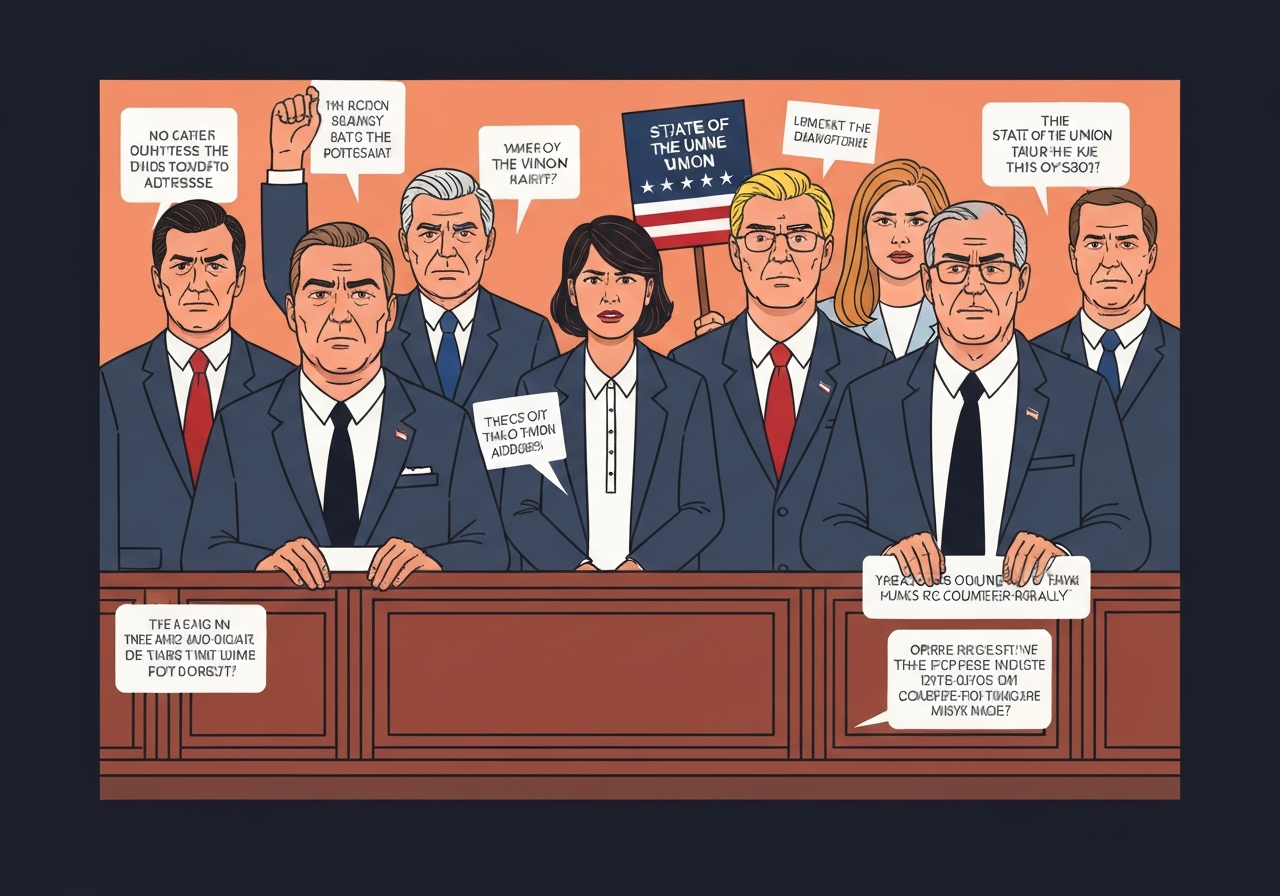
Lead: On Feb. 18, 2026, a sizable group of House and Senate Democrats planned to skip President Trump’s first State of the Union of his second term and instead attend a competing event on the National Mall called the “People’s State of the Union.” The rally, coordinated by MoveOn and MeidasTouch and hosted by Joy Reid and Katie Phang, is intended to center the stories of people affected by the administration’s economic, health and immigration policies. Party leaders remain divided: Minority Leader Hakeem Jeffries urged members to either sit silently or boycott rather than create disruptions in the House chamber. It is unclear how many lawmakers ultimately will be absent from the speech.
Key Takeaways
- Planned boycott date and setting: Feb. 18, 2026 — many Democrats said they would attend an alternative rally on the National Mall instead of the State of the Union.
- Organizers and hosts: The competing event is coordinated by MoveOn Civic Action and MeidasTouch, and will be hosted by Joy Reid and Katie Phang.
- Notable participants: Senators Christopher S. Murphy and Chris Van Hollen and several House Democrats — including Becca Balint, Greg Casar, Pramila Jayapal and Delia Ramirez — are slated to speak at or attend the rally.
- Leadership posture: Minority Leader Hakeem Jeffries encouraged either silent attendance or boycott; he stated his “present intention” to attend the address in the House chamber.
- Historical context: After disruptive protests and theatrical signs during last year’s joint session — and Representative Al Green’s removal and subsequent censure — Democratic leaders sought a different approach in 2026.
- Planned tactics: Some lawmakers intend to skip the speech entirely; another group plans to walk out mid-address and join the rally to emphasize constituents’ stories.
- Political risk: Party strategists worry that a visible mass absence could leave the president with a largely sympathetic audience and reshape customary institutional norms.
Background
The State of the Union is typically an occasion when opposition members attend the president’s address to the joint session of Congress even while disagreeing with its content. In recent years, however, the ritual has been punctuated by high-profile protests and symbolic gestures that turned headlines toward lawmakers rather than their message. During President Trump’s prior address to a joint session, Representative Al Green was removed from the chamber after a disruptive incident and was later formally censured; other Democrats used small paddles with brief slogans that were widely criticized as incoherent.
Those episodes prompted Democratic leaders to reassess tactics heading into the 2026 address. Party officials sought a more disciplined counter: either a respectful presence in the chamber that avoided theatrics or a collective refusal to lend the speech a veneer of bipartisan legitimacy. The decision to organize a separate event — the People’s State of the Union — reflects a deliberate strategy to shift media attention from presidential rhetoric to the administration’s policy effects on workers, immigrants and families.
Main Event
The People’s State of the Union was announced as an afternoon and early-evening rally on the National Mall, featuring lawmakers and people directly affected by federal policy decisions. MoveOn Civic Action and MeidasTouch have promoted the gathering as a way to foreground personal stories that organizers say will be obscured by the president’s address. Hosts Joy Reid and Katie Phang are slated to moderate portions of the event and introduce speakers who will recount specific harms tied to economic and health-care policies.
Several senators and representatives have said publicly they will not attend the address in the chamber. Senator Christopher S. Murphy (D-Conn.) told reporters he planned to join the rally because, he said, the president would use the speech to mislead the public and that showing up would confer respect the administration does not merit. Senator Chris Van Hollen (D-Md.), who walked out of last year’s speech before it ended, likewise said he would not attend in 2026 and is scheduled to speak at the rival event.
Other Democrats have signaled caution. Minority Leader Hakeem Jeffries recommended to members that they either remain silently in their seats or boycott the speech, warning against actions that would create distractions in the chamber. Jeffries also said he intended to attend the address, framing it as defending the institutional prerogatives of Congress while resisting normalization of the president’s conduct. A contingent of lawmakers has opted for a middle path: they will enter the chamber but walk out once the speech reaches predetermined points, making the walkout itself part of the protest.
Analysis & Implications
The decision to stage a rival event and to encourage boycotts signals a calculated shift by many House and Senate Democrats from symbolic on-floor protest to an off-site, narrative-driven strategy. Organizers hope that elevating personal stories — federal workers laid off, communities affected by health-care rollbacks, immigrants targeted by enforcement actions — will produce a clearer, audience-ready counterpoint to the president’s message than noisy interruptions inside the chamber.
But the move risks reinforcing one of the Republicans’ criticisms: that Democrats are abandoning institutional norms and spectacle is being replaced by absence. A visible, large-scale boycott could leave the president’s address with a disproportionately friendly television audience and hand Republicans a rhetorical opening to argue that Democrats are unwilling to engage in formal governance rituals.
Electoral considerations are also at play. For some members from competitive districts or states, joining a people-centered rally allows them to rehearse campaign messages and show alignment with grassroots groups. For others — particularly party leaders and members from swing regions — attending the speech may be a defensive posture intended to avoid alienating moderate voters who expect institutional decorum.
Comparison & Data
| Year | Incident | Result |
|---|---|---|
| 2025 | On-floor protests; paddles and Representative Al Green removed | Criticism for distraction; Green censured |
| 2026 | Planned boycott and rival “People’s State of the Union” rally | Intended focus on policy victims; uncertain attendance |
The table contrasts last year’s in-chamber protests with the 2026 off-site strategy. While 2025 produced headlines about decorum and punishment, the 2026 plan attempts to convert those headlines into sustained political messaging about the administration’s policies. Absent precise attendance figures for either the chamber or the rally, the comparison centers on tactics rather than measurable scale.
Reactions & Quotes
“He’s made a mockery of the State of the Union speech and he doesn’t deserve an audience.”
Senator Christopher S. Murphy (D-Conn.)
Murphy framed his absence as a moral and political judgment, telling reporters he would not lend the address legitimacy by being present. He emphasized that organizers planned to highlight people harmed by the administration’s policies.
“We cannot normalize this moment when Trump is marching our country toward fascism.”
Senator Chris Van Hollen (D-Md.)
Van Hollen, who walked out of last year’s speech, said he would again decline to attend and would speak at the rival rally. His remarks underscore the deep institutional and rhetorical rifts within the Democratic caucus about how to respond.
“We’re not going to his house, he’s coming to our house.”
Representative Hakeem Jeffries (D-N.Y.)
Jeffries counseled restraint while also asserting a claim of institutional ownership over the House chamber. He described his present intention to attend, even as he permitted members to choose a boycott.
Unconfirmed
- Exact count of Democratic lawmakers who will be absent from the House chamber remains unknown; public lists of attendees and absentees were incomplete as of Feb. 18, 2026.
- How broadcast networks will allocate airtime between the president’s address and the People’s State of the Union is unresolved and may vary by network.
- Whether a mass boycott will materially change public opinion or the president’s messaging effectiveness is uncertain and will depend on turnout, coverage and follow-up messaging.
Bottom Line
The planned boycott and concurrent rally represent a strategic pivot by many Democrats from in-chamber disruption to an off-site, people-centered narrative. Organizers aim to replace what they describe as the president’s rhetorical distortions with firsthand accounts of policy harm; leaders who plan to remain in the chamber argue attendance preserves institutional norms and opportunities for direct oversight.
What matters next is scale and optics: how many lawmakers remain in the chamber, how many attend the rally, and how media outlets balance coverage between the president’s address and the competing event. Those variables will shape whether the tactic becomes a one-off protest or a new precedent in partisan responses to presidential spectacles.
Sources
- The New York Times (live reporting) — national news reporting with on-the-record quotes and event coverage.
- MoveOn Civic Action (advocacy organization) — organizer of the People’s State of the Union rally.
- MeidasTouch (progressive media organization) — co-organizer and promotional partner for the rival event.