
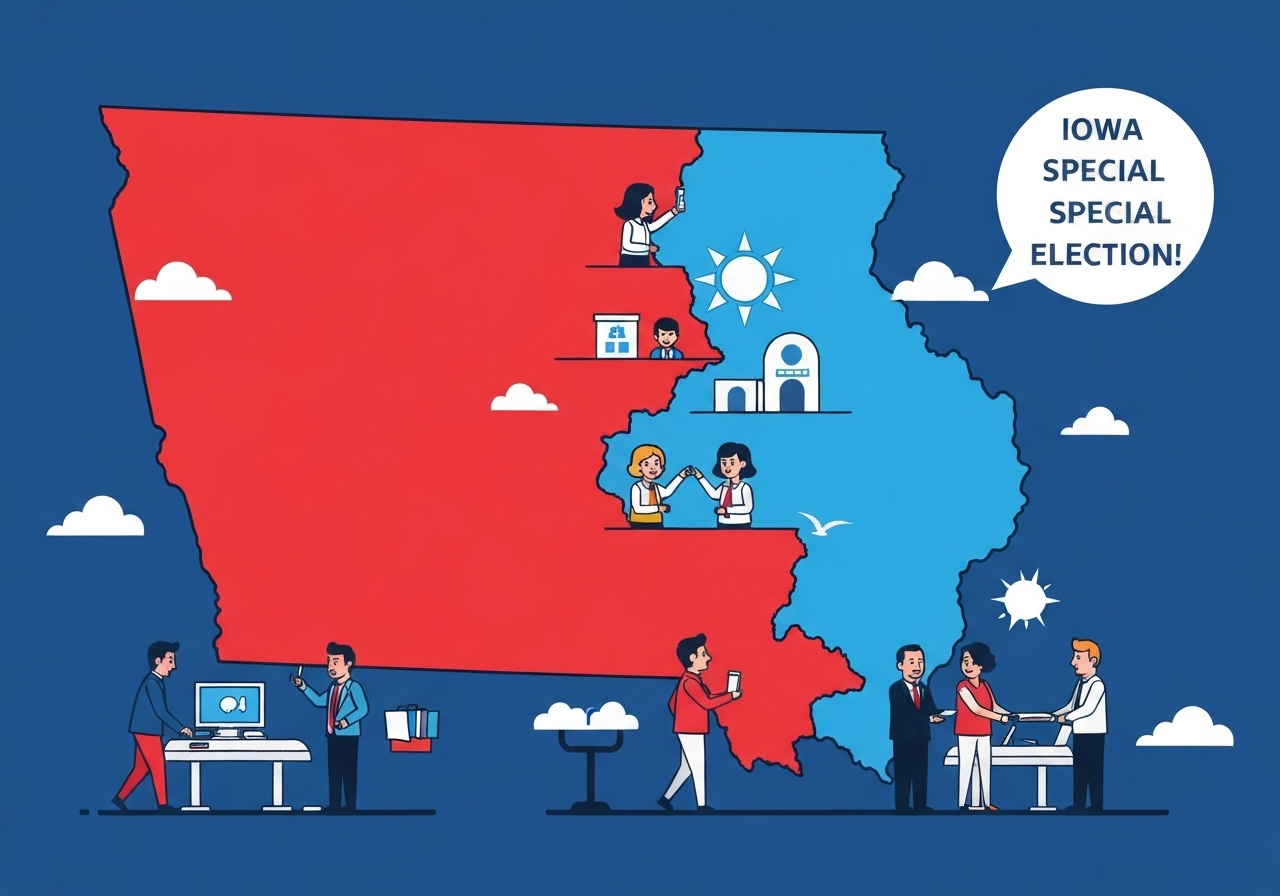
According to a Politico report on Aug. 29, 2025, Democrats made unexpected gains in a reliably Republican area of Iowa, a shift the story attributes to energy and organization sparked by a recent special election.
Key Takeaways
- Politico reported on Aug. 29, 2025, that Democrats improved their standing in a traditionally red Iowa district/area.
- Observers and party operatives link the shift to momentum generated by a nearby special-election victory.
- Turnout patterns—particularly among younger and suburban voters—were cited as a contributing factor in coverage.
- Local organizing and targeted messaging appear to have amplified the special election’s effects.
- Strategists say the result could influence fundraising, candidate recruitment and messaging ahead of future races.
- Republican leaders framed the outcome as a localized development, not a broader realignment.
Verified Facts
The reporting in question appeared on Politico’s website on Aug. 29, 2025, and described a measurable shift in voter behavior in portions of Iowa that normally favor Republican candidates. The article connects that shift to the momentum and attention generated by a recent special election in the state.
Coverage notes that campaign activity increased after the special election, including expanded field operations and outreach to suburban precincts. That intensified ground game is presented as one mechanism that helped narrow margins in contested areas.
Journalists and local officials cited in the report pointed to changes in turnout composition—specifically, higher participation among younger voters and some suburban blocs—as a contributing factor. Where available, the original story references local vote totals and margins; readers should consult the source for precise figures.
The piece contrasted Democratic optimism with Republican caution: party officials on both sides described the result differently, with Democrats emphasizing momentum and Republicans characterizing it as a localized anomaly rather than a durable shift.
Context & Impact
Special elections often attract outsized attention because they can serve as a rehearsal for broader campaigns. When a party converts a special-election win into sustained organizing, it can translate into improved performance in subsequent races by sharpening voter contact lists and volunteer networks.
For Democrats in a predominantly Republican state, a string of stronger-than-expected showings can help with fundraising, candidate recruitment and narrative-building—especially in suburban districts where margins tend to be slimmer.
Conversely, Republicans typically respond to such developments by refocusing resources, adjusting messaging, or highlighting local factors that limit the result’s broader applicability. How each party adapts will shape whether the outcome remains an isolated bump or signals a longer trend.
Official Statements
According to the report, state Democratic officials described the result as encouraging and said it validated intensified local organizing, while Republican leaders urged a cautious interpretation.
Politico (Aug. 29, 2025)
Unconfirmed
- Any specific seat flips, vote margins or exact turnout percentages referenced in headlines or social posts are not reproduced here and should be verified against the original reporting and official election returns.
- Attribution of long-term political consequences remains speculative until additional races and data confirm a pattern.
Bottom Line
Politico’s reporting frames the event as an example of how a special-election victory can catalyze broader Democratic organizing and competitive performance in parts of Iowa that usually lean Republican. The immediate effect is increased attention and resources; whether that leads to sustained partisan change will depend on follow-up organizing, turnout dynamics, and how both parties respond over the coming months.