
Lead
Researchers have linked a well‑preserved skull found near Harbin, China, to Denisovans, an archaic human group known mostly from DNA fragments. The Harbin specimen, roughly 146,000 years old, yielded 95 ancient proteins and mitochondrial DNA that match Denisovan signatures, resolving debate about its identity. The result connects a large cranium — nicknamed “Dragon Man” — to a broader Denisovan presence across Asia between about 217,000 and 106,000 years ago. This combination of proteomics and recovered DNA offers the first secure cranium-level view of Denisovan anatomy.
Key Takeaways
- The Harbin skull is dated at about 146,000 years old and produced 95 ancient proteins, three of which carry Denisovan-specific variants.
- Mitochondrial DNA recovered from tooth tartar helped confirm the specimen as Denisovan, despite the loss of dense ear bones decades earlier.
- The find ties a large cranium with thick brow ridges and a roomy braincase to Denisovan diversity rather than a new species called Homo longi.
- Denisovans occupied northeastern Asia in a pulse between roughly 217,000 and 106,000 years ago, overlapping with Neanderthals and early Homo sapiens.
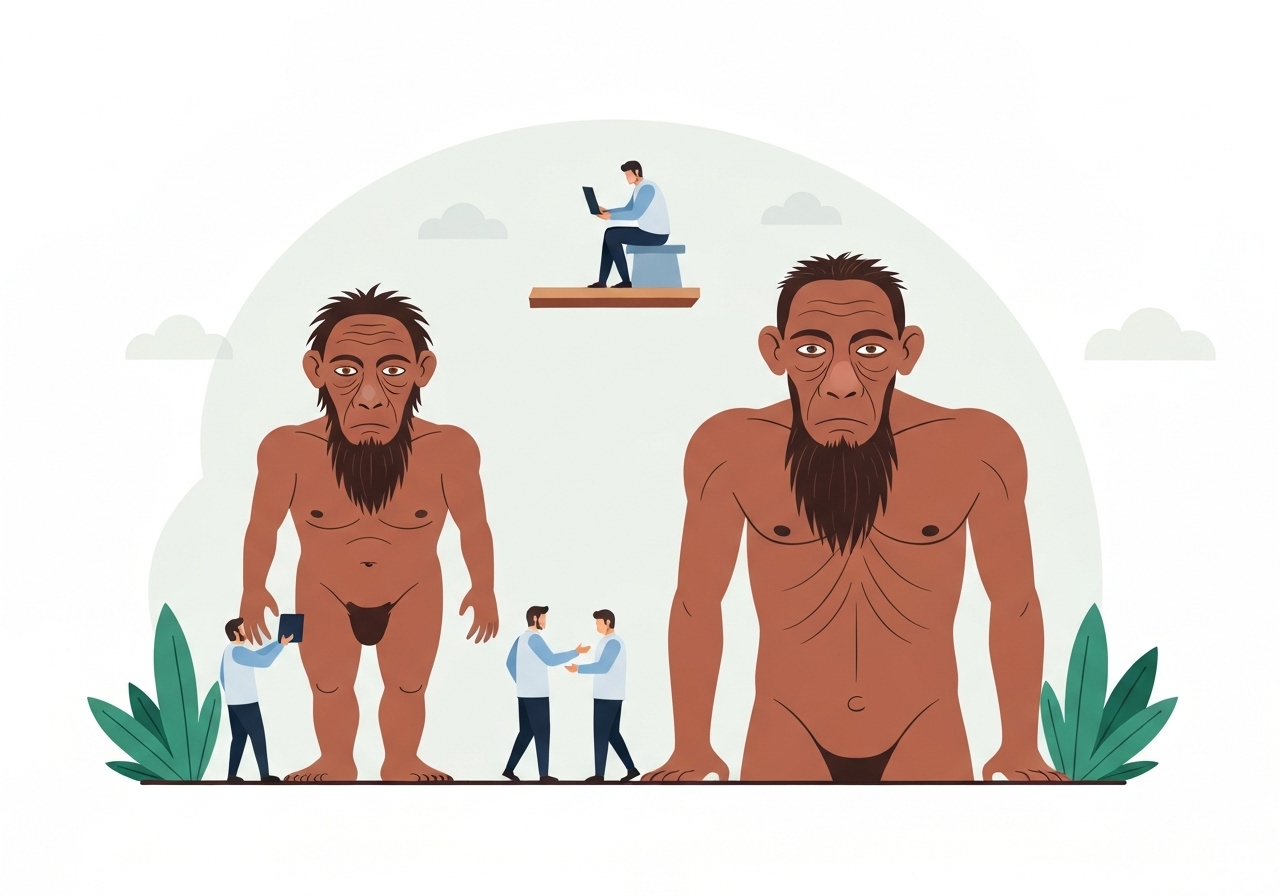
- Paleoanthropologists estimate a lean body mass near 220 pounds for Dragon Man, implying high caloric needs potentially above 4,000 kcal/day.
- Modern humans retain Denisovan DNA: Papuan and some Melanesian populations have about 4–6% Denisovan ancestry; Tibetan highlanders carry an EPAS1 variant linked to high-altitude adaptation.
- Proteomics and dental calculus are emerging as reliable tools when nuclear DNA is absent or degraded, expanding the pool of analyzable museum specimens.
Background
Denisovans were first recognized in 2010 from a finger bone recovered in Denisova Cave, Siberia, where genomic analysis revealed an archaic human lineage distinct from Neanderthals and modern humans. For roughly fifteen years Denisovans remained largely hypothetical in appearance because most finds were fragmentary: isolated teeth, a jaw from the Tibetan Plateau, and microscopic bone fragments. That genomic footprint, however, hinted at a geographically widespread but fossil-poor group whose genetic legacy persists in some contemporary populations.
Ancient DNA is an invaluable source of evolutionary information but degrades rapidly, especially under heat and moisture. As a result, many well-preserved skeletons lack retrievable nuclear DNA. Proteins and dental calculus are more resilient: proteins can survive far longer than DNA and dental tartar can entomb cells and microbial DNA in a mineral matrix. Those methods motivated teams to re-examine older collections and museum teeth with modern clean-room techniques.
Main Event
The Harbin cranium, commonly called “Dragon Man,” was recovered in northeastern China and is roughly 146,000 years old. The specimen displays pronounced brow ridges, a large cranial vault roughly comparable in volume to modern humans, and facial features intermediate between Neanderthal robusticity and modern gracility. Initial claims in 2021 proposed a separate species, Homo longi; the new molecular evidence challenges that interpretation by placing the skull within known Denisovan variation.
Qiaomei Fu and colleagues at Beijing’s Institute of Vertebrate Paleontology and Paleoanthropology led a molecular reanalysis. Because the dense petrous bone had been removed from the museum specimen decades earlier, the team targeted dental calculus and recovered enough mitochondrial reads to assemble a complete mitochondrial genome. Parallel proteomic analysis extracted 95 ancient proteins, and three protein variants matched those previously identified as Denisovan.
The combined molecular lines — mitochondrial genome and protein fingerprints — converge on a Denisovan attribution. That cross-validation is critical: mitochondrial DNA alone can be misleading due to its maternal inheritance, while proteomics provides independent amino-acid level markers. Together they reduce the likelihood that Harbin represents an unrelated archaic lineage and instead integrate the cranium into Denisovan diversity.
Analysis & Implications
Linking a large cranium to Denisovans reshapes geographic and morphological models for Middle Pleistocene Asia. Previously, Denisovan evidence came mostly from isolated dental and tiny bone fragments; a full cranium provides data on brain size, facial architecture, and potential muscle attachments that inform hypotheses about diet, locomotion, and social behavior. If the Harbin morphology is typical for some Denisovan groups, several Chinese fossils with mixed archaic and modern traits may warrant re-evaluation as regional Denisovan representatives.
The body-size inference — a lean mass near 220 pounds — implies elevated daily energy requirements and supports isotope-based suggestions of substantial meat consumption in at least some Denisovan populations. High caloric demands would influence territory size, seasonal movement, and resource competition, which in turn affect interaction rates with neighboring hominins such as Neanderthals and Homo sapiens. That behavioral ecology helps explain why Denisovan DNA is scattered across Asia despite a sparse fossil record.
Genomic traces in modern humans show that introgression from Denisovans was not a single event. Distinct Denisovan admixture episodes left different genetic contributions in Papuan, Melanesian, and some East Asian lineages, and adaptive alleles like EPAS1 in Tibetans illustrate functional consequences. As more morphological and molecular Denisovan data accumulate, researchers can refine models of when and where contacts occurred and assess which Denisovan traits were inherited by modern populations.
Comparison & Data
| Specimen | Approx. age (kya) | Evidence | Key finding |
|---|---|---|---|
| Harbin skull (Dragon Man) | 146 | Proteomics (95 proteins), mtDNA from dental calculus | Matches Denisovan-specific protein variants; cranium linked to Denisovans |
| Denisova Cave finger bone | — (discovered 2010) | Ancient nuclear DNA | First genetic identification of Denisovans |
| Xiahe jaw (Tibetan Plateau) | ~160?* | Dental proteomics/ancient DNA fragments | Large-jawed Denisovan-affinity specimen; isotope hints at meat-heavy diet |
| Modern Papuan genomes | Present | Population genomics | ~4–6% Denisovan ancestry |
Context: the Harbin date places this individual inside an early Denisovan expansion across northeastern Asia between about 217,000 and 106,000 years ago. The table highlights how complementary evidence types — nuclear DNA, mitochondrial DNA, and proteins — together build a fuller picture when any single archive is incomplete.
Reactions & Quotes
This is the first time we have connected a cranium to Denisovans.
Qiaomei Fu — IVPP (research team lead)
Fu emphasized the significance of finding a cranium that can be tied molecularly to Denisovan genetics, moving the group beyond a handful of tiny fossils and sequence fragments.
These are enormous individuals.
Bence Viola — paleoanthropologist (independent)
Viola’s comment, based on body-mass estimates, underlines how large body size could shape Denisovan ecology and mobility across variable Asian landscapes.
Proteomics and dental calculus open museum collections to new genetic questions.
Proteomics lab statement (paraphrased)
Laboratories scanning curated collections expect many more hidden genetic time capsules in museum teeth and calcified deposits, according to teams using these methods.
Unconfirmed
- Complete nuclear DNA from the Harbin inner ear has not yet been published; its recovery could revise kinship estimates and trait inferences.
- Whether the Harbin morphology represents one local Denisovan population or a broader Denisovan morphology across Asia remains unresolved.
- The precise caloric intake estimates for Harbin individuals (>4,000 kcal/day) are model-based and depend on body-composition assumptions that require further testing.
Bottom Line
The Harbin skull anchors Denisovans to a recognizable cranial form for the first time, bridging a long-standing gap between genetic signatures and fossil anatomy. By marrying proteomics with mitochondrial DNA recovered from dental calculus, researchers have placed Dragon Man within Denisovan diversity and moved the specimen out of the disputed status as a separate species.
This finding expands the geographic and morphological scope of Denisovans across Middle Pleistocene Asia and strengthens the case that multiple Denisovan groups interacted with and contributed genes to modern human populations. Future recovery of nuclear DNA and further proteomic surveys of museum material will determine how typical the Harbin anatomy was and which Denisovan traits influenced present-day human biology.
Sources
- Earth.com — news report (media coverage summarizing the study)
- Cell journal — peer‑reviewed publication (journal home; published study cited) (academic journal)
- Institute of Vertebrate Paleontology and Paleoanthropology (IVPP) (research institute; lead lab affiliation)