
Lead
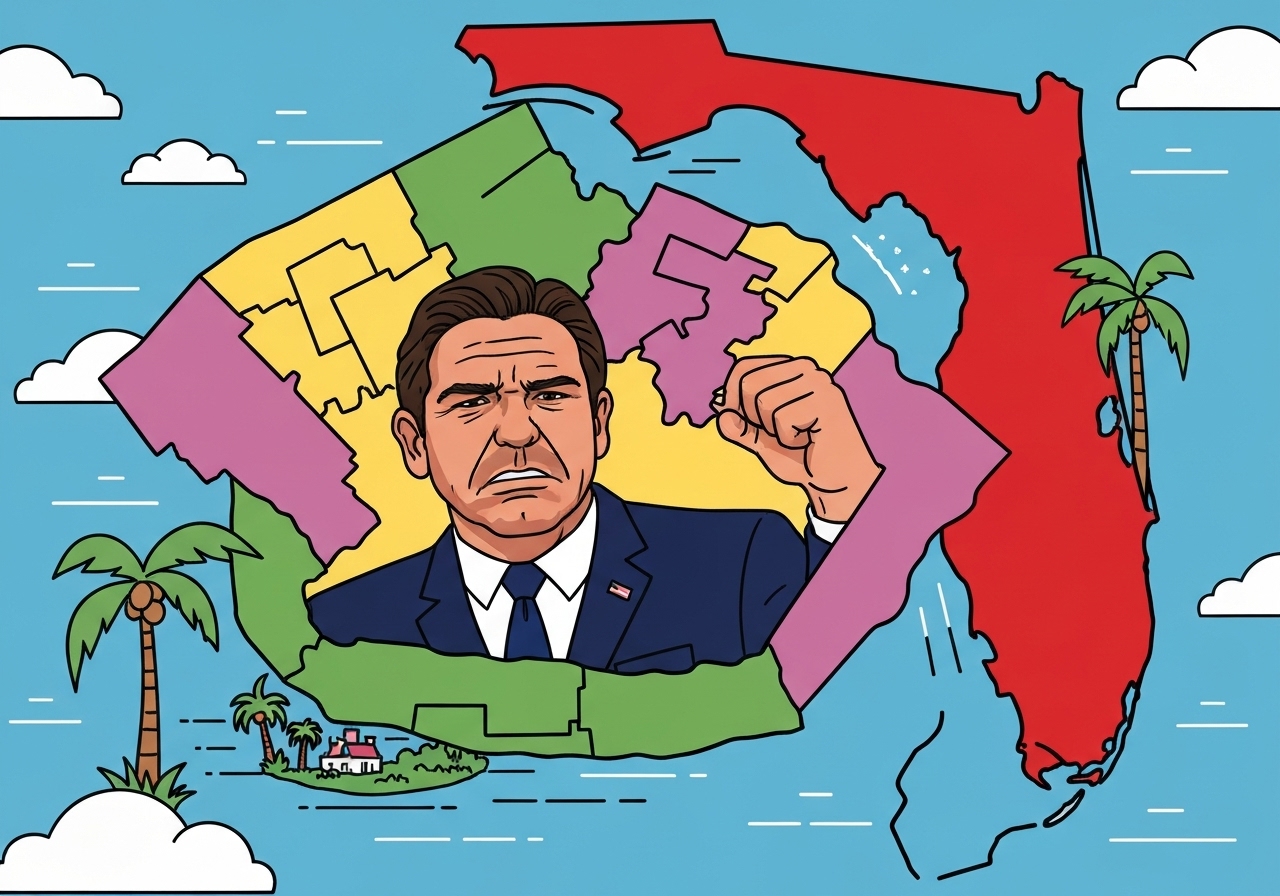
Florida Governor Ron DeSantis announced on Jan. 7, 2026 that he will call a special legislative session in April for the GOP-controlled legislature to redraw the state’s congressional districts. The move, announced in Steinhatchee, comes as the U.S. Supreme Court considers Louisiana v. Callais, a case that could affect Section 2 of the Voting Rights Act and potentially change which districts must provide minority voting opportunity. Currently Republicans hold 20 of Florida’s 28 U.S. House seats; the governor said “at least one or two” districts could be affected by the high court’s decision. DeSantis said the April session will allow the state to act ahead of the court’s eventual ruling.
Key Takeaways
- Governor Ron DeSantis announced an April special session on Jan. 7, 2026 to redraw Florida’s congressional map, citing a pending Supreme Court ruling in Louisiana v. Callais.
- Florida’s U.S. House delegation is currently 20 Republicans and 8 Democrats out of 28 seats.
- The governor indicated “at least one or two” districts could change depending on how the Court interprets Section 2 of the Voting Rights Act.
- Nationwide mid-decade map changes so far create projected opportunities for Republicans to pick up about nine seats (Texas, Missouri, North Carolina, Ohio) and Democrats about six seats (California, Utah), a net advantage of roughly three for Republicans if maps stand.
- Florida voters approved the Fair Districts Amendment in 2010 with more than 60% support, banning maps drawn primarily to favor a political party.
- The Florida Supreme Court in July 2025 upheld a congressional map backed by DeSantis that critics said violated the Fair Districts Amendment.
- Florida House Speaker Daniel Perez formed a select committee on the congressional map in August 2025 following the court ruling.
- Senate Democratic Leader Lori Berman called the proposed action illegal and tied the impulse for new maps to former President Donald Trump’s requests.
Background
Mid-decade redistricting — redrawing congressional maps outside the usual 10-year census cycle — has become a partisan tool in several states. After the 2020 census and subsequent litigation, some state legislatures have moved to redraw districts again in the middle of the decade, arguing changing legal circumstances or court rulings require fresh maps. These fights have intensified because narrow control of the U.S. House can hinge on small shifts in district boundaries.
Florida’s 2010 Fair Districts Amendment, approved by more than 60% of voters, was intended to curb partisan gerrymandering by banning maps drawn primarily to favor or disfavor political parties or incumbents. Despite that amendment, the Florida Supreme Court in July 2025 upheld a congressional plan supported by Governor DeSantis, a decision that critics argued ran counter to the amendment’s intent. That ruling set the stage for further legislative maneuvering.
The national context matters: in a handful of GOP-led states, mid-decade redraws have been used in recent years to try to shift competitive seats toward Republicans. At the same time, Democratic-controlled states have enacted maps favorable to their party in some cases. Many of those maps are subject to ongoing litigation, leaving outcomes uncertain for the 2026 elections.
Main Event
At a Jan. 7, 2026 news conference in Steinhatchee, Governor DeSantis said he would wait to call the April session until after the Supreme Court’s decision in Louisiana v. Callais becomes clearer, but he set the April date to ensure time for lawmakers to act. He framed the timing as a pragmatic step to respond to potential changes in legal requirements rather than a purely political maneuver.
DeSantis told reporters the key question is not whether the Supreme Court will rule but how broad its ruling will be; he said that scope could affect “at least one or two” Florida districts. The governor emphasized that the legislature, where Republicans hold a majority, should have the opportunity to craft new congressional boundaries in response to any new legal constraints.
Florida House Speaker Daniel Perez created a select committee in August 2025 to examine the state’s congressional map; DeSantis’s call for a special session gives that process a possible legal-political endpoint in April. Lawmakers will face legal guardrails — including the Fair Districts Amendment and any applicable federal voting-rights obligations — as they consider new maps.
Opponents pushed back immediately. Florida Senate Democratic Leader Lori Berman stated the proposal is illegal under the state’s Fair Districts Amendment and blamed former President Donald Trump for pressing Republican officials to pursue new, more favorable boundaries. Democrats argue that redrawing maps mid-decade to shift partisan balance would betray the 2010 amendment voters approved overwhelmingly.
Analysis & Implications
If Florida’s legislature enacts maps designed to consolidate or expand Republican advantage, the effect could be material for the 2026 midterms: Florida has 28 seats, and shifting just one or two districts could alter competitive margins in the closely divided U.S. House. Given the current 20-8 GOP advantage, even modest map changes could make several competitive districts safer for Republicans.
The timing of the special session is strategic. By scheduling an April session, the governor is attempting to align state action with anticipated federal legal guidance from the Supreme Court. A narrow ruling from the Court could limit the number of districts affected, while a broad ruling could require more extensive changes and potentially reduce the legislature’s flexibility.
Legal challenges are likely. Past mid-decade redraws in other states have produced court battles that in some cases reversed or modified maps. Florida’s Fair Districts Amendment provides a state-level legal standard that opponents can use in litigation. Even if the legislature adopts new lines in April, courts could later block or alter them, leaving final outcomes uncertain prior to the 2026 elections.
Beyond immediate electoral math, the episode underscores a broader national trend: parties with control of state government are increasingly willing to undertake mid-decade map changes when legal openings appear. That dynamic raises questions about long-term public trust in redistricting as a neutral mechanism and about whether voters’ 2010 reforms will hold up against partisan pressures and shifting federal jurisprudence.
Comparison & Data
| Context | Projected partisan seat changes |
|---|---|
| Republican-advantaged mid-decade redraws (TX, MO, NC, OH) | +9 seats (projected) |
| Democratic-advantaged redraws (CA, UT) | +6 seats (projected) |
| Net projected change | Republicans +3 (if maps hold) |
| Florida current delegation | Republicans 20, Democrats 8 (of 28) |
The table summarizes reported projections from recent mid-decade redistricting contests that political analysts and party strategists have cited. These numbers reflect current maps and litigation status as reported and are not predictions of actual 2026 electoral outcomes, because many maps remain under judicial review.
Reactions & Quotes
“I don’t think it’s a question of if they’re going to rule. It’s a question of what the scope is going to be. So, we’re getting out ahead of that.”
Governor Ron DeSantis, Jan. 7, 2026 news conference
DeSantis framed the special session as a response to legal uncertainty rather than a partisan gambit, emphasizing preparedness for the Supreme Court’s decision.
“Florida’s Fair Districts Amendment strictly prohibits any maps from being drawn for partisan reasons… The redistricting process is meant to serve the people, not the politicians.”
Lori Berman, Florida Senate Democratic Leader (statement)
Berman called the planned special session illegal under the state constitution and said the push for new maps stems from partisan pressure tied to former President Donald Trump.
Unconfirmed
- Whether the Supreme Court will rule in Louisiana v. Callais and, if so, the precise scope of any decision remains unresolved and could change which Florida districts are legally required to provide minority opportunity.
- Claims that the April session is being called at former President Donald Trump’s direct demand are reported as political allegation and have not been independently verified as the deciding motive for the governor’s timing.
- Projected net seat changes from mid-decade maps are contingent on maps surviving litigation and do not guarantee electoral results in 2026.
Bottom Line
Governor DeSantis’s announcement sets a clear timetable for Florida Republicans to try to reshape congressional boundaries ahead of the 2026 elections, amplifying an ongoing national pattern of mid-decade redistricting. Legal developments at the U.S. Supreme Court and in Florida’s courts will be decisive: they could either constrain or justify changes the legislature seeks to make.
Even if a new map is adopted in April, litigation is likely and could alter lines before ballots are cast. For voters and advocates, the central stakes are whether redistricting will respect the state’s Fair Districts Amendment and whether courts will enforce federal protections under the Voting Rights Act as currently understood.
Sources
- PBS (news report, AP) — original reporting on the Jan. 7, 2026 announcement and related context.