
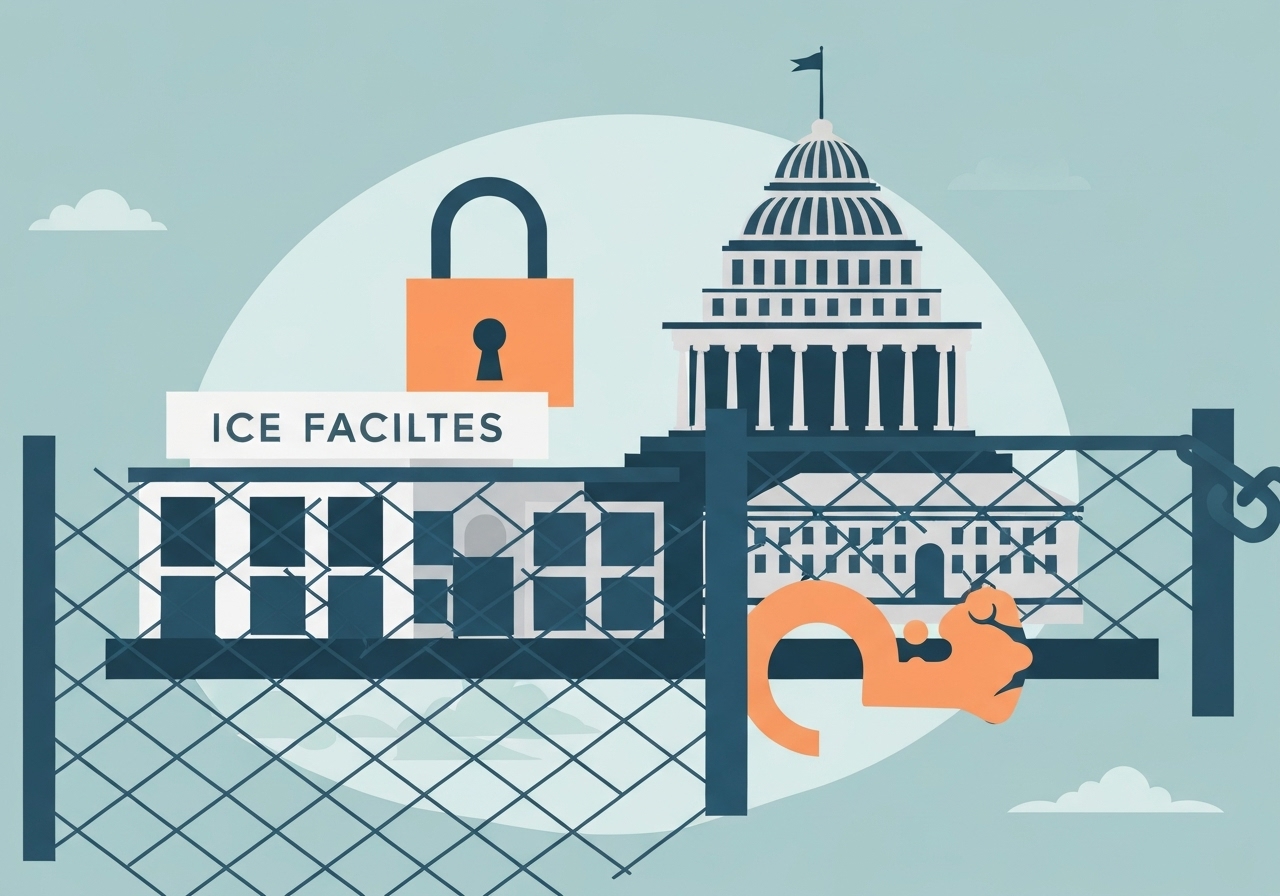
Federal lawmakers were blocked from touring an Immigration and Customs Enforcement (ICE) detention site in Minneapolis this weekend after the Department of Homeland Security (DHS) rolled out a new visitation rule. A Jan. 8 memo from DHS Secretary Kristi Noem instructs staff to require at least seven days’ notice for visits to facilities the department says are funded through the One Big Beautiful Bill Act; DHS cited safety and operational concerns. Members of Congress have a statutory right to unannounced inspections of ICE facilities funded by regular appropriations, and a D.C. federal court reaffirmed that right in December 2025. The dispute erupted at the Whipple Federal Building when Representatives Ilhan Omar, Kelly Morrison and Angie Craig were initially admitted but soon asked to leave.
Key Takeaways
- DHS Secretary Kristi Noem issued a Jan. 8 memo directing a seven-day advance notice requirement for certain ICE facility visits, citing funds from the One Big Beautiful Bill Act.
- The One Big Beautiful Bill Act allocated about $45 billion for immigration detention capacity and roughly $30 billion for ICE personnel, transportation and facility maintenance.
- A D.C. federal court ruling in December 2025 affirmed members of Congress have the right to unannounced visits to ICE facilities funded by regular congressional appropriations.
- On Saturday, three Minnesota members of Congress were initially allowed into the Whipple Federal Building detention site but were soon asked to leave under the new policy.
- Officials said the Minneapolis facility is being operated using reconciliation funds, which DHS says fall under the new seven-day-notice rule.
- More than 2,000 federal immigration agents have been deployed to Minnesota; officials say additional personnel may arrive in the coming days.
- The incident follows the fatal shooting of 37-year-old Renee Good by an ICE agent in Minneapolis, a case the administration says involved self-defense.
Background
The dispute centers on how visitation rules apply when facilities are funded from different federal sources. Under long-standing law, members of Congress may conduct unannounced inspections of detention facilities financed by regular annual appropriations. In December 2025 a D.C. federal court reiterated that right for facilities paid from those appropriations, reinforcing congressional oversight powers.
Last summer, Congress passed the One Big Beautiful Bill Act through the reconciliation process with only Republican support. That legislation designated a separate pool of funds—about $45 billion directed to expand detention capacity and roughly $30 billion earmarked for ICE hiring, transport and facility upkeep. DHS now contends that facilities financed from that reconciliation bucket are not subject to the same unannounced-visit rule tied to ordinary appropriations.
The Minneapolis visit occurred amid heightened tensions after an ICE agent shot and killed 37-year-old Renee Good last week. Federal and local scrutiny of ICE operations in Minnesota has intensified, while the agency has responded by deploying more than 2,000 federal immigration personnel to the state.
Main Event
On the weekend in question, Representatives Ilhan Omar, Kelly Morrison and Angie Craig arrived at the Whipple Federal Building to inspect an ICE-operated detention space. They were initially escorted into the regional ICE headquarters, but officials quickly reversed course and asked the lawmakers to leave. ICE staff told the delegation the site is being funded with reconciliation dollars from the One Big Beautiful Bill Act and that Noem’s memo requires seven days’ advance notice for such visits.
The Jan. 8 memo that DHS provided to NPR instructs staff to use reconciliation funds to implement and enforce the new visitation policy, effectively narrowing the circumstances in which unannounced congressional visits are permitted. The memo frames the change as a safety and operational necessity, saying unscheduled inspections pull agents away from essential duties and can create chaotic, high-emotion environments.
Members of Congress and their aides disputed the characterization and objected to the denial of access. Outside the facility, Representative Angie Craig told reporters the delegation’s role is to ensure humane treatment of people in custody and criticized the administration’s approach. DHS and ICE officials have argued the policy is intended to protect staff, detained people and visiting lawmakers alike.
The incident has prompted calls from Minnesota Democrats for clearer oversight and accountability. Congressional offices say they will pursue remedies and clarification on how visitation rights apply when facilities receive reconciliation funding rather than standard appropriations.
Analysis & Implications
The policy change raises immediate separation-of-powers and oversight questions. Statutory inspection rights are premised on transparency for Congress to assess detention conditions; narrowing those rights by linking applicability to specific budget buckets shifts the balance toward administrative discretion. If DHS’s interpretation stands, it could make it harder for lawmakers to conduct surprise inspections that historically surfaced deficiencies in detention operations.
Operationally, requiring seven days’ notice may allow facilities to prepare for visits in ways that obscure daily conditions. Advocates for oversight argue this risks sanitizing sites prior to inspections; DHS counters that unannounced entries can disrupt operations and endanger staff and detainees. The two positions reflect a fundamental tension between unfiltered oversight and site safety/operational continuity.
Politically, the move arrives amid a charged local context: the fatal shooting of Renee Good and the large-scale federal deployment to Minnesota have already escalated scrutiny. Restricting access to facilities in such an environment is likely to fuel partisan disputes and may prompt litigation or congressional inquiries to clarify statutory authority and the reach of reconciliation-funded programs.
Economically and administratively, the use of the One Big Beautiful Bill Act funding to expand capacity and personnel—$45 billion for detention capacity and about $30 billion for staff and logistics—signals a significant federal investment in immigration enforcement infrastructure. How those funds are classified for oversight purposes could set a precedent for other agencies using reconciliation or earmarked funds to limit routine oversight mechanisms.
Comparison & Data
| Funding Source | Approx. Amount | Visit Policy (DHS Position) |
|---|---|---|
| Regular congressional appropriations | N/A (ongoing annual budgets) | Unannounced congressional visits permitted (as affirmed by D.C. court) |
| One Big Beautiful Bill Act (reconciliation) | $45B for detention; ≈$30B for hire/transport/maintain | DHS memo: seven-day advance notice required |
The table summarizes how DHS distinguishes between funds for purposes of visit policy. The reconciliation allocation is the basis DHS cites to require advanced notice; however, court rulings and statutory language on inspection rights have traditionally focused on facility control and access rather than the particular financing instrument.
Reactions & Quotes
Members of Congress and local advocates framed the denial of access as a rollback of oversight at a sensitive moment. They connected the new rule to broader concerns about transparency and detainee welfare.
“It is our job as members of Congress to make sure those folks detained are treated with humanity because we are the damn United States of America!”
Rep. Angie Craig
Representative Craig spoke to reporters after being asked to leave the Whipple facility. Her statement emphasized lawmakers’ oversight responsibilities and framed the refusal as inconsistent with U.S. values, reflecting urgency among Minnesota Democrats after recent events.
DHS framed the memo as an operational safety measure designed to reduce risk and maintain order at detention sites.
“Unannounced visits require pulling ICE officers away from their normal duties,”
Secretary Kristi Noem (Jan. 8 memo)
Noem’s memo also warned against what it called publicity-driven visits that could cause chaotic scenes. DHS officials told staff the seven-day requirement is intended to protect members, staff, detainees and ICE personnel by allowing time to coordinate security and logistics.
Unconfirmed
- Whether every visit denial at the Minneapolis site is being made solely on the basis of reconciliation funding is unclear; DHS guidance as reported ties enforcement to specific uses of the reconciliation dollars.
- Whether the facility will permanently enforce the seven-day-notice rule for all congressional delegations has not been formally announced beyond the memo and Saturday’s enforcement.
Bottom Line
DHS’s Jan. 8 memo and the enforced seven-day notice at a Minneapolis ICE facility mark a significant friction point between executive agency discretion and congressional oversight. By tying visit rules to reconciliation funding, DHS has created a novel rationale that is likely to be tested in political and legal arenas.
For lawmakers and advocates, the immediate stakes are access and transparency at detention facilities—particularly in Minnesota, where recent events have heightened public concern. Expect continued protests, congressional demands for clarity, and possible litigation to determine whether the source of funds can lawfully restrict traditional oversight mechanisms.
Sources
- NPR (news report)