
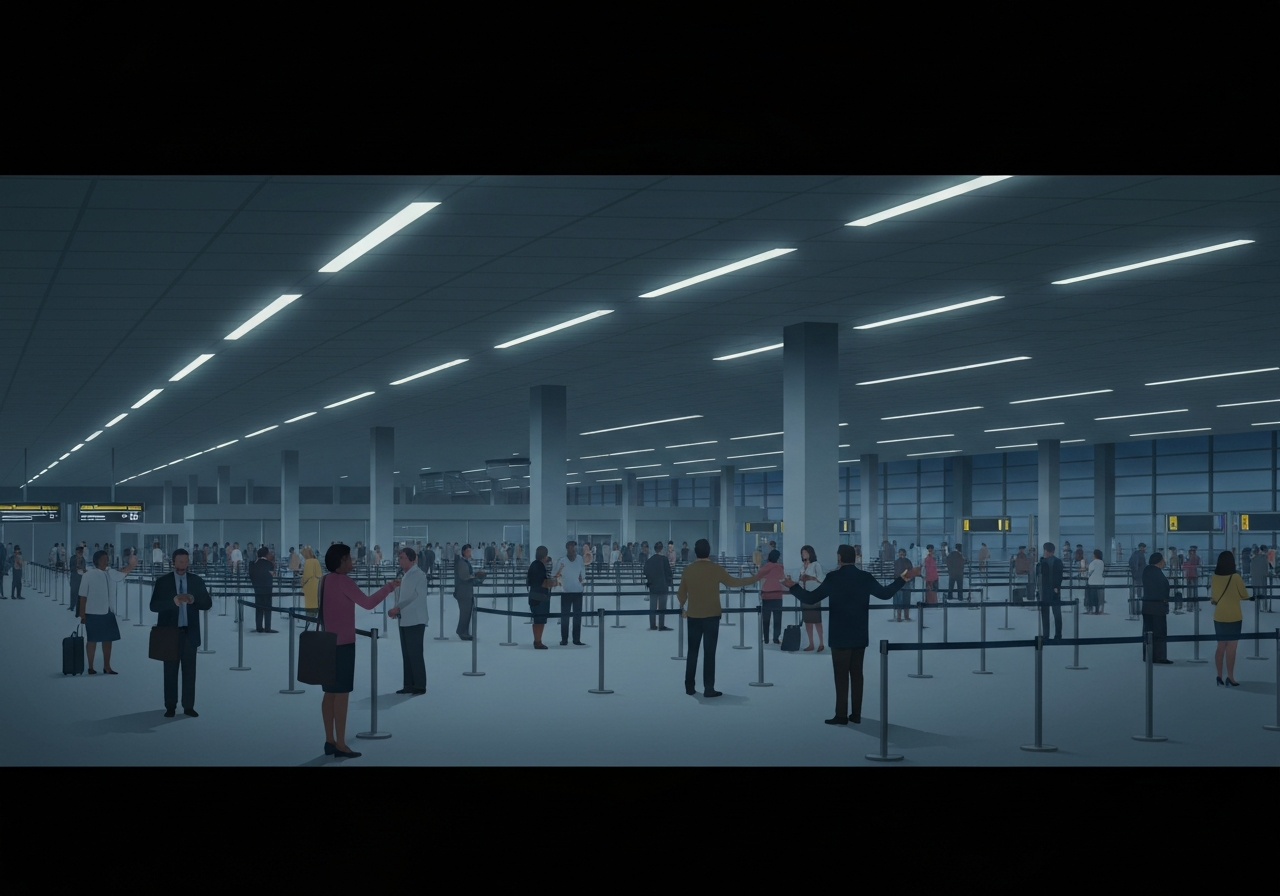
Republican and Democratic senators in Washington spent Wednesday sparring over how to fund the Department of Homeland Security, with negotiations stalled as the department’s partial shutdown — which began on Feb. 14 — enters its fourth week. The impasse has left many of the department’s roughly 260,000 employees working without pay and produced long security lines at airports nationwide, including multi-hour waits at Houston’s secondary airport and hour-plus delays in New Orleans and Atlanta. Democrats say they will fund parts of DHS but not Immigration and Customs Enforcement (ICE) or Customs and Border Protection (CBP) unless operational changes are made; Republicans have rejected several of those conditions. The stalemate left both parties blocking each other’s temporary funding proposals after hours of debate on the Senate floor.
- Shutdown start: The DHS funding lapse began on Feb. 14; the impasse has continued into a fourth week, disrupting operations and employee pay.
- Workforce impact: More than 260,000 DHS employees remain on duty but unpaid, marking the second recent period they have worked without pay since last fall’s 43-day shutdown.
- Airport delays: Houston’s secondary airport reported lines exceeding three hours on Sunday and Monday; several other airports, including New Orleans and Atlanta, saw waits over one hour.
- Appropriations status: Congress completed 11 of 12 fiscal-year spending bills; the Homeland Security bill is the only one still outstanding.
- Policy demands: Democrats seek limits on ICE operations at sensitive sites, independent investigations of alleged misconduct, judicial warrants for certain entries, and visible identification for agents.
- Broken offers: Lawmakers report multiple rejected offers — Senate leaders say the White House made an offer nearly two weeks ago that Democrats did not accept; Democrats say the White House must guarantee any deal will stand.
- Previous compromises: Earlier bipartisan talks had included $20 million for body-worn cameras and de-escalation training, but those accords unraveled after a high-profile Minneapolis shooting.
Background
The Department of Homeland Security, created after the 2001 attacks, coordinates immigration enforcement, border security, transportation security and disaster response. Under the Trump administration, ICE arrests and detentions rose, and enforcement tactics became a focal point of political debate; Democrats and some Republicans have called for changes to tactics and oversight. Congress’s annual appropriations process usually divides spending across 12 bills; after completing 11, lawmakers left the DHS bill unresolved, producing the current partial shutdown that began Feb. 14.
Recent events intensified pressure on appropriators. A shooting in Minneapolis involving immigration-enforcement activity prompted protests and renewed calls for policy changes, and negotiators who had reached limited agreements on training and equipment — including $20 million for body-worn cameras for enforcement agents — saw those agreements falter following the incident. Senate leaders and appropriators from both parties now face competing priorities: Republicans pressing for full operational funding of DHS components including ICE and CBP, and Democrats insisting on new constraints and oversight before approving funds for those agencies.
Main Event
On the Senate floor Wednesday, lawmakers alternated between procedural motions and pointed criticisms as each side blocked temporary measures proposed by the other. Democrats twice offered plans to fund most DHS accounts while excluding ICE and CBP pending reforms; Republicans objected both times. Republican senators pressed instead for measures that would maintain full departmental funding for a limited period to avoid operational interruptions and to ensure federal employees continued to receive paychecks.
Senate Majority Leader John Thune (R-S.D.) said Republicans have repeatedly extended offers, and he noted a White House proposal delivered nearly two weeks earlier. Democrats, led in appropriations by Sen. Patty Murray (D-Wash.), countered that without the White House at the table and assurances that senior aides like Stephen Miller would not undercut agreements, any informal talks would lack credibility. Murray told colleagues she would not make concessions that could be overturned by the White House after the fact.
The policy demands driving Democratic objections include barring ICE enforcement at sensitive locations such as schools and places of worship, establishing independent investigatory authority for alleged agency wrongdoing, requiring judicial warrants before forcible entries into private, nonpublic spaces, and mandating visible identification for agents. Republicans, including Sen. Eric Schmitt (R-Mo.), said they would not accept measures that weaken ICE’s capacity to enforce immigration laws.
Analysis & Implications
Operationally, the immediate consequence is a strain on air travel. TSA screening shortages have been the most visible symptom: understaffing slows checkpoint throughput, which cascades into missed connections, longer staffing demands and higher costs for airlines and airports. Trade groups, including the U.S. Chamber of Commerce, have warned that prolonged delays will harm commerce and tourism, urging Congress to restore funding quickly to limit economic fallout.
Politically, the dispute highlights fractures within and between parties over immigration policy and oversight. Democrats are using funding leverage to press for accountability reforms in enforcement, while Republicans frame full funding as essential to law enforcement and border control. That divergence reduces the bargaining space for a short-term patch and raises the risk both sides will continue to posture for political audiences rather than converge on a compromise.
For the federal workforce, repeated spells of working without pay erode morale and can diminish institutional capacity over time. Many DHS employees — from border agents to cybersecurity staff — perform roles that have national-security implications; protracted funding gaps could impair readiness. Even if a short-term continuing resolution ultimately passes, unresolved policy fights over ICE and CBP operations are likely to resurface, meaning this moment may be a pause rather than a resolution.
Comparison & Data
| Metric | Current | Recent Comparison |
|---|---|---|
| DHS employees on duty | ~260,000 (working unpaid) | Also worked unpaid during 43-day shutdown last fall |
| Airport wait examples | Houston secondary: >3 hours; New Orleans/Atlanta: >1 hour | Typical pre-shutdown waits are usually under 30–45 minutes at these facilities |
| Appropriations bills | 11 of 12 completed; DHS outstanding | Unlike most years, DHS remains the lone unsettled bill |
| Body-worn camera funding | $20 million previously agreed in talks | That provision was in bipartisan drafts but collapsed after a Minneapolis shooting |
The table underscores the asymmetric impact of the impasse: small changes in checkpoint staffing translate to outsized travel delays, while policy disputes over ICE and CBP affect broad categories of DHS funding and oversight. Even limited funding measures can be blocked when policy riders or conditions become dealbreakers for the opposing party.
Reactions & Quotes
Lawmakers and outside groups offered sharply different takes on responsibility and acceptable remedies. Proponents of restrictions on enforcement actions framed their stance as a response to public safety concerns and specific incidents; opponents framed the same proposals as operationally crippling.
“We are in a negotiation. However, we are not close.”
Sen. Brian Schatz (D-Hawaii)
Sen. Schatz’s comment reflected frustration with the slow pace and emotional stakes of the talks; he and other Democrats cited recent violence tied to enforcement activity as a reason the party could not simply fund ICE and CBP without conditions.
“Let me be clear, we are going to do nothing — nothing — that kneecaps ICE’s ability to enforce our immigration laws.”
Sen. Eric Schmitt (R-Mo.)
Sen. Schmitt’s remark signaled Republicans’ firmness on maintaining ICE’s operational capacities, a stance that helped block Democratic proposals excluding ICE and CBP from short-term funding measures.
“Blocking operational funding and paychecks for those who help us travel safely is wrong and strains the air travel system.”
Neil Bradley, U.S. Chamber of Commerce (business group)
The Chamber’s statement emphasized economic consequences and urged a swift congressional fix, highlighting business-sector concerns about continued travel disruption.
Unconfirmed
- Reports that the White House will categorically override any Senate agreement remain unverified; Democrats cite the possibility as a concern but no formal override has been documented.
- Precise nationwide totals of travelers who missed flights because of these specific checkpoint delays are not publicly available and have not been independently confirmed.
- Claims that a single negotiating offer was the final, comprehensive White House proposal have not been independently corroborated by a publicly released document or joint statement.
Bottom Line
The impasse over DHS funding reflects a deeper policy clash: Democrats demanding operational limits and oversight for immigration enforcement, and Republicans insisting on full funding to preserve enforcement capacity. That divide has turned routine appropriations work into a high-stakes standoff with immediate consequences for airline travelers, DHS employees and businesses that depend on reliable travel.
In the near term, the most likely outcomes are continued short-term fixes or a narrowly tailored funding resolution that keeps key functions running while leaving the core policy disputes unresolved. Absent a durable compromise that addresses both funding and oversight concerns, these tensions are likely to resurface in future appropriations cycles and could prompt renewed public and legal scrutiny of enforcement practices.
Sources
- Associated Press (news)