
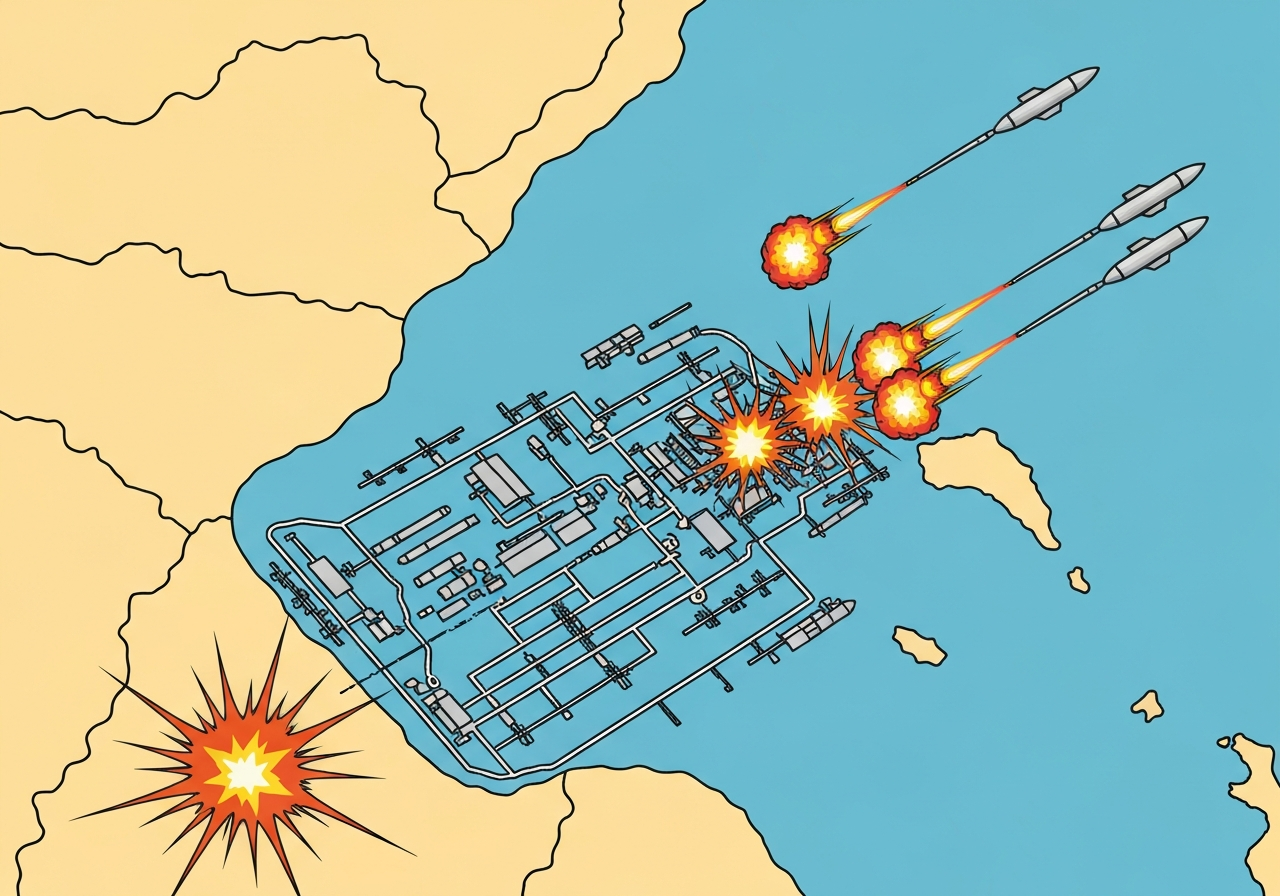
Iran launched missiles toward Diego Garcia, a remote Indian Ocean island that hosts a key U.K.-U.S. military facility, in a recent failed effort to strike the base. Britain condemned the attempt as “reckless,” while officials said it was unclear how close the weapons came to the island, roughly 2,500 miles (4,000 kilometers) from Iran. Diego Garcia, home to about 2,500 primarily American personnel, has long served as a logistical and operational hub for U.S. missions across the Middle East, South Asia and East Africa. The episode has sharpened debate over the base’s role, regional reach of Iranian systems and enduring sovereignty disputes over the Chagos Archipelago.
Key Takeaways
- Iran reportedly launched missiles at Diego Garcia in a recent attempt that failed to hit the island; exact impact point and proximity remain unclear.
- Diego Garcia is about 2,500 miles (4,000 km) from Iran; Iran has stated a self-imposed ballistic limit of 1,240 miles (2,000 km).
- The base hosts roughly 2,500 mostly American personnel and has supported operations from Vietnam through Afghanistan and Iraq.
- In 2023–24 period U.S. forces deployed nuclear-capable B-2 Spirit bombers to Diego Garcia amid heightened regional strikes.
- Analysts have suggested Iran could have improvised a Simorgh space-launch vehicle for extended range, trading accuracy for reach.
- The island is part of the Chagos Archipelago, a chain of more than 60 islands at the southern end of the Indian Ocean; the territory’s sovereignty and the 1960s–70s eviction of up to 2,000 residents remain contested.
- Last year the U.K. agreed to transfer sovereignty to Mauritius while leasing Diego Garcia back to preserve base access for at least 99 years; parliamentary approval is paused amid political pushback.
- The U.K. says its bases may be used only for “specific and limited defensive operations,” while Iran’s foreign minister warned the U.K. against allowing strikes on Iran from British soil.
Background
Diego Garcia sits in the middle of the Indian Ocean and has been under British control since 1814, following a transfer from France. In the 1960s and 1970s the British government removed as many as 2,000 islanders from Diego Garcia to make way for a U.S. military facility; that forced displacement remains a focal point of legal and moral challenges. The United Nations and the International Court of Justice have urged the United Kingdom to end its colonial administration of the Chagos Archipelago and restore sovereignty to Mauritius.
The U.S. has long described Diego Garcia as a strategically invaluable platform, providing logistics, refueling, reconnaissance and forward basing for air and naval operations across three theaters: the Middle East, South Asia and East Africa. Its facilities have supported campaigns from the Vietnam War through operations in Iraq and Afghanistan, and in the 2000s were linked to rendition flights. To address shifting regional threats, U.S. planners have periodically rotated long-range aircraft and other capabilities through the base.
Main Event
According to British and international reporting, Iran launched missiles aimed at Diego Garcia in a recent episode that did not produce confirmed strikes on the island itself. London publicly denounced the attempt as reckless, and officials emphasized that assessments were ongoing about trajectory and origin. Because Diego Garcia lies roughly 2,500 miles (4,000 km) from Iran, the launch has raised immediate questions about the weapon system used and whether it involved an improvised conversion of a space-launch vehicle.
Iranian Foreign Minister Abbas Araghchi took to social media to criticize the U.K. after British permission expanded to allow U.S. bombers to operate from Diego Garcia in response to regional attacks; he argued that such permission endangered British lives. The British government, for its part, reiterated its line that the use of its bases would be confined to specific defensive tasks, while noting co-operation with U.S. forces on protecting shipping routes and countering missile launches that threaten regional stability.
Defense analysts—including experts at the Royal United Services Institute—have speculated that Iran might have improvised greater reach by using a Simorgh satellite launch vehicle as a ballistic launcher. That approach could achieve longer distance but would likely sacrifice guidance precision, making accurate targeting of a small island facility more difficult. U.S. and allied officials continue to assess telemetry, debris (if any), and satellite tracking to determine the systems involved.
Analysis & Implications
Strategically, an attack on Diego Garcia—if confirmed—would represent an escalation in Iran’s ability and intent to project power into the western Indian Ocean. Diego Garcia’s value as a staging area for aircraft, maritime patrols and logistics means any credible threat to the facility reverberates beyond bilateral tensions, potentially affecting freedom of navigation in nearby sea lanes and allied force posture across three regions. The reported use or attempted use of longer-range launchers would force planners to re-evaluate base vulnerability and redundant basing options.
Politically, the episode complicates a sensitive U.K. domestic debate about the future of the Chagos Archipelago. The U.K.-Mauritius sovereignty deal, which would transfer sovereignty to Mauritius while leasing the base back to Britain and its ally, was intended to insulate operations at Diego Garcia from legal challenges; critics in Parliament and displaced islanders say the arrangement raises security and moral questions. If Diego Garcia becomes a target, the political costs for the U.K.—both in terms of parliamentary approval of the deal and public confidence—could increase.
For Iran, employing a space-launch vehicle or other unconventional delivery would signal an intent to circumvent existing range limits and complicate arms-control dialogues. The trade-off—greater reach in exchange for lower accuracy—could be sufficient to send political signals without guaranteeing precision strikes. For regional navies and merchant shipping, the incident underscores persistent vulnerability to missile- and drone-enabled harassment originating from land- and sea-based launch points.
Comparison & Data
| Metric | Diego Garcia | Iranian self-limit |
|---|---|---|
| Distance from Iran | ~2,500 miles (4,000 km) | — |
| Iran’s stated missile range cap | — | 1,240 miles (2,000 km) |
| Personnel at base | ~2,500 | — |
The table highlights the gap between the island’s distance from Iran and Tehran’s claimed self-restraint on missile range. Analysts point out that space-launch rockets like Simorgh could close that gap at the expense of accuracy, complicating attribution and threat assessment.
Reactions & Quotes
“Iran’s reckless attacks risk destabilising regional security and threaten lives; such behaviour is unacceptable,”
United Kingdom government statement (official)
This statement followed initial assessments that the missile attempt had not succeeded in striking Diego Garcia. London used firm language to underscore the political sensitivity of attacks on territories hosting allied forces.
“Putting a satellite launcher to improvised ballistic use can extend range but degrades accuracy,”
Justin Bronk, Royal United Services Institute (defence analyst)
Bronk and other analysts noted that converting a space vehicle such as the Simorgh would be technically possible but would carry important limitations for targeting precision, shaping both tactical impact and strategic messaging.
“Allowing UK bases to be used for operations against Iran puts British lives at risk,”
Abbas Araghchi, Iranian Foreign Ministry (social media)
Araghchi’s comment framed Tehran’s objection to any U.K. support for strikes on Iranian targets, raising diplomatic tensions between London and Tehran over basing and use-of-force questions.
Unconfirmed
- Precise impact location and how close missiles came to Diego Garcia remain unverified; official trajectory and debris analysis are pending.
- Whether Iran actually used a Simorgh space-launch vehicle in this incident is not confirmed; analysts have proposed it as a possibility based on range considerations.
- Claims that Diego Garcia was an intended primary target versus a symbolic demonstration of reach have not been independently confirmed.
Bottom Line
The attempted strike on Diego Garcia—if later confirmed—signals a new layer of complexity in Iran’s regional posture and in allied planning for force protection across the Indian Ocean. Diego Garcia’s strategic utility for U.S. operations makes even unsuccessful attacks politically and operationally significant, prompting fresh assessments of base resilience and redundant options for long-range missions.
Separately, the incident is likely to intensify domestic debate in the U.K. over the Chagos sovereignty arrangement and could affect parliamentary timing on ratifying the lease-back deal with Mauritius. For regional actors and commercial shipping, the event underlines persistent vulnerabilities in sea lanes and the growing intersection of space-capable systems with missile proliferation concerns.