
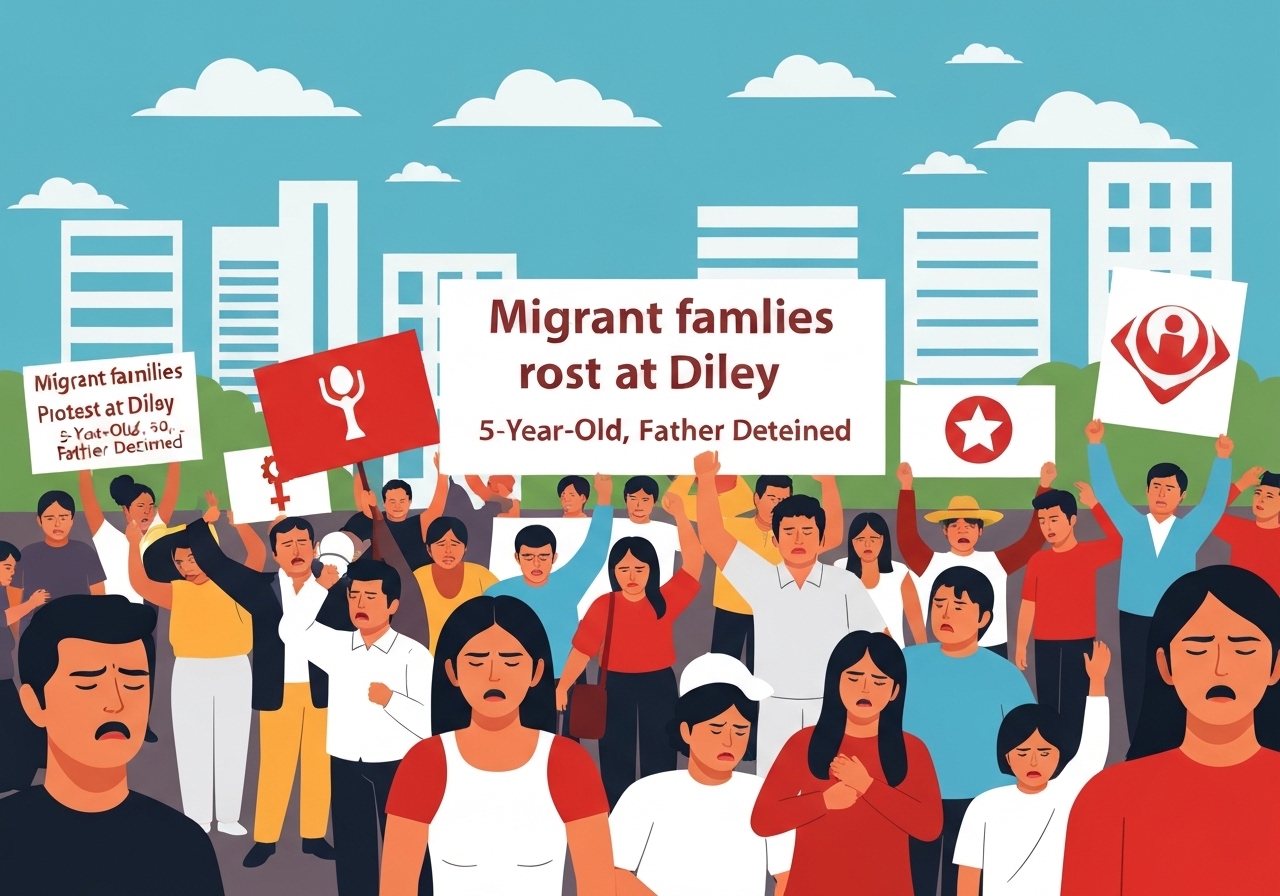
Lead: Dozens of immigrant families gathered behind the fences of the South Texas Family Residential Center in Dilley on Saturday to protest the recent transfer of 5-year-old Liam Conejo Ramos and his father to the facility after their detention in Minnesota earlier this week. Demonstrators chanted for freedom and held signs demanding better treatment for children in custody, while attorneys said visitors were abruptly escorted out. The event has added momentum to a national debate over family detention policies and the treatment of children in U.S. immigration custody.
Key Takeaways
- About a dozen to dozens of family members and children staged a visible protest outside the South Texas Family Residential Center in Dilley on Saturday; aerial photos published alongside reporting showed groups of parents and children with signs.
- The child at the center of the complaint is 5-year-old Liam Conejo Ramos; he and his father were detained by federal agents outside their Minnesota home earlier this week and later moved to Dilley.
- Attorney Eric Lee, present as a visitor to the facility, reported that guards told visitors to leave abruptly and later heard detainees chanting in support of the boy and broader protests.
- Advocates and attorneys, including Neha Desai of the National Center for Youth Law, say the Dilley facility has reported problems including delayed medical care and unsafe water since it reopened after a 2024 closure.
- Policy context: the Flores Settlement Agreement (1997) requires humane treatment and prioritizes release of children; family detention was curtailed under the Biden administration and later resumed after the 2024–2025 policy shifts.
- Texas has been a major enforcement site: the Texas Department of Public Safety assisted in more than 3,000 arrests of undocumented immigrants in 2025, and roughly one in four ICE arrests from the second Trump inauguration through July 2025 occurred in Texas.
- ICE reported four deaths in its detention facilities over the prior two months, including a 55-year-old Cuban detainee whose death in El Paso was ruled a homicide by the local medical examiner.
Background
The South Texas Family Residential Center in Dilley opened in 2014 as a large family detention facility and became a focal point in debates over how the United States handles parents and children who cross the border together. The facility was closed in 2024 after the Biden administration moved away from detaining families; it was reopened following policy shifts under the subsequent administration. That restart has renewed scrutiny from child welfare advocates, legal groups and some members of Congress.
The Flores Settlement Agreement of 1997 remains central to legal and political disputes. Flores sets standards for the custody and care of children in immigration detention, including a preference for prompt release and requirements for safe and sanitary conditions. During the prior Trump administration, enforcement practices including family separation and a zero-tolerance criminal prosecution policy brought Flores into the public eye and helped shape litigation and policy responses ever since.
Within Texas, state-level enforcement has intensified. State law changes and cooperative agreements have increased local law-enforcement participation with ICE operations; sheriffs across the state have entered memoranda of understanding with federal authorities. Those shifts coincided with a significant share of ICE arrests occurring in Texas through mid-2025 and with a rise in public protests when high-profile incidents occur elsewhere in the country.
Main Event
The protest Saturday unfolded behind chain-link fencing at the Dilley center, where participants — many wearing jackets against cold weather — chanted “Libertad” and displayed signs reading “Libertad para los niños.” Aerial photos published with news reports showed families gathered outside the compound. Visitors outside the facility, including legal representatives, said staff moved to clear the waiting areas and urged people to leave abruptly.
Attorney Eric Lee said he had been in the waiting room to meet clients when staff told visitors to exit the premises. Roughly 30 minutes later, Lee said a client inside called him to report that detainees were staging a protest in support of the 5-year-old and against recent enforcement practices. Video shared by Lee and others shows voices from inside the compound and staff asking visitors not to record.
Family members and detainees described the demonstration as an appeal for dignity and humane treatment. Maria Alejandra Montoya Sanchez, 31, who has been held at Dilley with her 9-year-old daughter since October, told reporters that detainees want to be treated “with dignity and according to the law” and emphasized that families are not criminals. DHS and ICE officials did not provide an on-the-record response to questions about the transfer and the protest when contacted by reporters.
The transfer that triggered the outrage began earlier in the week when federal agents detained a Minneapolis household and moved the father and child to federal custody. Family and neighbors allege tactics they describe as using the child to prompt a parent to open the door; federal officials have rejected that account and called related assertions inaccurate. The contested nature of those claims has fueled national attention and local demonstrations in multiple states.
Analysis & Implications
The Dilley demonstration underscores how individual enforcement actions can catalyze broader public reaction when they intersect with concerns about children in custody. A case involving a young child amplifies emotional resonance and political salience, raising pressure on federal and state officials to explain both the factual basis for actions and the safeguards in place for minors. The rapid mobilization of protests suggests advocacy networks and local communities remain primed to respond to perceived overreach.
Legally, the Flores Settlement continues to constrain how and for how long children can be held; any sustained increase in family detention will likely trigger litigation and regulatory scrutiny. Advocates argue that long stays and delays in medical care risk violation of Flores standards and of other statutes governing treatment of children. Administrations that expand detention face both courtroom challenges and a politically visible backlash, especially when deaths or alleged mistreatment surface in public reporting.
For Texas politics and operations, the protests also highlight coordination between federal and state enforcement. Large numbers of arrests assisted by state agencies and statutory requirements for county cooperation have made Texas a primary locus of enforcement activity. That centrality increases the state’s exposure to reputational and legal risks when detention conditions or enforcement tactics become controversial nationally.
Operationally, sudden visitor removals and the reported chanting inside the facility draw attention to management practices and crisis protocols at family detention sites. Independent oversight and transparent reporting of medical care, water safety and incident responses would be central to assessing whether conditions meet legal and humanitarian benchmarks; advocates say current transparency is insufficient.
Comparison & Data
| Metric | Reported Value |
|---|---|
| Dilley facility opened | 2014 |
| Facility closure | 2024 |
| Reopening | 2025 (after change in federal policy) |
| Texas DPS-assisted arrests in 2025 | More than 3,000 |
| Share of ICE arrests in Texas | ~25% (through July 2025) |
| ICE facility deaths reported (recent 2 months) | 4 |
The table above places the Dilley protests in context of recent enforcement activity: the facility has moved from closure back into operation within roughly a year, and Texas has accounted for a disproportionate share of enforcement actions reported through mid-2025. Reported deaths in ICE custody and complaints about medical and sanitation conditions are cited by advocates as evidence of urgent oversight needs.
Reactions & Quotes
“The message we want to send is for them to treat us with dignity and according to the law. We’re immigrants, with children, not criminals.”
Maria Alejandra Montoya Sanchez, detainee at Dilley
Montoya Sanchez framed the protest as a plea for humane treatment and an assertion that families should not be criminalized.
“They looked white faced. They were very concerned, obviously, by whatever was happening.”
Eric Lee, immigration attorney
Lee described abrupt action by staff and later reported calls from inside the facility indicating detainees were protesting the treatment of the 5-year-old and broader ICE practices.
“The current conditions at Dilley are fundamentally unsafe for anyone, let alone young children.”
Neha Desai, National Center for Youth Law
Legal advocates pointed to long-standing complaints about medical care and sanitation at the facility and urged oversight and remedy.
Unconfirmed
- Claims that federal agents used the 5-year-old as bait to get the child’s mother to open the door are disputed; family and neighbors allege that tactic, while federal officials have called that account false.
- Reports from inside the facility about detainees coordinating a unified protest are based on attorney and visitor accounts but lack independent corroboration from facility officials at the time of reporting.
Bottom Line
The Dilley protest following the detention and transfer of a 5-year-old and his father crystallizes wider tensions over family detention, child welfare and aggressive immigration enforcement. Individual enforcement actions that touch children rapidly become focal points for national debate and community mobilization.
Policy and legal constraints such as the Flores Settlement will remain central to challenges against expanded family detention. For federal and state authorities, the episode underscores the need for clear, prompt public explanations, independent oversight of conditions and transparent incident reporting to reduce legal exposure and restore public confidence.
Sources
- Texas Tribune (news) — original reporting on the Dilley protest and transfer
- The Associated Press (news) — aerial images and on-the-ground reporting cited in coverage
- National Center for Youth Law (advocacy) — statement on Dilley conditions
- U.S. Department of Homeland Security (official) — DHS/ICE statements and policy pages