
Lead
At 1:33am on Saturday in Melbourne, Novak Djokovic collapsed to the court after a four-hours-nine-minutes semi-final to beat Jannik Sinner 3-6, 6-3, 4-6, 6-4, 6-4 and reach the Australian Open final. The 38-year-old Serb — seeded fourth — overturned the two-time defending champion and second seed, ending a five-match losing run to Sinner. Djokovic’s win on Rod Laver Arena makes him the oldest man in the Open era to reach this final, his 11th in Melbourne and 38th grand slam final overall. The victory sets up a final against world No. 1 Carlos Alcaraz, who also prevailed in a five-set semi-final.
Key Takeaways
- Match duration: 4 hours 9 minutes; finish time recorded at 1:33am local in Melbourne.
- Final score: Novak Djokovic def. Jannik Sinner 3-6, 6-3, 4-6, 6-4, 6-4.
- Age and milestones: Djokovic, 38, reached his 11th Australian Open final and 38th major final; he is chasing a record 25th Grand Slam singles title.
- Match statistics: Sinner produced 72 winners and 26 aces (a career high), with 42 unforced errors; Djokovic faced 18 break points and saved 16 of them.
- Seeding and form: Djokovic entered as the fourth seed; Sinner was the two-time defending champion and seeded second.
- Path to the semi: Djokovic had earlier benefited from a Musetti retirement (while trailing) and a Mensik withdrawal, meaning he had not won a complete match-set since the third round.
- Final opponent: Djokovic will face Carlos Alcaraz (world No. 1, age 22) after Alcaraz beat Alexander Zverev in five sets.
Background
Novak Djokovic’s longevity has been a defining narrative of men’s tennis in the Open era. At 38, he remains competitive at the very highest level, a rarity in a sport where most top players retire or decline well before this age. Djokovic has collected more major finals than any male player in history and enters this match trying to extend a record Grand Slam tally.
Jannik Sinner arrived in Melbourne as the two-time defending champion and the second seed, widely regarded as one of the tour’s most devastating ball-strikers. His combination of power, timing and serve had previously produced a five-match winning streak over Djokovic, making him a clear favorite on paper.
The 2026 Australian Open has been marked by dramatic late finishes and unexpected withdrawals. Djokovic’s route to the semi-final included complications: a retirement by Lorenzo Musetti while leading and a fourth-round withdrawal by the 16th seed, Jakub Mensik. Those events left questions about match rhythm and recovery for a 38-year-old seeking another major.
Main Event
The semi-final played out as a high-intensity, five-set epic on Rod Laver Arena. Sinner opened strongly, taking the first set 6-3 by dictating rallies with heavy winners and punishing Djokovic’s short replies. The Italian’s serve, including 26 aces, helped him remain aggressive and pin Djokovic back early in points.
Djokovic responded in the second set with improved baseline positioning and earlier ball striking, taking the set 6-3 and forcing longer rallies where experience and defence mattered. The match swung again in the third as Sinner reclaimed the edge to win 6-4, using depth and pace to expose Djokovic’s movement at times.
The fourth and fifth sets saw Djokovic lift his game under pressure. He saved multiple break points across the match — 16 of 18 overall — and produced precise serving when it mattered most. In the decisive moments of the fifth set, Djokovic’s ability to take the ball early and redirect off both wings, combined with timely serving, proved decisive in closing out the match 6-4.
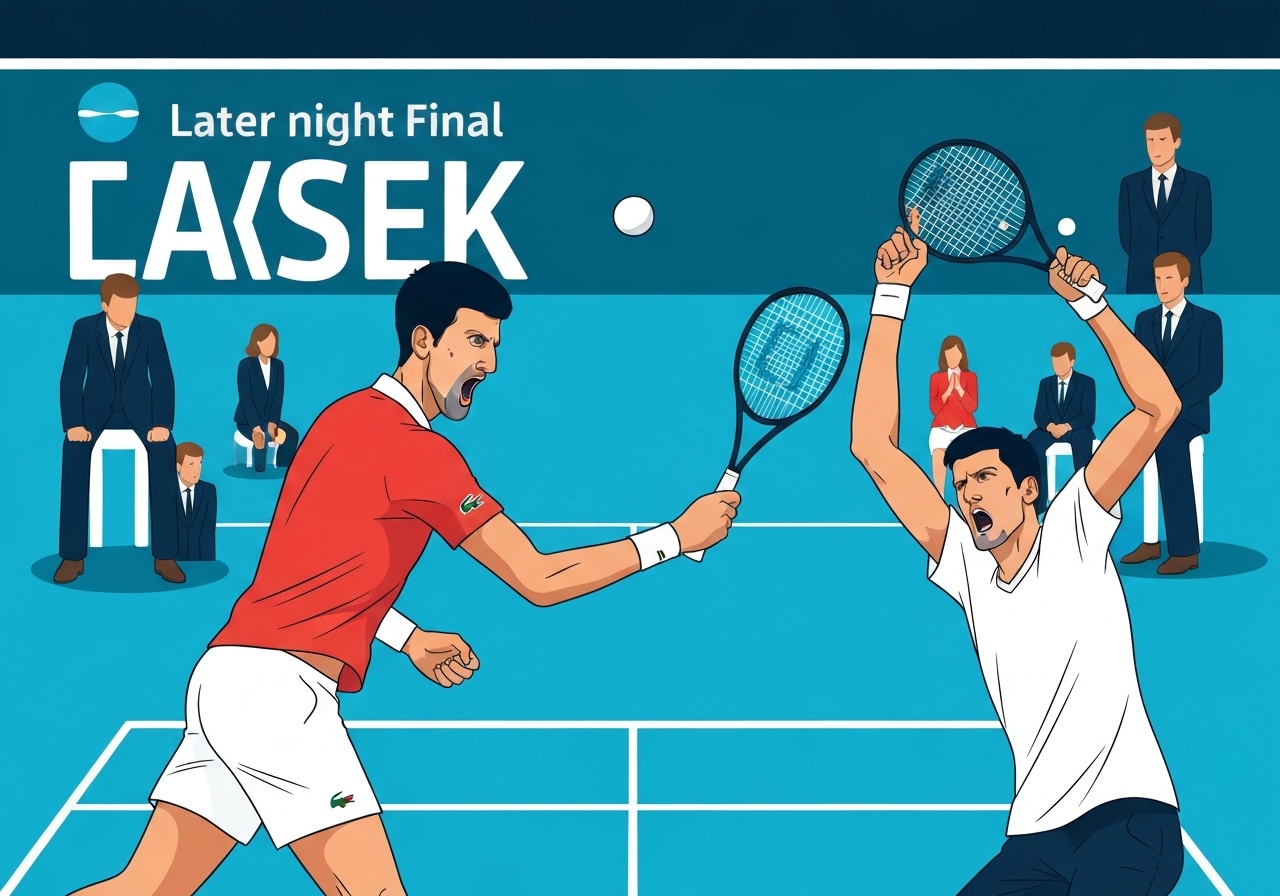
At the finish, Djokovic dropped to the court on his back and raised his arms, an exhausted reaction to a contest that combined technical excellence with sheer physical demand. The win also broke his five-match losing run against Sinner and qualified him for a renewal of his rivalry with Alcaraz.
Analysis & Implications
This victory reinforces two concurrent storylines: Djokovic’s exceptional longevity and Sinner’s rise as a generational power. For Djokovic, this is evidence that elite tactical acumen and physical maintenance can extend a career beyond conventional expectations. Reaching an 11th Melbourne final at 38 underlines a sustained standard that few if any peers have matched in the Open era.
For Sinner, the match exposed both strengths and vulnerabilities. His 72 winners and 26 aces demonstrate a top-tier offensive arsenal, yet 42 unforced errors and conversion of eight break-point opportunities in the final set revealed moments of inconsistency under pressure. Those margins were enough to swing a contest decided by a few crucial points.
Strategically, Djokovic’s late-match adjustments—taking the ball earlier, remaining on top of the baseline and choosing higher-percentage serving patterns at critical times—showcase how experience can offset raw power. Saving 16 of 18 break points highlights mental resilience; in matches between elite returners and big servers, clutch defence often determines the outcome.
Looking ahead to the final versus Carlos Alcaraz, the matchup will pit Djokovic’s veteran control against Alcaraz’s explosive shotmaking. If Djokovic can maintain movement and return depth, he can neutralize Alcaraz’s pace. Conversely, Alcaraz’s ability to vary spin and open the court could pressure Djokovic physically over long rallies, especially if conditions favour aggressive baseline play.
Comparison & Data
| Metric | Djokovic | Sinner |
|---|---|---|
| Final score | 3-6, 6-3, 4-6, 6-4, 6-4 | |
| Match time | 4h 9m | |
| Winners | — | 72 |
| Unforced errors | — | 42 |
| Aces | — | 26 |
| Break points faced / saved | 18 / 16 | — |
The table highlights the statistical contrast: Sinner delivered more outright winners and aces, while Djokovic survived by saving an overwhelming share of break points and converting decisive opportunities. Those defensive numbers, rather than raw counts of winners, were decisive in a five-set match where margin and timing mattered most.
Reactions & Quotes
Djokovic expressed a mix of disbelief and gratitude after the match, invoking the physical toll and the intensity of the contest.
“I’m lost for words right now… It feels surreal. Playing over four hours, almost 2am. The level of intensity was extremely high and I knew that was the only way for me tonight to have a chance.”
Novak Djokovic (post-match)
Djokovic also relayed a light-hearted exchange with Carlos Alcaraz, underscoring the camaraderie between rivals ahead of the final.
“I saw Carlos after his match and he told me: ‘I’m sorry to delay the start of your match.’ I told him: ‘I’m an old man, I need to go earlier to sleep.'”
Carlos Alcaraz (recounted by Djokovic)
Unconfirmed
- Whether Djokovic’s physical form after this match will be fully recovered in time for the final remains unclear and depends on his recovery in the coming days.
- Longer-term effects of this five-set performance on Sinner’s season are unconfirmed; medical or training updates from his team have not been published here.
- Any off-court reasons cited informally (for example, Djokovic’s quip about changing his mobile number) are anecdotal and not independently verified.
Bottom Line
Djokovic’s late-night comeback against Sinner is both a testament to his exceptional durability and a reminder that at elite levels the smallest margins decide outcomes. The match combined power tennis with resilient defence: Sinner produced the big numbers, but Djokovic saved the critical points and closed when it mattered.
As Djokovic prepares to face Carlos Alcaraz in the final, the contest will present a classic contrast of generations: a veteran whose game is honed for crisis moments versus a young champion with explosive ball-striking. The final’s outcome will hinge on Djokovic’s movement and return game versus Alcaraz’s ability to control rallies and shorten points.
Readers should watch the recovery reports and official physio updates over the next 48 hours to better assess Djokovic’s chances; in the meantime, this semi-final stands as one of the most significant late-career wins in men’s tennis in decades.
Sources
- The Guardian (news media) — original match report and quotations.
- Australian Open (official) — tournament information and event context.
- ATP Tour (official) — player rankings and career records.