
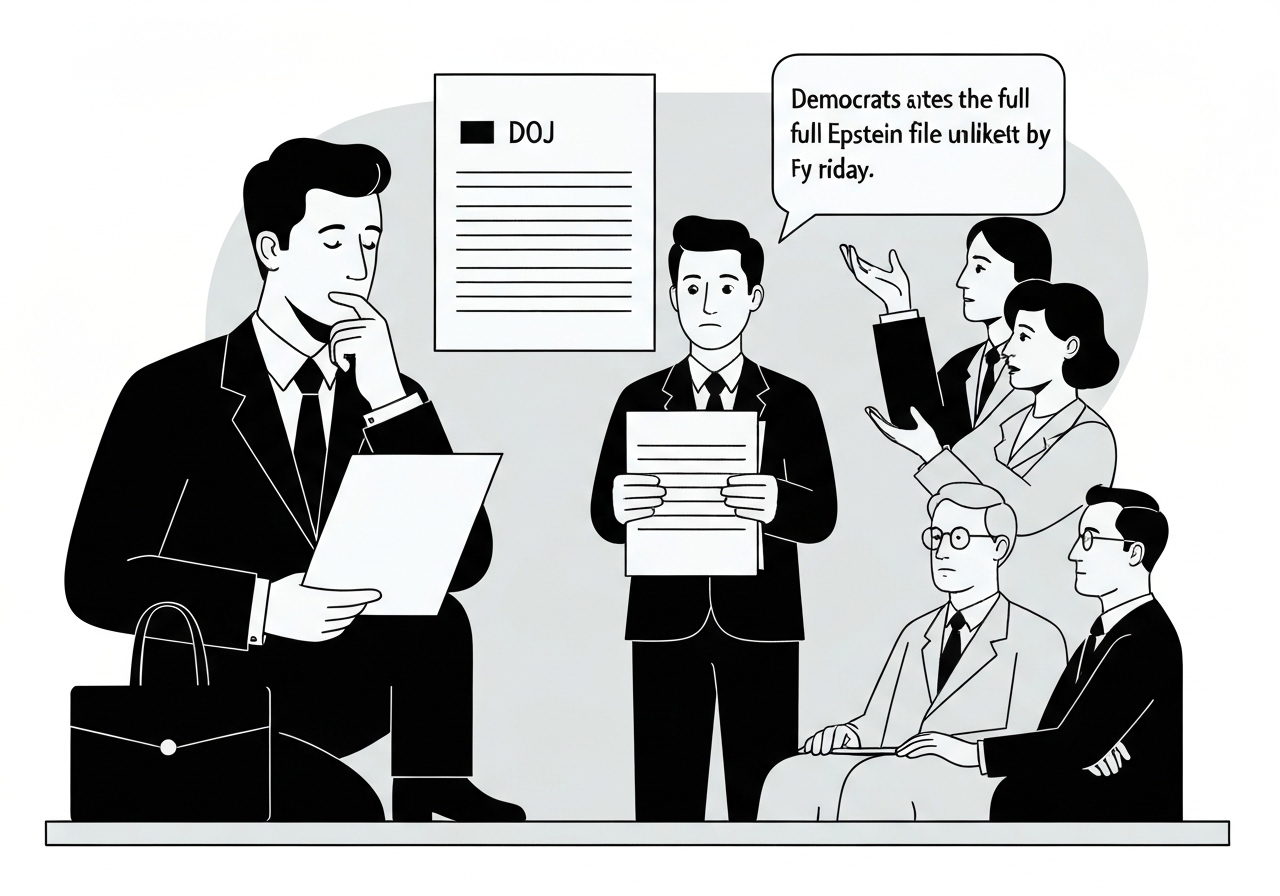
Democratic lawmakers said they are weighing legal steps after the Justice Department announced it would not complete the public release of all records tied to convicted sex offender Jeffrey Epstein by the statutory deadline at 11:59 p.m. on Friday. On Friday the DOJ began releasing hundreds of thousands of pages but Deputy Attorney General Todd Blanche told reporters additional batches would follow over the coming weeks as teams review material for sensitive victim information. The announcement prompted immediate criticism from top Democrats on Capitol Hill, who said the rolling production violates the Epstein Files Transparency Act and vowed to press for full disclosure on behalf of survivors.
Key Takeaways
- The DOJ made an initial public production of “several hundred thousand” pages on Friday and said it expects “several hundred thousand more” in the following weeks.
- Deputy Attorney General Todd Blanche said the department identified over 1,200 names of victims or their relatives and deployed a review team of more than 200 attorneys, including 187 from the National Security Division.
- Senate Minority Leader Chuck Schumer and Rep. Ro Khanna, co-author of the Epstein Files Transparency Act, say the partial release fails to meet the law’s requirements for full, explained disclosure.
- House Democrats including Reps. Robert Garcia and Jamie Raskin say they are “examining all legal options,” including potential contempt or referral actions, to enforce the deadline.
- Republican Rep. Thomas Massie also criticized the release as noncompliant, saying it violates both the “spirit and the letter” of the statute that compelled the vote to make the files public.
- Blanche and DOJ officials argue that a rolling production is necessary because of the volume of material and the need to protect victim privacy, citing established case law against requiring the impossible.
- Sen. Ron Wyden described any failure to publish all records by the end of Friday as a “violation of the law,” framing the dispute as one over statutory compliance and public transparency.
Background
Congress passed the Epstein Files Transparency Act to force the Department of Justice to make investigative records about Jeffrey Epstein publicly available. The statute set a firm deadline — to produce all responsive documents by 11:59 p.m. on Friday — after a prolonged public and congressional outcry over secrecy around Epstein-related investigations. Lawmakers from both parties previously pressed DOJ for fuller disclosure, though Republicans and Democrats have framed the stakes differently: Republicans emphasized constitutional and procedural arguments that led to the compelled vote; Democrats emphasized victims’ rights and institutional accountability.
Jeffrey Epstein’s arrest in 2019 and his subsequent death intensified scrutiny of how prosecutors and other institutions handled both criminal charges and civil allegations linked to a transnational sex trafficking enterprise. Public releases earlier in the year contained names and references to many prominent individuals, prompting renewed demands for a comprehensive archive. The new law aimed to resolve lingering secrecy by legally compelling the department to disclose its records within a narrow window, but it left open how the department should treat sensitive victim information and classified material.
Main Event
On Friday the Justice Department began a large-scale public production of records related to Epstein, describing the first tranche as “several hundred thousand” pages. In interviews and a letter to Congress, Deputy Attorney General Todd Blanche said additional productions would be made in the coming weeks because review teams continue to identify victim information that requires redaction or reconsideration. Blanche said the department’s review had identified more than 1,200 names of victims or relatives, which prompted supplemental review steps and contributed to the staggered schedule.
That explanation immediately drew rebuke from Democratic lawmakers who argued the statute requires both a full release and written explanations for any redactions. Rep. Ro Khanna, a co-author of the bill, posted a video saying the DOJ had not provided the required explanations and labeled the production “incomplete.” He told reporters he is exploring remedies that include impeachment, contempt votes, or criminal referrals to enforce the law’s terms.
Senate Minority Leader Chuck Schumer accused the administration of “breaking the law” and pledged to work with survivors’ attorneys and outside counsel to determine which records are being withheld. Rep. Robert Garcia and Rep. Jamie Raskin, ranking Democrats on the House Oversight and Judiciary Committees, issued a joint statement saying they are “examining all legal options” to compel full compliance. Republican Rep. Thomas Massie also condemned the release as insufficient, saying it fails to meet congressional intent.
Analysis & Implications
The dispute turns on competing legal and practical claims: Congress wrote a deadline into law to secure public access, while DOJ officials argue the scale of material and victims’ privacy obligations make a single-day, comprehensive release impracticable. Courts have at times interpreted statutes so they do not demand the impossible; DOJ cites that body of case law to justify rolling productions. If courts accept that argument here, it could reinforce executive discretion in large disclosure mandates — but if judges side with Congress, the department could face orders to accelerate production.
Politically, the clash elevates oversight tensions between a Democratic-led push for transparency and a Republican administration defending operational choices. Democrats frame the partial release as an institutional cover-up that denies survivors full access to the investigative record; the administration frames its actions as balancing transparency with legal obligations to protect victims and classified information. The outcome could shape future statutes aimed at forced disclosures, determining whether deadlines or process specifications must be stricter to be enforceable.
For survivors and their counsel, the timing of disclosures matters not only for public reckoning but for legal strategy and potential civil litigation. Missing or heavily redacted documents could complicate discovery in private suits or limit evidence available for future prosecutions. Conversely, a full release without careful vetting could risk exposing victims’ identities and hamper ongoing investigations, a point DOJ officials emphasize when describing the size and composition of their review teams.
Comparison & Data
| Item | Reported figure |
|---|---|
| Initial pages released (Friday) | Several hundred thousand |
| Additional pages expected (weeks) | Several hundred thousand |
| Victim/relative names identified | Over 1,200 |
| DOJ attorneys on review team | More than 200 (187 from NSD) |
The table summarizes figures the Justice Department provided publicly: large document volumes and a multi-hundred-person review team. These numbers help explain the department’s claim that a single-night, complete production would be operationally difficult. Still, members of Congress counter that the statute’s deadline reflects legislative intent to force timely transparency; the dispute hinges on how courts interpret that intent against practical constraints.
Reactions & Quotes
Lawmakers on both sides quickly framed the decision through political and legal lenses. Democrats emphasized statutory compliance and victims’ rights; some Republicans echoed concerns that the release fell short of the legislative command that triggered the disclosure vote.
“The Department is breaking the law by failing to release the full record by the deadline — we will not stop until the whole truth comes out.”
Senate Minority Leader Chuck Schumer (statement)
Schumer linked the department’s actions to broader demands for accountability and said Senate Democrats would coordinate with survivors’ attorneys to identify withheld material.
“Our law requires explanations for redactions. There is not a single explanation in this production — it is incomplete.”
Rep. Ro Khanna (co-author, Epstein Files Transparency Act)
Khanna said he is considering remedies up to impeachment or criminal referral to enforce the statute’s terms, and pledged to work with survivors to secure complete records.
“The Department has worked diligently to meet the Act’s deadline, but the volume of materials to be reviewed means the Department must produce responsive documents on a rolling basis.”
Deputy Attorney General Todd Blanche (letter/interview)
Blanche defended the rolling production as necessary to protect victim privacy and to comply with legal requirements governing disclosure of sensitive information.
Unconfirmed
- Allegations that the partial release was timed to protect a specific political figure remain unproven and are assertions from critics rather than established facts.
- Exact final volume of documents that will be publicly produced remains unknown; DOJ provided estimates but no definitive total count has been published.
- Claims that particular records have been intentionally withheld for non-privacy reasons have not been independently verified and require documentary proof or judicial review.
Bottom Line
The immediate dispute is legal and procedural: Congress demanded a complete release by a set deadline; DOJ says the scale of material and identified victim information require a phased production. How courts interpret statutory language and accepted case law about impossibility will likely determine whether rolling releases are legally permissible in this instance.
Politically, the episode sharpens oversight conflicts and could set precedent for how future compelled-disclosure laws are enforced. For survivors and the public, the key questions remain whether the full record will be produced promptly and whether redaction explanations will meet the transparency standards lawmakers wrote into the statute.
Sources
- ABC News — media report summarizing DOJ comments, congressional reactions, and DOJ letter (news organization).
- U.S. Department of Justice — official department website and source for letters/statements referenced by DOJ officials (official government).