
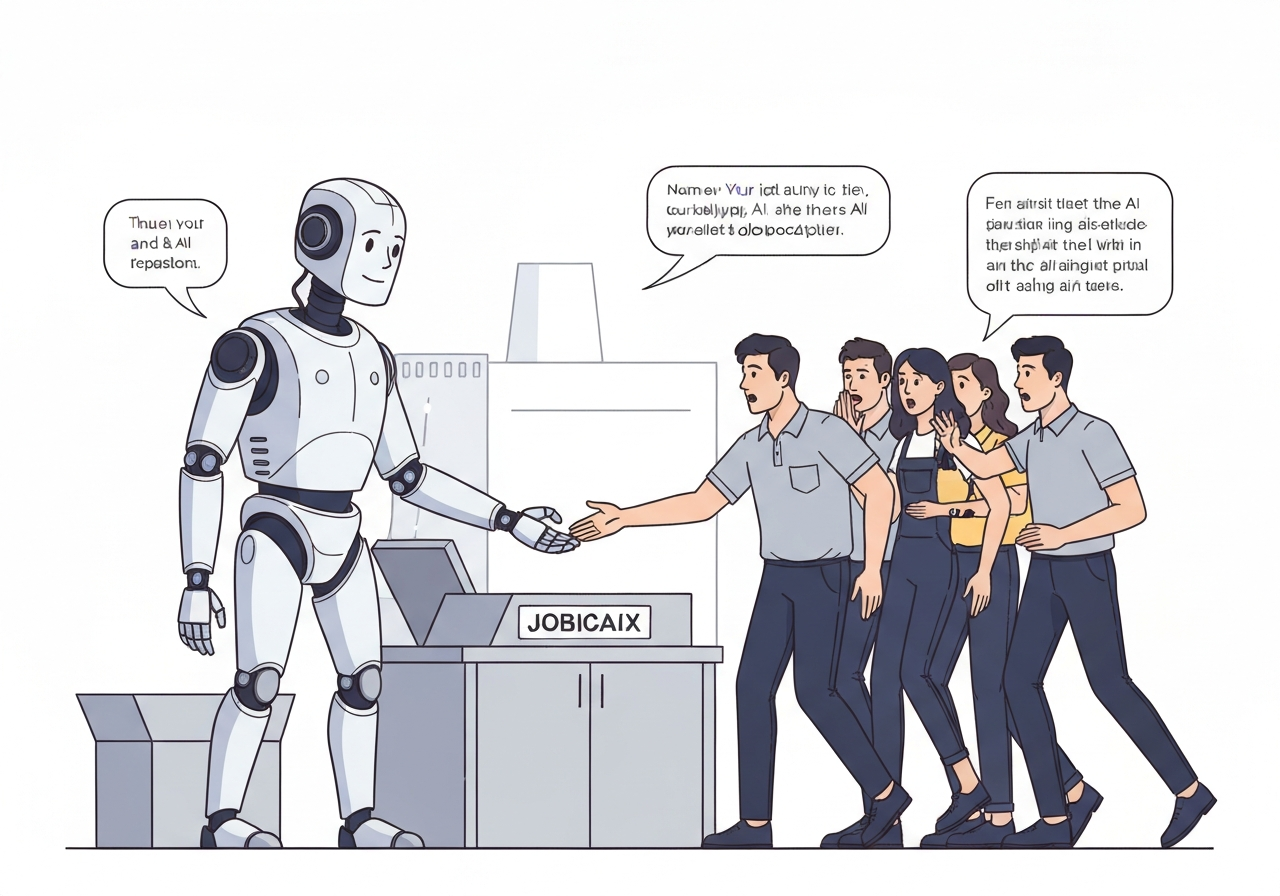
Lead: Debates over an imminent AI-driven mass unemployment — the so-called “jobpocalypse” — have intensified since the public rise of generative models in late 2022. Policymakers, employers and workers worldwide are weighing the speed and scale of automation against the potential for new roles and productivity gains. Early evidence and historical precedent indicate disruption will be uneven across sectors and geographies, producing short-term dislocation more than an inevitable, total collapse of employment. The outcome will depend on policy responses, corporate choices and how quickly workers can reskill.
Key takeaways
- The OECD estimated in 2019 that about 14% of jobs are highly automatable and roughly 32% could undergo significant change in tasks; large-scale transformation is likely but not uniform.
- A McKinsey Global Institute analysis (2017) suggested automation could displace up to 800 million workers globally by 2030 under certain scenarios, while also creating new work as economies adapt.
- The World Economic Forum (2020) projected roughly 85 million jobs might be displaced by automation by 2025 while 97 million new roles could emerge, highlighting simultaneous job loss and creation.
- The public launch of widely accessible generative AI tools in late 2022 accelerated adoption across white-collar and creative functions, increasing automation of repetitive and semi‑routine tasks.
- Historical technology shifts — from mechanised agriculture to ATMs — reduced demand for some roles but ultimately coincided with higher overall employment and new industries, though transitions often took decades and left uneven regional effects.
- Short-term effects are likely to include task reallocation, wage pressure in exposed occupations, and faster demand for digital and interpersonal skills; policy interventions will shape distributional outcomes.
Background
Concerns about machines replacing human work are longstanding. Previous industrial revolutions replaced particular tasks but also generated new industries and services. The distinguishing feature of current AI systems is their ability to perform cognitive and creative tasks once seen as uniquely human, from drafting text to analysing images, which broadens the range of occupations exposed to automation.
Policy debates have therefore shifted from whether automation will change work to how fast and who bears the cost. Researchers and institutions offer a range of scenarios: some emphasise rapid displacement in a decade, others foresee gradual transformation that allows time for adaptation. What unites most assessments is uncertainty about timing, sectoral detail and the capacity of education and training systems to respond.
Main event
The rapid public uptake of generative AI from late 2022 onward has been a catalyst, prompting businesses to pilot and scale tools for customer service, content production, coding assistance and data analysis. These pilots often replace tasks within jobs rather than whole occupations, but they can reduce hours for some workers and shift hiring demand toward oversight, integration and higher‑level judgment tasks.
Employers typically report productivity gains when AI automates predictable, repetitive elements of work. That reduces routine workloads but raises questions about job design: will remaining human tasks be higher value or will they become lower-paid oversight roles? Early corporate examples show a mixture — some firms redeploy staff to higher-value activities, others use automation to cut headcount.
Geography and sector matter. Manufacturing and logistics have seen long-standing automation; office-based and creative industries have more recently absorbed generative tools. Low- and middle-income countries that rely on routine service exports may face distinct pressures if offshorable, routine tasks are automated, while advanced economies will face different reskilling and redistribution challenges.
Analysis & implications
Macroeconomically, AI could raise productivity growth if firms successfully integrate technology and invest complementary capital and skills. Higher productivity can support higher wages and living standards over time, but the benefits are unlikely to be evenly distributed without deliberate policy. Productivity gains accrue primarily where firms capture value — ownership of models, data, and deployment expertise.
Distributional effects are a central concern. Workers in roles that are task‑routine, codifiable and well‑defined are most exposed to automation, while those requiring complex social judgement, manual dexterity or advanced domain expertise are more resilient. This predicts greater pressure on mid‑skill office and clerical jobs, potentially hollowing out some occupational tiers unless new roles arise to absorb displaced workers.
Policy responses matter. Effective strategies include investing in lifelong learning and targeted reskilling, strengthening social safety nets during transitions, and encouraging corporate practices that share productivity gains with workers. Regulatory measures — from data governance to sectoral standards — can influence how firms deploy AI and how value is distributed across the economy.
Comparison & data
| Historic shift | Primary effect | Time to major adjustment |
|---|---|---|
| Agricultural mechanisation | Large fall in farm employment; growth in manufacturing/services | Decades |
| ATMs in banking | Fewer teller-hours but more branches and new services | 5–15 years |
| Digitalisation / internet | New industries and occupations; routine tasks automated | 10–20 years |
These examples show that technology often eliminates certain tasks while creating different economic opportunities, but the pace and distribution of change vary. Transition periods can be long and politically sensitive, especially where displaced workers cluster in particular regions or sectors.
Reactions & quotes
“Automation reshapes tasks within jobs far more often than it erases entire occupations; policy must focus on smoothing transitions for affected workers.”
OECD (analysis)
“Projections show significant displacement in some scenarios but concurrent job creation in others — the net effect depends on policy and investment choices.”
McKinsey Global Institute (report)
“Our companies are using generative AI to augment teams, not simply replace them, but the shift requires retraining and clear governance.”
Industry leaders (sector statements)
Unconfirmed
- Precise timing for a large-scale employment decline is uncertain — claims of total job losses within one to two years lack robust evidence.
- Predictions of exact net job numbers (losses versus gains) remain scenario-dependent and sensitive to policy, investment and corporate strategy.
- Sector-level impacts vary; blanket statements about entire industries being wiped out are unverified without granular, region-specific analysis.
Bottom line
AI will reshape work substantially, automating many tasks and creating others, but the most plausible near‑term outcome is significant disruption rather than a sudden, universal job apocalypse. The historical record suggests economies can absorb major technological change, yet the scale, speed and fairness of that absorption depend on choices by governments, firms and educators.
Policymakers should prioritise scalable reskilling programs, portable safety nets, and incentives for firms to invest in human capital alongside AI. For workers, the most resilient paths combine technical skills with strong communication, problem‑solving and domain expertise. Those choices will determine whether AI becomes a broad engine of shared prosperity or a source of concentrated displacement.
Sources
- Financial Times — Media/Analysis
- OECD — Analysis on automation and employment — International organisation analysis
- McKinsey Global Institute — Independent research (jobs and automation scenarios)
- World Economic Forum — Future of Jobs Report 2020 — Multi-stakeholder research