
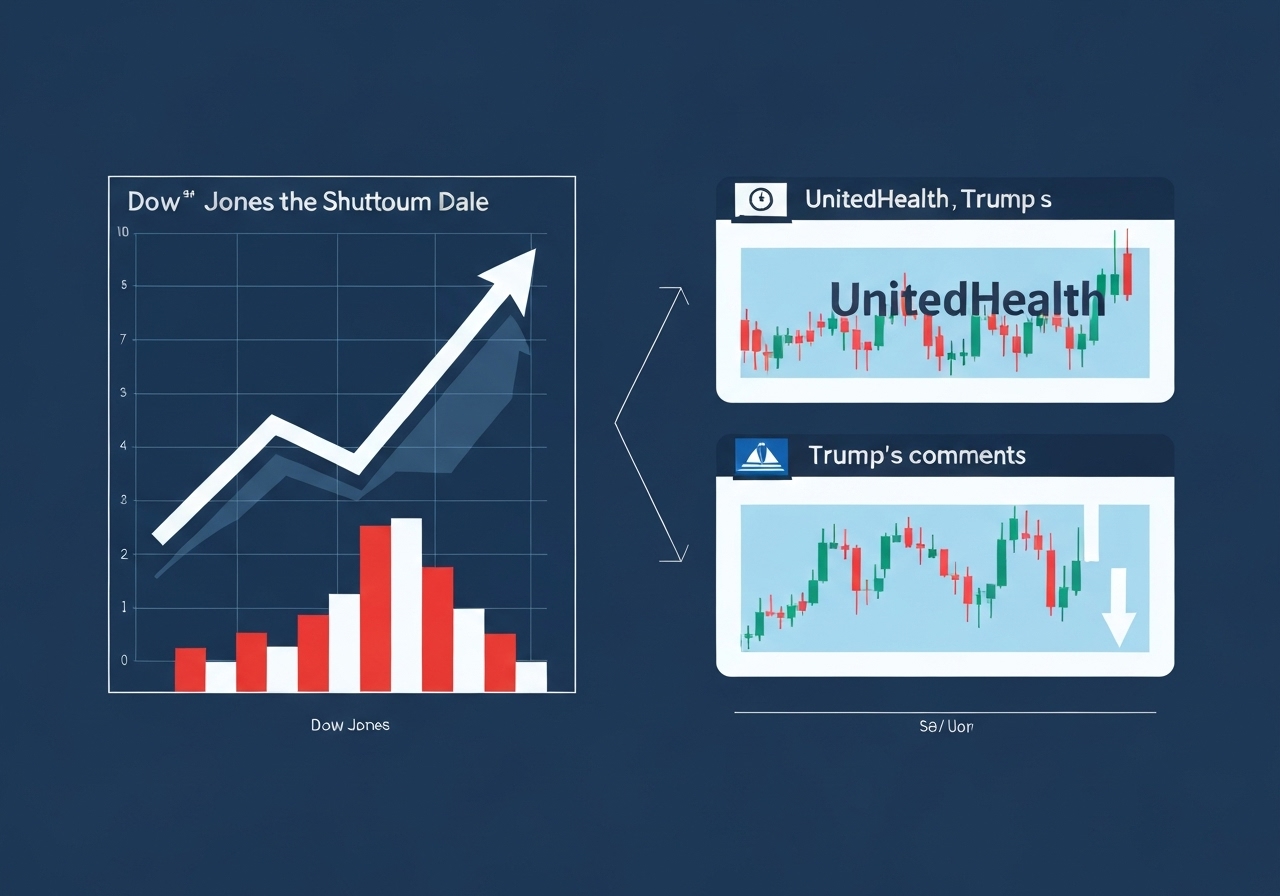
Lead: Futures for the Dow Jones Industrial Average and other major U.S. indexes rose in premarket trading Monday after a late-Sunday vote advanced a measure to end the federal government shutdown. The market reaction reflected relief that a funding agreement may be imminent, though trading stayed cautious ahead of the open. UnitedHealth Group shares fell after President Donald Trump made comments about health insurers, amplifying sector volatility. Separately, Investors.com warned of scheduled maintenance from 10:00 PM ET to 2:00 AM ET that may limit access to some site features.
Key Takeaways
- Late Sunday, a key procedural vote advanced a bill intended to end the government shutdown; markets reacted positively in premarket Monday trading.
- Dow futures rose in early trading, lifting broader sentiment across the S&P 500 and Nasdaq ahead of the session open.
- UnitedHealth Group (UNH) declined after President Trump’s remarks about health insurers, making it one of the larger movers among large-cap names.
- Investors remained cautious: trading volumes and volatility typically increase around funding votes and political milestones.
- Investors.com will perform scheduled maintenance from 10:00 PM ET to 2:00 AM ET; some features may be unavailable during that window.
Background
The U.S. federal government entered a funding impasse that prompted a partial shutdown earlier in the week, creating uncertainty for markets that sensitive to fiscal outcomes. Funding stalemates often heighten investor risk aversion because they can delay federal payments, slow economic data releases, and complicate policymaking. In recent years, short-term shutdowns have produced transient market reactions that reverse once lawmakers reach a stopgap or continuing resolution. Key stakeholders include House and Senate leaders, the White House, affected federal employees and contractors, and large employers whose operations intersect with federal programs.
Financial markets price political risk continuously; even the prospect of compromise can shift short-term positioning among funds, pension investors and high-frequency traders. For equity market participants, sectors such as defense, federal contractors and health insurers often display outsized sensitivity to shutdown-related headlines. Traders also monitor liquidity conditions and upcoming corporate calendars, since earnings, economic prints and policy comments can amplify intraday moves.
Main Event
Late Sunday, lawmakers in a congressional chamber advanced a proposal designed to reopen government functions, triggering immediate positioning in futures markets before Monday’s open. Market orders placed in premarket trading reflected a relief rally as participants reduced some of the political-risk premium they had been carrying. Equity futures for the Dow and other benchmarks moved higher, signaling an expectation that uncertainty tied to the shutdown could ease in the near term.
UnitedHealth Group emerged as a notable decliner amid the session, with traders linking the drop to public comments by President Trump aimed at health insurers. Those remarks appeared to raise concerns about near-term regulatory or political pressure on insurers’ margins and revenue outlook. Market participants said the combination of politics and sector-specific news can accelerate intraday rotations from growth into defensive names and back as headlines change.
Throughout the premarket and into the regular session, investors balanced the positive implications of a potential funding deal against lingering execution risks: timing of final passage, any attached policy riders, and implementation details that could alter fiscal forecasts or sector-specific exposure. As a result, while headline risk eased, market participants noted a still-elevated sensitivity to follow-up developments and official confirmations.
Analysis & Implications
A workable deal to end the shutdown would reduce an immediate source of economic drag and policy uncertainty, which typically supports equity valuations in the short run. Reduced fiscal disruption can normalize government payrolls and agency operations, stabilizing demand for services tied to federal activity. For investors, the near-term implication is a recalibration of risk assets: higher-beta names may recover some ground, while defensive allocations could be trimmed as the perceived tail risk diminishes.
UnitedHealth’s decline underscores how political comments can transmit to corporate valuations even absent new regulation. Insurers operate in a highly regulated sector where policy pronouncements can affect future reimbursement rates, benefit design and pricing power. If political rhetoric hardens into concrete policy proposals, insurers could face margin pressure that would alter earnings trajectories and valuation multiples.
On a broader level, U.S. equity sensitivity to political events highlights the importance of scenario planning for portfolio managers: mapping outcomes from full passage, partial funding, to further delays. Fixed-income markets and foreign investors will also watch final legislative language for fiscal implications that could influence Treasury yields and dollar strength. In sum, a passed deal would likely be a short-term positive for markets but one that leaves open questions about policy details and medium-term fiscal direction.
Comparison & Data
| Index | Premarket Direction |
|---|---|
| Dow Jones Industrial Average | Up (premarket) |
| S&P 500 | Up (premarket) |
| Nasdaq Composite | Up (premarket) |
The table above summarizes qualitative premarket moves reported ahead of Monday’s open. Investors typically interpret uniform premarket gains as a broad-based risk-on signal, though intraday dynamics can diverge by sector and company news. Traders use these early indications alongside order flow and economic releases to shape opening strategies.
Reactions & Quotes
Market sources and commentary framed the advance vote as the key trigger for early optimism.
Investors.com noted scheduled site maintenance between 10:00 PM ET and 2:00 AM ET that may restrict access to some features.
Investors.com (media)
Traders described the late-Sunday development as a catalyst for position adjustments, especially among funds that hedge political risk.
Market participants said the procedural vote reduced near-term legislative uncertainty and prompted premarket buying across major indexes.
Market participants (industry commentary)
Observers pointed to political rhetoric as the proximate driver of UnitedHealth’s move.
Analysts linked UnitedHealth’s drop to President Trump’s public comments on health insurers, which increased investor caution in the sector.
Financial media reporting
Unconfirmed
- Exact wording and intended policy consequences of President Trump’s comments on health insurers remain unconfirmed in public reporting at the time of this article.
- The final margin and timing for full legislative passage were not confirmed at the time markets opened; procedural advancement does not guarantee final enactment.
- Detailed figures for UnitedHealth’s intraday percentage decline and sector-level spillover were not provided in the source report and require market-data confirmation.
Bottom Line
The late-Sunday procedural vote that advanced a shutdown-ending measure gave markets a near-term lift in premarket trading Monday, easing one immediate political overhang. However, markets are treating the development as one step in a process: full passage, text of the agreement and implementation timelines will determine how durable the rally is.
UnitedHealth’s decline illustrates how political statements can move individual stocks and sectors quickly, even before policy proposals are formalized. Investors should monitor official legislative updates and corporate disclosures to distinguish transient headline-driven moves from changes to underlying fundamentals.
For readers using Investors.com, be aware of scheduled maintenance from 10:00 PM ET to 2:00 AM ET that may limit site functionality; confirm critical market data through alternate verified sources during that window.
Sources
- Investor’s Business Daily — media reporting and market coverage