
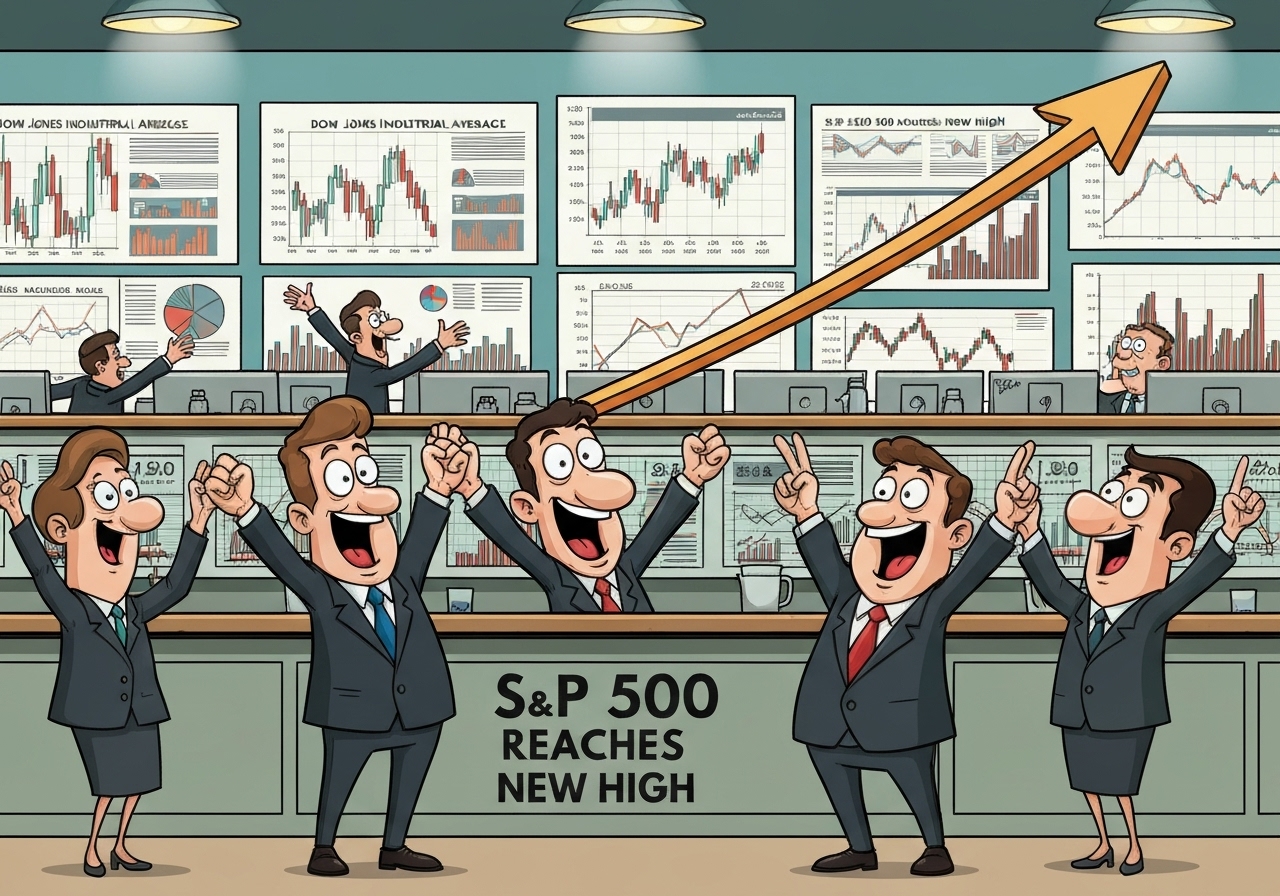
Today in U.S. markets, the Dow Jones Industrial Average climbed while the S&P 500 recorded a fresh high, and a mid-cap aerospace stock staged a technical breakout that lifted several sector peers. Traders cited a mix of economic data and trade-related headlines as drivers of risk appetite, while market-data feeds showed active intraday flow. The moves came amid continuing attention on labor-market signals and policy-related commentary, which pushed investors to reprice near-term growth and inflation expectations.
Key Takeaways
- The Dow Jones Industrial Average finished higher today, reversing modest weakness earlier in the session and buoyed by heavyweight names.
- The S&P 500 hit a new record intraday level, extending a recent rally in large-cap growth and cyclicals.
- An aerospace company (mid-cap) cleared technical resistance, producing a pronounced breakout and outperformance within the industrials sector.
- Market participants noted that labor-market indicators and trade-policy remarks were primary catalysts for intraday rotation between sectors.
- Real-time prices were supplied via Nasdaq Last Sale; ownership and estimate metadata reflected LSEG and FactSet inputs.
- This report is informational and not investment advice; readers should verify data and consult their advisors before acting.
Background
U.S. equity benchmarks have been tracking a mix of macro updates and corporate-specific news in recent sessions. Investors remain sensitive to labor-market prints because they inform expectations for monetary policy and growth momentum; even subtle surprises can shift sector leadership. At the same time, trade-related comments—both current and potential future measures—continue to influence cyclical sectors, particularly aerospace and industrials, which are exposed to supply chains and export demand. Market-data vendors and research firms have increased the frequency of intraday estimate revisions, making real-time feeds and ownership records more prominent for active traders.
Historically, periods of steady S&P 500 gains coincide with rotation among value and growth pockets rather than uniform strength. Aerospace companies, for example, can swing with defense budgets, commercial aircraft orders, or supply-chain dynamics, and a technical breakout in one name often pulls several smaller suppliers higher. Analysts and proprietary screens frequently highlight such breakouts as potential leading indicators of sector breadth improving. That interplay between macro news and technical triggers is shaping the current trading environment.
Main Event
The session opened with modest gains but accelerated after early buying interest in large-cap technology and industrials. The S&P 500 pushed to a new high in the mid-afternoon when buyers absorbed lighter-than-expected selling pressure, while the Dow climbed as several blue-chip components rallied. In the aerospace group, one company cleared a key resistance level after stronger-than-expected order commentary and technical buying, prompting momentum-driven inflows into related suppliers. Traders noted that the breakout appeared to be driven by both fundamental updates and algorithmic strategies responding to volume and price thresholds.
Across sectors, rotation was visible: defensive names lagged while cyclicals and select growth stocks outperformed. Market breadth improved as more S&P 500 constituents posted gains versus recent sessions. Option-implied volatility eased for the major indices, reflecting reduced short-term hedging demand after the market established new highs. Liquidity in mid-cap aerospace names tightened as retail and institutional interest rose following the breakout signal.
Data providers showed real-time quotes from Nasdaq Last Sale, and estimate/ownership overlays were provided by FactSet and LSEG respectively. Market participants used those feeds to monitor flows and update models intraday. Execution desks reported stepped-up activity in industry ETFs and single-stock orders tied to the aerospace rally. Overall, the session reflected a combination of fundamentals, technical triggers, and real-time data-driven trading.
Analysis & Implications
The immediate implication of the S&P 500’s new high is a reduction in near-term technical resistance, which can encourage momentum players and trend-following funds to add exposure. However, record levels do not guarantee a sustained advance; the market remains sensitive to macro surprises such as unexpected labor-market readings or trade-policy shifts. If incoming economic data show persistent strength, investors may increasingly price in a higher-for-longer policy path, weighing on rate-sensitive sectors while favoring cyclicals that benefit from robust growth.
The aerospace breakout is notable because sector leadership can presage broader cyclical rotation. Aerospace firms are tied to both commercial aviation cycles and defense spending, so renewed strength in this area could signal improving industrial demand. Still, single-stock breakouts often require confirmation through expanding volume and follow-through in peer groups. Portfolio managers will be watching order books, supplier commentary, and backlog metrics to determine whether today’s move represents a durable trend or a short-term momentum spike.
On the international front, trade headlines and tariff-related commentary can alter supply-chain expectations and cross-border demand for aircraft and components. Persistent rhetoric about tariffs or export controls would raise costs and uncertainty for aerospace firms, potentially reversing gains. Conversely, any indications of easing trade friction could reinforce the sector’s upward momentum. Investors should therefore monitor both company-level updates and policy developments for a full picture of downside and upside risks.
Comparison & Data
| Index / Sector | Session Status |
|---|---|
| S&P 500 | New intraday high |
| Dow Jones | Advanced, led by select blue chips |
| Aerospace (noted name) | Technical breakout, peers rallied |
The table above summarizes the session’s directional outcomes without prescribing specific price levels. While the S&P 500 reached a fresh high, breadth improvements were moderate rather than broad-based. The aerospace name’s breakout coincided with rising volumes, but analysts will look for multi-session confirmation and corroborating fundamentals such as order backlog or margin trends. Historical comparisons show that sector-led rallies that align with macro improvement tend to sustain longer than isolated momentum moves.
Reactions & Quotes
Market desks and strategists offered quick takes as the session unfolded, noting the interplay between macro signals and technical action.
“Investors are currently balancing labor-market data with trade headlines, and that mix is driving sector rotation rather than a uniform market advance.”
Market strategist, major brokerage (comment)
The strategist emphasized that recent macro releases have produced nuanced market responses, prompting traders to favor names with clearer growth exposure. They added that technical breakouts often attract short-term allocators even when fundamental visibility remains mixed.
“A breakout in a mid-cap aerospace stock can draw in ecosystem flows—suppliers and smaller peers often follow if order trends support the move.”
Equity analyst, industrials coverage (comment)
The analyst noted that confirmation looks for expanding volume, improving backlog commentary, and a narrowing of downside risks in supply chains. They recommended watching upcoming quarterly updates for momentum validation.
“Real-time market feeds and ownership overlays are increasingly central to intraday decision-making for active traders.”
Trading desk head, electronic execution firm (comment)
This trading-desk view highlights the practical role of Nasdaq Last Sale quotes alongside LSEG and FactSet inputs in shaping intraday executions and model adjustments. The desk head said execution algorithms reacted quickly to the aerospace breakout, amplifying price moves.
Unconfirmed
- Reports that a pending tariff announcement directly triggered today’s aerospace rally remain unverified and lack an official confirmation.
- Several market rumors circulated about accelerated corporate order receipts in the aerospace name; these claims have not been corroborated by public filings or company statements.
- Speculation that large institutional rebalances were the primary cause of the S&P 500’s record has not been confirmed by regulatory filings or fund disclosures.
Bottom Line
Todays session combined macro sensitivity with technical market mechanics: the S&P 500’s new high reflects continued investor willingness to own large-cap equities, while the aerospace breakout highlights how sector-specific developments can shift intraday leadership. Traders should demand confirmation—expanding volume, corroborating company fundamentals, and consistent peer behavior—before treating a breakout as a durable trend. For portfolio managers, the near-term outlook hinges on upcoming economic releases and any further policy-related headlines affecting trade and supply chains.
Readers should treat this write-up as informational rather than investment advice. Market-data feeds cited here (Nasdaq Last Sale; ownership and estimates via LSEG and FactSet) informed the coverage, but verification against official releases and regulatory filings is recommended before making financial decisions.