
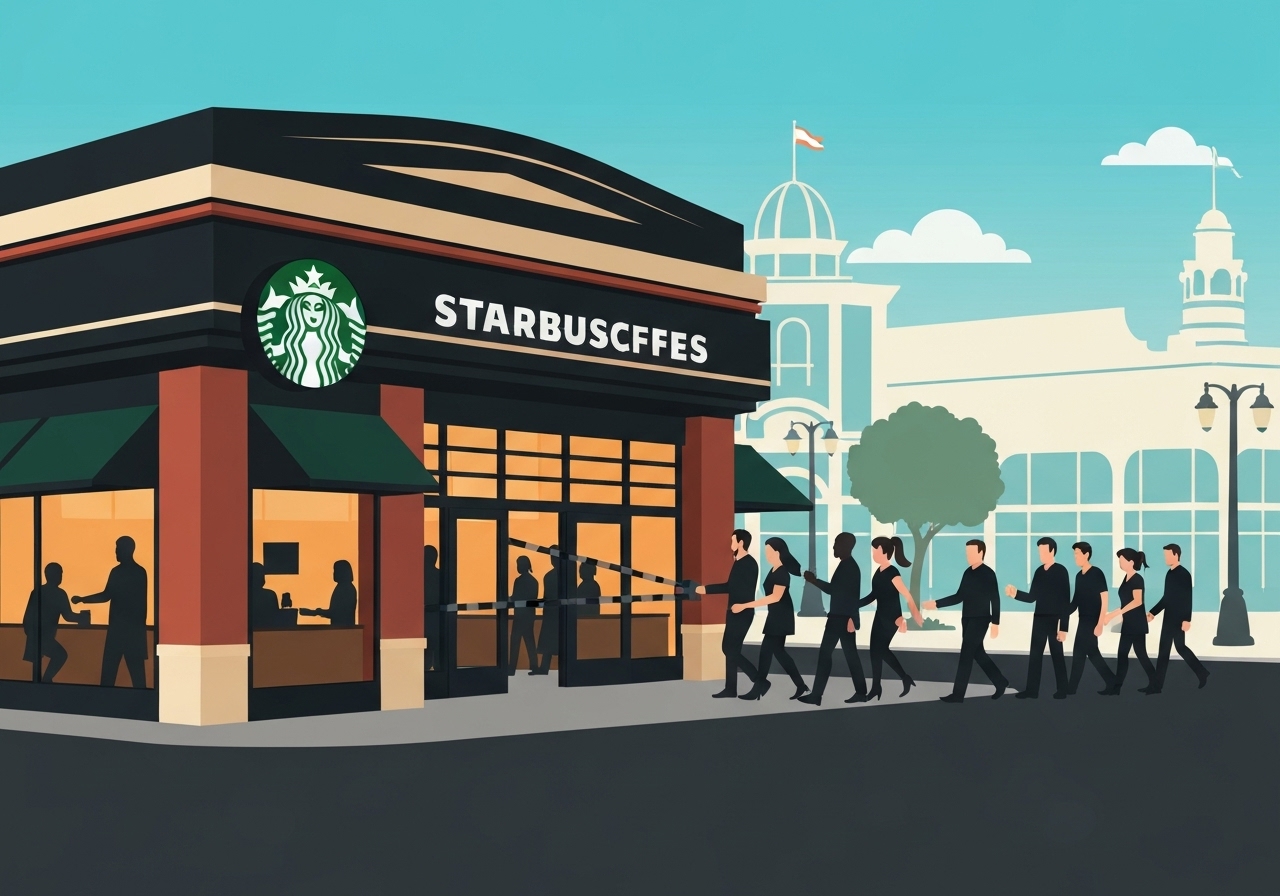
— A heavily frequented Starbucks at Downtown Disney in Anaheim, California, shut its doors on Saturday night after baristas walked off the job in a labor action. The walkout, organized by Starbucks Workers United, followed a union vote authorizing strikes during ongoing national contract negotiations. The closure was reported by local outlets and is reflected on Starbucks’ store locator, which lists the site as closed. Customers and park visitors encountered the unexpected shutdown during a busy evening, raising questions about timing ahead of the holiday promotion known as Red Cup Day.
Key Takeaways
- Location and date: Downtown Disney Starbucks in Anaheim, California, closed on the night of Nov. 8–9, 2025 after employees walked out, according to local reports.
- Labor motive: Workers cited demands for fair pay, predictable scheduling and an end to union-busting; the action was coordinated by Starbucks Workers United.
- Union action authorized: The union had voted to authorize strikes nationwide in the week preceding the walkout, part of broader contract negotiations with Starbucks.
- Operational impact: The store locator lists the Downtown Disney outlet as closed; the shutdown affected a high-traffic venue adjacent to Disneyland and Downtown Disney visitors.
- Timing concerns: The walkout occurred days before Starbucks’ seasonal Red Cup Day, a period when barista staffing and customer volume typically increase.
- Scope: The strike is local to this store but is linked to a nationwide dispute; not all Starbucks locations are participating in strikes.
Background
Starbucks Workers United, the union representing many organized Starbucks baristas, has been negotiating with Starbucks over a national contract covering wages, scheduling practices and anti-union conduct. Since 2021, unionization efforts at Starbucks have spread across hundreds of stores, bringing labor relations to the forefront of the company’s public profile. Contract talks have produced periodic escalations, including authorized strike votes and targeted store actions meant to pressure the company to make concessions.
Downtown Disney’s Starbucks is among the chain’s busiest individual locations due to its proximity to Disneyland and high foot traffic from visitors and tourists. Labor actions at high-visibility sites are a common tactic in modern organizing campaigns: they maximize public attention and leverage while signaling seriousness in stalled negotiations. Company officials and union representatives typically meet through bargaining rounds, but progress can be uneven and punctuated by local walkouts or public demonstrations.
Main Event
On the night of the closure, baristas at the Downtown Disney outlet left their posts and staged a walkout after informing management of their decision, according to local news reporting. The union framed the action as a response to stalled bargaining and what employees describe as unpredictable schedules and compensation that do not match the store’s sales volume. Management temporarily shuttered service at that specific location; other nearby Starbucks stores continued operating.
Witnesses and customers reported finding the Downtown Disney shop closed without the usual notice many expect for planned service interruptions. Starbucks’ public store locator showed the site as closed following the walkout, consistent with accounts from LAist and NJ.com. The union announced the action on social channels, highlighting the workers’ demands and the proximity of the walkout to the holiday season.
The shutdown did not appear to be linked to safety incidents or regulatory actions; local authorities were not reported to be involved. Instead, the disruption was explicitly tied to labor-management conflict and the timing of authorized national strike activity. Company spokespeople have in other instances characterized such walkouts as unsanctioned by management, while unions assert worker agency in pressing for faster progress at the bargaining table.
Analysis & Implications
The Downtown Disney closure illustrates how localized labor actions can have outsized operational and reputational impact when they occur at flagship or high-visibility locations. For Starbucks, a store adjacent to a major tourist destination carries both revenue significance and symbolic weight; closures there amplify public attention and may increase leverage for workers seeking concessions. If similar actions are repeated at other busy sites, the company could face concentrated service disruptions during peak seasonal demand.
Economically, intermittent store shutdowns can ripple through nearby vendors and the wider visitor experience in entertainment districts such as Downtown Disney. Consumers who planned purchases or relied on quick-service options were forced to seek alternatives, potentially shifting revenue to competitors like local cafés or other quick-service chains. For the chain’s corporate bargaining position, visible disruptions increase media scrutiny and can influence public perceptions of both the union and management.
Politically, the walkout underscores tensions over scheduling practices that many workers nationwide have flagged: unpredictable shifts, last-minute cancellations and hours that complicate household budgeting. Those issues have become central bargaining items in many service-sector negotiations, and a favorable outcome for these Downtown Disney workers could set an example for other organized locations. Conversely, a protracted impasse risks hardening positions and prompting more widespread authorized actions.
Comparison & Data
| Metric | Downtown Disney Store | Typical Starbucks Store |
|---|---|---|
| Service status (Nov. 11, 2025) | Closed after walkout | Open (varies by location) |
| Visibility | Very high (tourist hub) | Variable (neighborhood/retail) |
| Union presence | Unionized (represented by Starbucks Workers United) | Mixed (many non-union) |
The table shows why a closure at Downtown Disney has larger local and public effects than a typical neighborhood store closure. High foot traffic and tourist dependence magnify the immediate consumer-facing impacts, while union representation increases the likelihood the action is framed as part of nationwide bargaining dynamics.
Reactions & Quotes
Union representatives framed the walkout as a targeted action to pressure Starbucks in ongoing negotiations. The union’s messaging emphasized fairness and scheduling as core demands.
“Our members walked out to demand fair pay and stable schedules — we will use every lawful tactic to make our priorities clear at the bargaining table.”
Starbucks Workers United (union statement)
Starbucks corporate communications typically emphasize dialogue and the company’s position on bargaining. In prior incidents, Starbucks has cited concerns about the operational disruption caused by unsanctioned walkouts.
“We are committed to negotiating in good faith and serving our customers. We are assessing the situation at the Downtown Disney location and hope to restore service quickly.”
Starbucks spokesperson (company statement)
Local patrons expressed frustration at the unexpected closure, particularly given the store’s location near major attractions. Many noted the timing ahead of a seasonal promotional day increases inconvenience.
“We came from the park for a quick coffee and found it closed — it was a surprise for all of us that evening.”
Local customer (on-site account)
Unconfirmed
- The exact number of employees who participated in the Downtown Disney walkout has not been independently verified by official headcounts.
- The length of the closure and whether it will extend beyond short-term shifts remains unconfirmed pending further statements from management or the union.
- Any specific concessions being negotiated (wage figures, schedule guarantees) have not been publicly confirmed in a finalized contract.
Bottom Line
The abrupt closure of the Downtown Disney Starbucks on Nov. 8–9, 2025 is a localized manifestation of a larger national labor dispute between Starbucks and Starbucks Workers United. The action underscores how strategically timed walkouts at high-visibility sites can shape bargaining dynamics and public perception. For customers and visitors, the immediate effect is operational inconvenience; for the company and union, the balance of leverage may shift depending on media coverage and subsequent actions.
Observers should watch for follow-up developments: any official statements from Starbucks, further authorized strikes at other prominent locations, and whether bargaining talks produce concrete, verifiable commitments on pay and scheduling. Those outcomes will determine whether this closure is an isolated incident or a sign of escalating labor conflict into the holiday season.