
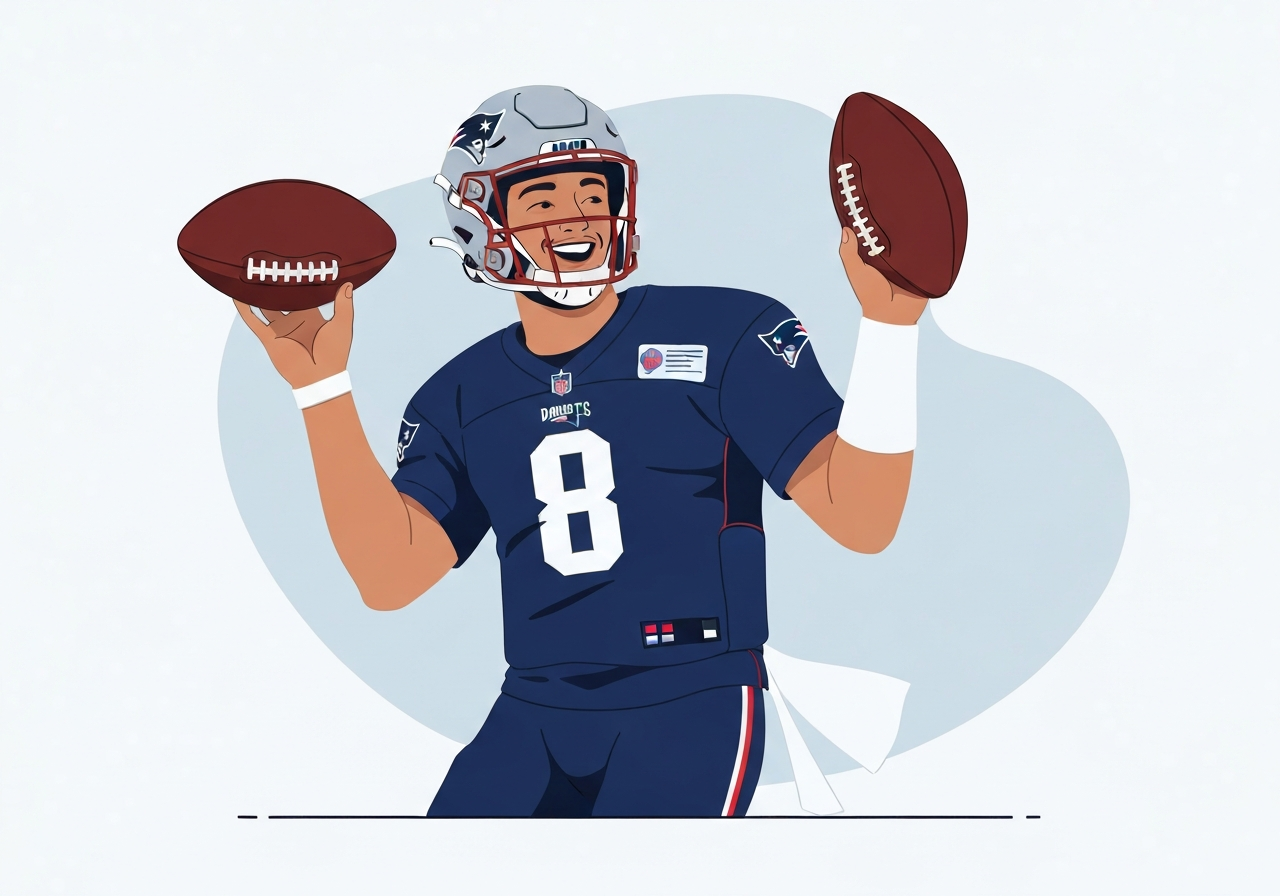
SAN JOSE, Calif. — New England Patriots quarterback Drake Maye said Monday that his right throwing shoulder, injured in the AFC Championship Game, has “turned a corner” as the club prepares for Super Bowl LX against the Seattle Seahawks. Speaking at the team’s opening-night event in San Jose, Maye reported he took his normal number of throws during a 90-minute practice at Stanford and felt encouraged after travel and warm California weather. He acknowledged a brief illness that kept him out of Friday’s session but said he is healthy and expects a conventional preparation week ahead of Sunday. The quarterback credited the Patriots’ athletic training staff, led by Jim Whalen, for helping his recovery.
Key takeaways
- Drake Maye said his right throwing shoulder was injured in the AFC Championship Game but “turned a corner” after recent treatment and rehab.
- On Monday at Stanford University, the Patriots held a ~90-minute practice; Maye said he threw his normal number of reps and “a good bit.”
- Maye was limited in Thursday’s practice and missed Friday’s session because of illness, then attended practice later that day as a spectator.
- The comments were made at opening-night events in San Jose, Calif., ahead of Super Bowl LX versus the Seattle Seahawks on Sunday.
- Maye specifically credited head athletic trainer Jim Whalen and the training staff for his progress.
- He emphasized confidence in being ready for the game, describing the Super Bowl prep window as an opportunity to get treatment and fine-tune recovery.
Background
Maye sustained a right-shoulder injury during the AFC Championship Game that raised questions about his availability and effectiveness for the Patriots’ upcoming Super Bowl LX matchup with the Seattle Seahawks. Shoulder injuries to quarterbacks often affect throwing velocity, accuracy and comfort, prompting conservative timelines and stepwise progressions through throwing protocols. The Patriots, a franchise with extensive playoff and Super Bowl experience, entered a high-stakes preparation period in San Jose with heightened medical surveillance and a focused practice plan. Jim Whalen, the team’s lead athletic trainer, has overseen rehabilitation for key players throughout the season, underscoring the club’s emphasis on incremental return-to-play measures.
New England’s coaching staff has historically balanced on-field work with medical caution in postseason runs; that approach informed limited practice sessions late last week. Maye’s limited participation on Thursday, then absence on Friday due to illness, followed by active throwing on Monday, fits a monitored ramp-up rather than a binary cleared/not-cleared timeline. Environment and recovery logistics—such as milder California temperatures and two weeks between the AFC title game and the Super Bowl—provided extra opportunities for rest and targeted treatment. The team faces both the immediate task of preparing a game plan for Seattle and the longer task of ensuring its starting quarterback is physically reliable for a championship game scenario.
Main event
On Monday the Patriots conducted a roughly 90-minute practice at Stanford University; Maye said he completed what he described as his normal number of throws and that he “threw a good bit.” He characterized Sunday—after the team’s flight to California—as a turning point, saying he felt improvement following travel and a treatment regimen. Maye was limited in practice on Thursday and did not take part on Friday because of an illness circulating in the locker room, though he later attended that practice to observe after reporters had left. At the public opening-night event in San Jose, he demonstrated visible confidence, rotating his right shoulder while describing his progress and saying he expected to be fully ready for the Super Bowl.
The quarterback repeatedly framed the situation as recoverable rather than precarious, noting the extended preparation window between playoff rounds as an advantage. He singled out the team’s athletic training staff—led by Jim Whalen—for assisting his stepwise return to throwing. Patriots coaches plan a standard practice cadence this week with sessions Wednesday through Friday, and Maye indicated he looked forward to that routine as part of final preparations. The club has not announced any change to the starting lineup; Maye’s public remarks suggest the team anticipates him taking the field Sunday unless new information emerges.
Analysis & implications
From a medical and performance standpoint, Maye’s report of completing his usual throwing workload on Monday is a positive sign but not definitive proof of full recovery. Quarterback shoulder injuries can respond quickly to rest and targeted therapy, yet late-stage rehab still requires functional tests under game-like stress to evaluate arm strength, throwing accuracy and pain under fatigue. The Patriots’ decision to maintain a measured practice schedule indicates they value controlled exposure over high-volume reps that could risk setback. For New England, fielding Maye at or near full strength is essential; an impaired throwing shoulder could constrain downfield passing, timing with receivers and play-calling balance.
Strategically, the Patriots may adjust game planning based on Maye’s in-practice performance this week—emphasizing short, rhythm throws, play-action off effective run schemes, or more quarterback protections to limit contact. Opposing defenses such as the Seahawks will scout the pace and depth of Maye’s throws during visible practices to infer limitations. A healthy-sounding quarterback can also influence locker-room morale and betting markets; Maye’s public confidence may dampen speculation about a diminished role and reduce pressure on coaching staff to reveal medical specifics. Still, medical progress reported in public settings must be corroborated with non-public imaging and performance metrics that the team typically does not release.
Finally, the presence of Jim Whalen and the training staff in public comments reinforces a coordinated, team-led recovery narrative that aims to reassure stakeholders—fans, league officials and media—without disclosing clinical detail. If Maye maintains or increases throwing volumes through midweek practices without setbacks, the probability he starts and performs near baseline on Sunday will rise materially. Conversely, any regression or new symptoms would force rapid adjustments to the game plan and personnel usage.
Comparison & data
| Day | Location | Participation |
|---|---|---|
| Thursday (pre-San Jose) | Team practice | Limited participation |
| Friday | Team practice | Did not practice (illness); observed later |
| Monday | Stanford University (90-minute practice) | Threw normal number of reps; “a good bit” |
The table summarizes Maye’s reported practice timeline in the days before Super Bowl LX. The pattern shows a conservative ramp-up: limited activity, a brief non-participation tied to illness, and a return to fuller throwing on Monday. That sequence is consistent with a managed return to play when a player has recently suffered a throwing-shoulder injury and experienced an intervening illness. Medical staff typically use such stepwise progressions to evaluate tolerance to throwing loads and to prevent re-aggravation under practice stress.
Reactions & quotes
Maye’s public comments sought to convey confidence while acknowledging the team’s careful process for his return. His directness is intended to reassure teammates and fans without substituting for medical details the team will keep private.
“I’m feeling good. I’ll be just fine.”
Drake Maye, New England Patriots quarterback
That brief statement was delivered with a wink at the San Jose event and followed by a longer description of how flight recovery and practice reps influenced his assessment. Team sources emphasize that public optimism must be tempered by objective testing in controlled practice sessions.
“I really had no doubt in being 100 percent for the game.”
Drake Maye, New England Patriots quarterback
Maye framed the two-week preparation window between the AFC Championship and Super Bowl LX as a key factor enabling thorough treatment and rehab. He named Jim Whalen and the athletic training staff when describing support that aided his recovery, though the staff did not provide a separate public medical update.
“It’s cold out there, some sickness was going around in the locker room, but I’m really feeling good.”
Drake Maye, New England Patriots quarterback
He used that remark to explain his Friday absence while underscoring that he returned to the facility as an observer and resumed throwing once symptoms resolved.
Unconfirmed
- No public confirmation of recent imaging results (MRI or ultrasound) related to Maye’s shoulder has been released.
- The team has not provided objective metrics (throwing velocity, pain scores) to quantify Maye’s recovery level.
- There is no official update yet on whether any special in-game protections or snap-count limitations will be employed Sunday.
Bottom line
Drake Maye’s Monday report that he threw his normal number of reps and felt that his shoulder has “turned a corner” is reassuring for the Patriots as they enter Super Bowl LX preparation. The sequence—limited practice Thursday, illness-related absence Friday, and fuller participation Monday—matches a controlled medical ramp-up rather than an abrupt return. While public optimism reduces immediate concern, final assessment will depend on midweek practice observations, internal medical testing and whether Maye sustains volume without symptom recurrence.
For the Patriots’ coaching staff, the priority is to strike a balance between getting their starting quarterback comfortable and avoiding any exposure that could trigger a setback. If Maye continues to progress through Wednesday-to-Friday work without limitation, the team can plan for his typical role against the Seattle Seahawks; if not, contingency adjustments to play-calling or personnel will be necessary. Fans and bettors should watch the practice reports and official injury designations this week for the clearest indications of Maye’s game-day readiness.