
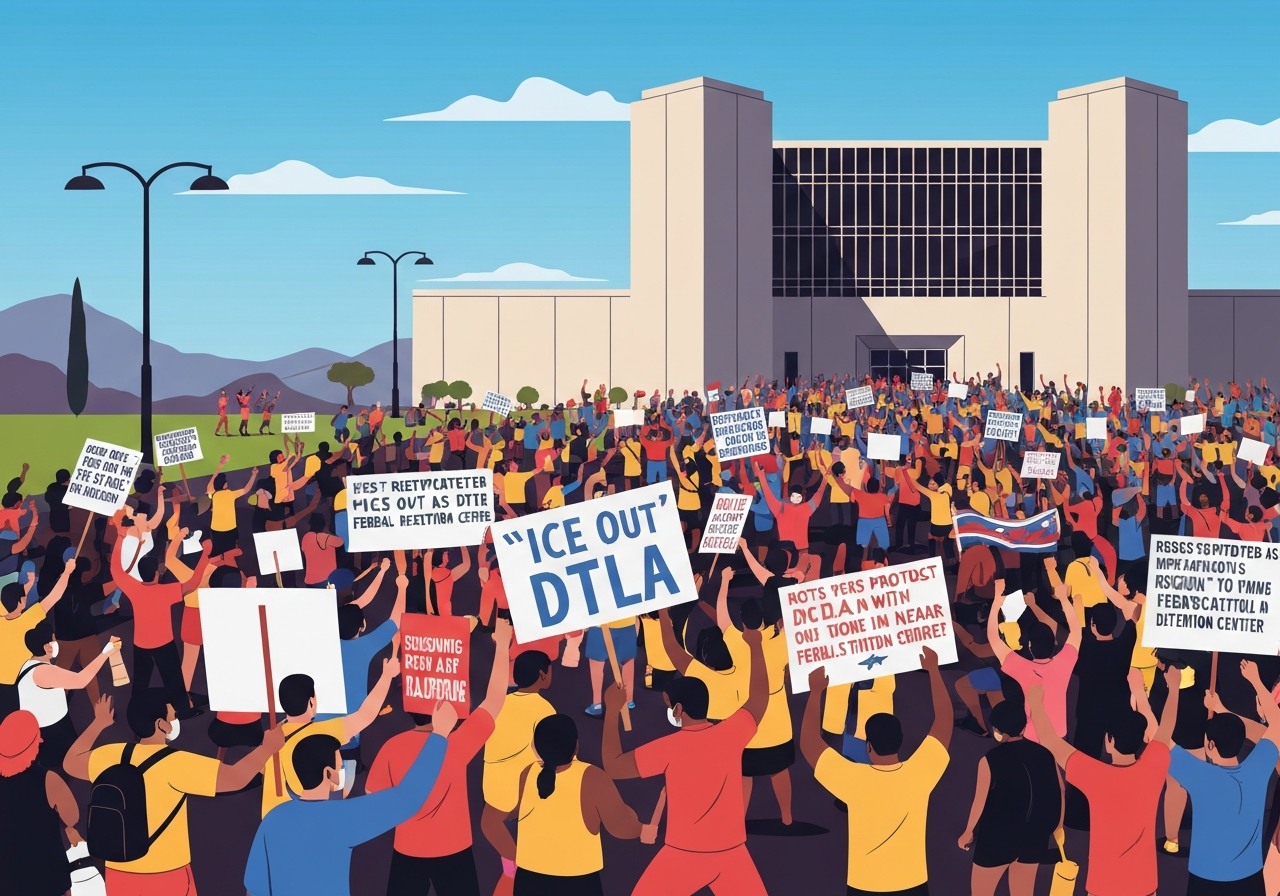
Friday evening in downtown Los Angeles, an “ICE Out” demonstration that began peacefully turned confrontational near the federal detention center on Alameda Street, between Aliso and 1st Street. By about 7:30 p.m., roughly 150 people remained in the area, and Los Angeles police said up to five people were arrested for failure to disperse after multiple dispersal orders and a declaration of unlawful assembly. Video from ABC7’s AIR7 shows a smaller group moving toward federal agents, moving a large shipping container and hurling objects; federal officers deployed tear gas while LAPD pushed the crowd away from the building. Mayor Karen Bass urged protesters to keep demonstrations peaceful while decrying the recent arrest of journalist Don Lemon as a factor in heightened tensions.
- Approximately 150 people remained near Alameda Street by about 7:30 p.m.; crowd estimates come from Mayor Karen Bass’s briefing.
- Up to five arrests were reported for failure to disperse after LAPD issued multiple dispersal orders and declared an unlawful assembly.
- Video from AIR7 shows protesters confronting federal agents behind the federal detention center and moving what appeared to be a large shipping container.
- Federal officers deployed tear gas during the escalation; LAPD gradually pushed demonstrators further up the street away from the detention facility.
- The protest was part of a national day of action against federal immigration operations and, according to Mayor Bass, was further energized after the arrest of former CNN journalist Don Lemon the previous night.
- Mayor Bass warned that while protest is legitimate, violence and vandalism harm the city and warned against escalation that could prompt a heavier federal response.
Background
The demonstration was organized as part of a nationwide “ICE Out” day of action protesting federal immigration enforcement operations. Such coordinated events have drawn activists, immigrant-rights groups and local residents challenging recent enforcement tactics and seeking policy changes at the federal level. Downtown Los Angeles, which hosts a federal detention center, has been a focal point for such actions because of the proximity of federal personnel and facilities.
Local officials and law enforcement frequently face a balancing act during these events: protecting the right to protest while maintaining public order and safety. In this case, Mayor Karen Bass connected part of the turnout to the arrest of former CNN journalist Don Lemon the previous night, saying the incident motivated additional people to join; that claim reflected her assessment of why numbers swelled but is not independently verified. Federal agents, LAPD and protest organizers represent the immediate stakeholders—each with different priorities and legal authorities that can collide in downtown settings.
Main Event
The afternoon gathering reportedly remained peaceful for several hours before a subset of participants advanced on the area behind the federal detention center. Air7 footage captured protesters coming face-to-face with federal agents positioned near the facility; the footage shows objects thrown toward the officers and people attempting to move a shipping container. Confrontation escalated quickly as tensions rose between that subgroup and federal personnel.
Federal officers responded by deploying tear gas, according to the video and local reporting, and LAPD officers moved in to push the group away from the building. Law enforcement announced multiple dispersal orders and declared the assembly unlawful, citing public-safety concerns and the proximity to a federal facility. Police subsequently arrested up to five people for failure to obey dispersal orders; officials described the arrests as limited in number relative to the total crowd.
Mayor Bass addressed reporters at the scene, urging protesters to refrain from violence and vandalism while reiterating support for peaceful demonstration. She framed the arrest of Don Lemon the night before as a galvanizing event that drew additional participants and warned of broader implications if protests turned violent. City officials emphasized the need to protect civil liberties while also restoring order in the vicinity of federal operations.
Analysis & Implications
The incident underscores the friction between federal enforcement actions and local responses to immigration policy. When federal agents operate in urban environments, they can become a direct flashpoint for protests, particularly on coordinated national days of action. Local leaders and law enforcement must navigate legal limits on crowd-control tactics and coordinate—formally or informally—with federal authorities, raising questions about jurisdiction and accountability.
Mayor Bass’s public linking of the protest surge to a high-profile journalist’s arrest highlights another dimension: concerns over press freedom and how media interactions with law enforcement can influence public-perception and turnout. Whether the journalist’s arrest was a primary trigger or a secondary factor remains uncertain, but the mayor’s comments illustrate how single incidents can quickly amplify local protests into broader political flashpoints.
On the operational side, the deployment of tear gas and the declaration of unlawful assembly reflect law enforcement’s priority on dispersal and containment near sensitive facilities. Such choices carry legal and political consequences: use of crowd-control agents draws scrutiny from civil-rights groups and can affect public trust, while arrests for failure to disperse may lead to court challenges if procedures are contested. In the short term, expect heightened scrutiny of federal operations in Los Angeles and increased coordination meetings among city, county and federal officials.
Comparison & Data
| Metric | Value |
|---|---|
| Approximate crowd near Alameda (by ~7:30 p.m.) | ~150 people |
| Arrests reported | Up to 5 (failure to disperse) |
| Law-enforcement actions | Multiple dispersal orders; tear gas deployment; crowd pushed away from detention center |
These figures reflect city statements and video evidence reported by ABC7 Los Angeles. The crowd estimate and arrest total are officials’ counts at the time of the briefing; such numbers can change after formal reporting and booking records are finalized. The operational details—dispersal orders and use of tear gas—are consistent across visual reporting and police statements.
Reactions & Quotes
“I think the protests are extremely important, but it is equally important for these protests to be peaceful,”
Mayor Karen Bass
Mayor Bass used her remarks to support protest rights while urging restraint to prevent property damage and escalation. She also raised concerns about the arrest of a journalist in the city the night before, saying it contributed to public outrage.
“Multiple dispersal orders were issued and an unlawful assembly was declared,”
Los Angeles Police Department (official statement)
LAPD characterized the arrests as responses to failure to disperse after those orders. The department emphasized that officers acted to move the crowd away from the federal facility and to limit further escalation.
Unconfirmed
- Whether the arrival of additional protesters was primarily driven by Don Lemon’s arrest remains unverified beyond Mayor Bass’s statement.
- Attribution of the initial escalation to a single subgroup or organizer has not been confirmed by independent investigation.
- Any immediate plans by federal authorities to change their presence or posture in Los Angeles after this event have not been announced publicly.
Bottom Line
The downtown Los Angeles “ICE Out” action illustrates how national protest days can morph rapidly when federal facilities and controversial enforcement actions are involved. Officials reported a roughly 150-person presence by 7:30 p.m. and up to five arrests tied to failure to disperse after law enforcement declared an unlawful assembly.
Going forward, expect heightened attention on federal-local coordination, legal reviews of crowd-control tactics, and monitoring of further demonstrations linked to immigration enforcement or high-profile arrests. The city faces the dual task of protecting peaceful protest while preventing violence and property damage; how leaders manage that balance will shape short-term public order and longer-term debates over enforcement and civil liberties.