
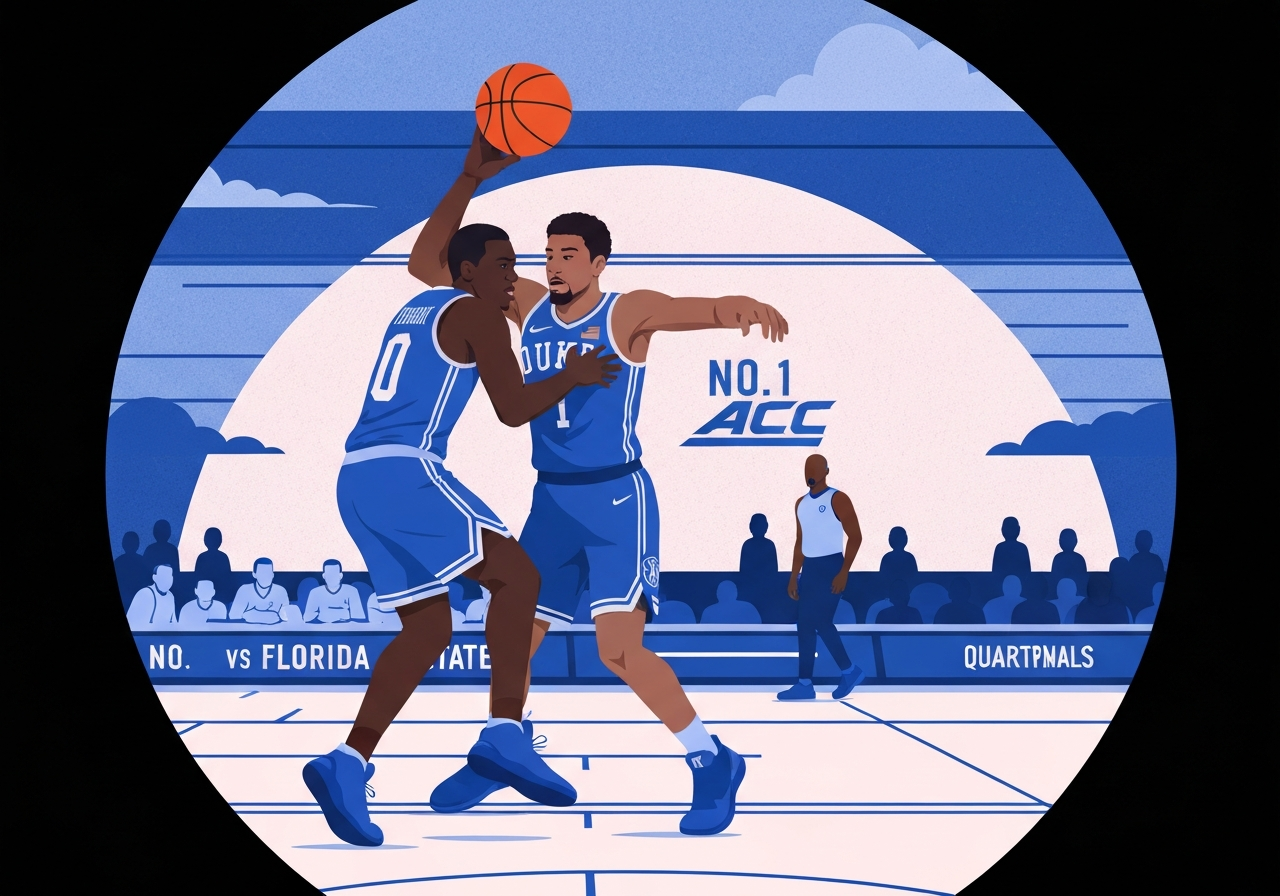
Lead — In Charlotte on March 12, 2026, top-seeded Duke survived a turbulent ACC Tournament quarterfinal against eighth-seeded Florida State, prevailing 80-79 after a late-game push and a missed buzzer jumper by Robert McCray V. The Blue Devils answered an eight-point second-half deficit with a 19-2 run and closed out the game despite missing two starters. Isaiah Evans scored a career-high 32 points and Cameron Boozer recorded a double-double as Duke improved to 30-2. The result sends Duke into Friday’s semifinals to face the winner of North Carolina and Clemson.
Key takeaways
- Duke defeated Florida State 80-79 in the ACC quarterfinals in Charlotte on March 12, 2026.
- Isaiah Evans posted a career-high 32 points, going 11-of-20 overall and 7-of-16 from three, and added six rebounds and three assists.
- Cameron Boozer finished with 23 points and 10 rebounds for his 18th double-double of the season.
- Duke played without starting PG Caleb Foster (right foot fracture) and center Patrick Ngongba (right foot soreness); Foster was hurt in the regular-season finale and Ngongba missed his second straight game.
- Florida State’s Lajae Jones scored 28 and Robert McCray V had 25; McCray’s last-second stepback attempt missed at the buzzer.
- Duke recorded 22 offensive rebounds and 24 second-chance points, with Maliq Brown contributing eight offensive boards among 12 total and three steals.
- The Blue Devils had been winning ACC games by an average margin of 26.5 points before this contest and still lead the nation in scoring margin at +20.5.
Background
Duke entered the ACC Tournament as the No. 1 seed and a national title favorite, carrying a 29-2 record into the Charlotte bracket and a reputation for dominant conference wins—six straight ACC victories by at least 13 points. Jon Scheyer, named ACC Coach of the Year, has emphasized depth and defensive identity all season, elements that have helped Duke maintain the top national ranking despite midseason personnel shifts.
Florida State arrived in Charlotte as the eighth seed at 18-15 overall but with clear momentum, winners of four straight and 10 of their last 12 before facing Duke. The Seminoles’ recent surge under coach Luke Loucks has been fueled by scoring balance and improved perimeter shooting, making them a dangerous matchup against any top seed.
Injuries framed the matchup. Duke was without point guard Caleb Foster (right foot fracture) and center Patrick Ngongba (right foot soreness), forcing rotations to adjust and younger players to step into larger roles. Those absences set the stage for a more contested, physical game than many expected from the top-seeded Blue Devils.
Main event
The first half unfolded as a back-and-forth affair, with eight ties and 15 lead changes before halftime, reflecting both teams’ contrasting strengths: Duke’s offensive depth and Florida State’s hot streaks. Early on, Duke relied on offensive rebounding and second-chance points to stay in striking distance while Florida State leaned on Lajae Jones and McCray to create separation.
Down eight early in the second half, Scheyer called a timeout to regroup his depleted rotation and challenge the roster to view the moment as an opportunity rather than setback. The Blue Devils responded emphatically, ripping off a 19-2 run capped by defensive stops and hustle plays that swung momentum back to Duke.
Isaiah Evans fueled the late push with aggressive shooting; he converted 11 of 20 field-goal attempts and buried seven triples, including several late, pressure-packed shots in his hometown of Charlotte. Cameron Boozer’s physical play yielded second-chance points—he finished with five offensive rebounds—and Maliq Brown’s offensive rebounds (eight) and three steals were vital during the decisive run.
The Seminoles mounted a furious rally in the closing 90 seconds, cutting Duke’s lead to one twice, but never reclaimed the advantage. On the final possession, Robert McCray V’s stepback jumper at the buzzer rimmed out, sealing an 80-79 Duke victory and advancing the Blue Devils to the semifinal round.
Analysis & implications
Short term, the win preserves Duke’s seeding momentum heading into the NCAA tournament conversation; a resilient, one-point advancement underscores the program’s ability to win under duress even without two starters. Scheyer’s decision to lean on bench will and offensive-rebounding aggression suggests the staff trusts its depth in tournament settings.
For Florida State, the narrow loss should not obscure the program’s upward trend: 10 wins in the last 12 games and multiple players capable of carrying scoring loads make the Seminoles a program on the rise in the ACC. Lajae Jones and Robert McCray V showed they can pressure elite opponents late, which bodes well for FSU’s offseason recruiting and confidence entering 2026–27.
Injury monitoring will be critical for Duke. Caleb Foster’s right foot fracture and Patrick Ngongba’s ongoing soreness raise questions about minutes distribution and late-season durability. If either injury lingers, Duke’s backcourt ball-handling and interior minutes could be strained against deeper NCAA tournament opponents.
Strategically, the game validated two features that have defined Duke’s season: offensive rebounding and the ability of role players to impact possessions. Maliq Brown’s offensive-board output and the team’s 24 second-chance points were decisive; opponents aiming to upset Duke must limit those opportunities and pressure Duke’s perimeter shooters to reduce turnovers and extra chances.
Comparison & data
| Stat | Duke | Florida State |
|---|---|---|
| Final score | 80 | 79 |
| Record (postgame) | 30-2 | 18-15 |
| Leading scorer | Isaiah Evans (32) | Lajae Jones (28) |
| Top rebounder | Cameron Boozer (10, 5 offensive) | Maliq Brown — (note: Duke’s Brown had 12; FSU top rebounder varied) |
| Offensive rebounds | 22 | — |
| Second-chance points | 24 | — |
The table highlights how Duke converted extra possessions into decisive points—22 offensive rebounds led to 24 second-chance points—an advantage that offset the absence of two starters. While box scores credit individual totals, the game was decided by possession management and timely defense in the final stretch.
Reactions & quotes
Coach Jon Scheyer framed the comeback as a test of character and a learning moment for a team missing key rotation pieces. He emphasized the players’ willingness to embrace challenge late in the season.
“I just tried to get them to look at it as an opportunity.”
Jon Scheyer, Duke head coach (ACC Coach of the Year)
Scheyer later called the response “big time,” attributing the run to effort and belief rather than schematic changes. His remarks highlighted trust in younger contributors to perform under pressure.
Cameron Boozer, who logged his 18th double-double, downplayed style and stressed outcome—winning even when execution wasn’t pristine.
“We can win ugly. Obviously we don’t want to win ugly, but we can if we have to.”
Cameron Boozer, Duke forward
Florida State coach Luke Loucks praised Duke’s talent and toughness while noting his team’s growth over the stretch run. Loucks framed the outcome as a narrow margin against a championship-caliber opponent.
“There’s a reason they’re the No. 1 team in the country… a well put together team with a lot of selfless kids.”
Luke Loucks, Florida State head coach
Unconfirmed
- Exact recovery timeline for Caleb Foster’s right foot fracture and whether he will be available for the NCAA tournament remains unclear.
- Patrick Ngongba’s right foot soreness has not been publicly diagnosed beyond the team’s description of soreness; further medical details are unreported.
Bottom line
Duke’s 80-79 win over Florida State showcased the program’s depth, mental resilience, and the importance of offensive rebounding in tight tournaments. The victory keeps Duke on track for ACC championship talks and preserves its national-title resume, but the narrow margin underscores vulnerability without two starters.
Florida State leaves Charlotte with momentum despite the loss—two primary scorers carried the Seminoles into contention, and the late-game pressure they applied illustrates why the program appears to be trending upward. For Duke, monitoring Foster and Ngongba’s health and keeping bench contributors ready will be key heading into the semifinals and the NCAA tournament.