
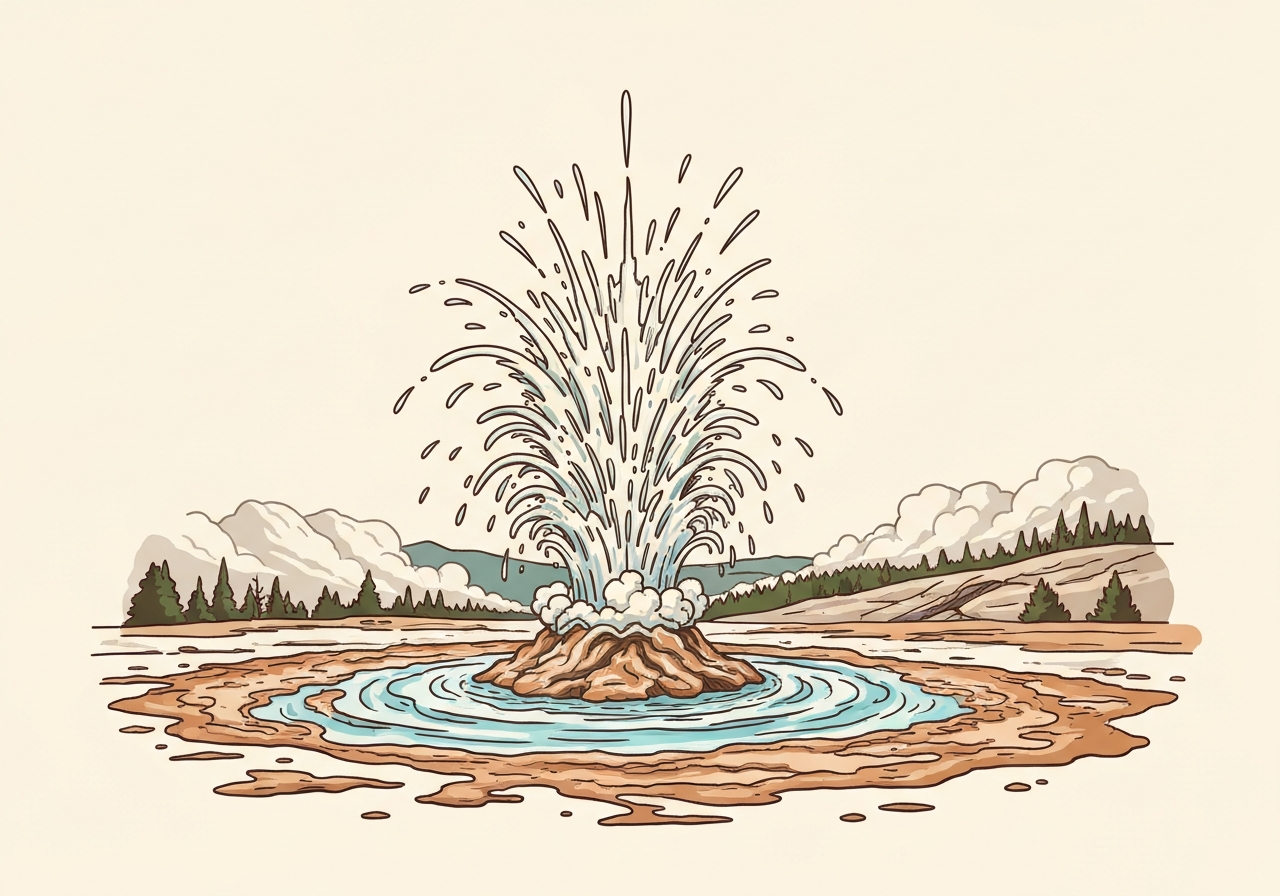
Lead: Echinus Geyser in Yellowstone National Park resumed eruptive activity in February 2026 after being largely dormant for more than five years. The acidic pool, located in the back basin of the Norris Geyser Basin, showed multiple eruptions beginning Feb. 7 and then more sustained 20–30 foot eruptions from Feb. 16. Park officials say the geyser’s chemistry—acidic gases mixing with neutral waters—produces distinctive red staining and spiny formations but does not aggressively dissolve surrounding rock. While recent temperature records show activity spikes, park staff cautioned on March 3, 2026 that future behavior is unpredictable and likely to taper before summer.
Key Takeaways
- Echinus Geyser, roughly 66 feet across, erupted intermittently beginning Feb. 7, 2026, with regular 20–30 foot blasts every few hours from Feb. 16.
- Named for sea-urchin–like deposits first noted by Albert Charles Peale in 1878, the pool’s red and spiny formations reflect its acidic water chemistry.
- Historically active through the late 20th century—1970s eruptions every 40–80 minutes; 1980s–90s blasts lasted up to 90 minutes and reached about 75 feet.
- A temperature monitoring system installed in 2010 recorded 15 eruptions between Oct. 2010 and Jan. 2011; activity was sporadic after Oct. 2017.
- Park staff describe the acidity as mild—comparable to orange juice or vinegar—insufficient to rapidly erode the surrounding stone.
- Recent temperature graphs show pre-eruption spikes even on days without visible eruptions, making short-term prediction difficult.
Background
Echinus Geyser sits in the back basin of the Norris Geyser Basin, one of Yellowstone’s most geothermally active areas. The feature’s pool is about 66 feet wide and ringed by spiny mineral deposits that early visitors likened to sea urchins; mineralogist Albert Charles Peale recorded that resemblance in 1878. Echinus is unusual because its water is acidic due to dissolved gases mixing with neutral waters; the resulting chemistry produces striking red staining and unusual mineral textures around the vent.
Through much of the late 20th century Echinus was among the park’s more predictable attractions, erupting frequently and sometimes with horizontal surges that soaked nearby viewers. That pattern began to decline in the early 2000s. A temperature-monitoring installation in 2010 gave park scientists better data: 15 recorded eruptions between October 2010 and January 2011, then long stretches of low activity, a brief run of regular eruptions in October 2017, and relative dormancy until the activity noticed in February 2026.
Main Event
Yellowstone reported the first renewed activity on Feb. 7, 2026, followed by additional eruptions the next week. Beginning Feb. 16, the geyser produced recurring 20–30 foot eruptions every few hours for several days, as logged by the park’s monitoring systems. In the most recent days before March 3, temperature graphs showed pronounced spikes that often precede eruptions, though some spikes did not culminate in visible blasts.
Park personnel have emphasized that while Echinus’s acidic chemistry gives it distinctive formations, the acid concentration is moderate—park statements compared it to orange juice or vinegar—so the pool’s apparent structures have persisted rather than rapidly dissolving. Rangers have not reopened any closer viewing platforms; historically there were benches and closer vantage points when the feature was more regular, but safety and preservation guide current public access decisions.
Yellowstone staff said the pattern of intermittent eruptions and pre-eruption temperature spikes mirrors past behavior: periods of activity can begin suddenly and stop without a clear external trigger. On March 3, 2026 the park reiterated that while summer continuation is unlikely, there is no reliable way to forecast the geyser’s course beyond short-term temperature and visual monitoring.
Analysis & Implications
Echinus’s return after years of dormancy highlights the inherent unpredictability of hydrothermal systems. Geyser behavior depends on a complex interplay of subsurface heat, plumbing geometry, and chemistry; modest shifts in any of those factors can flip a system between quiescence and activity. For park managers, sporadic reactivation raises operational questions about visitor access, monitoring priorities, and interpretive messaging—balancing public interest with safety and resource protection.
Scientifically, renewed activity offers a window into the subsurface processes that control acidic geysers, which are rarer than neutral-alkaline features in Yellowstone. The park’s 2010 temperature-monitoring installation and subsequent records give researchers baseline data to compare the 2026 sequence with earlier episodes, potentially revealing changes in frequency, duration, or thermal input. Any systematic shift could inform models of heat and fluid flow in the Norris area, a zone already known for rapid thermal variability.
Economically and socially, short-lived eruptions can boost interest and visitation in the near term but do not necessarily translate to sustained tourist traffic if activity wanes. For scientific institutions and the park, intermittent events reinforce the value of continuous instrumentation—temperature probes and visual logs—so that even short reactivation phases are captured in detail. Internationally, Echinus is a notable example of acidic geyser behavior; improved understanding may assist researchers studying similar features in other volcanic or hydrothermal provinces.
Comparison & Data
| Period | Typical Interval or Behavior | Reported Height |
|---|---|---|
| 1970s | Every 40–80 minutes | Variable |
| 1980s–1990s | Longer eruptions, up to 90 minutes | Up to ~75 feet |
| Oct 2010–Jan 2011 | 15 sporadic eruptions recorded | Smaller, intermittent |
| Feb 2026 (from Feb. 16) | Regular every few hours | About 20–30 feet |
The table summarizes widely reported patterns and heights across decades and the current 2026 sequence. While historical peaks reached near 75 feet, the recent activity has been more modest in height but still notable given the prior multi-year lull. Instrumented temperature records rather than visual estimates provide the clearest short-term signals of reactivation.
Reactions & Quotes
“That somewhat unique water chemistry results in interesting formations and compositions,”
Yellowstone National Park (official statement)
Yellowstone used this phrasing to explain how moderate acidity and mineral deposition combine to produce red staining and spiny deposits around Echinus. The park emphasized the acid is not concentrated enough to rapidly dissolve the conduit rock.
“It is unlikely the geyser will continue erupting into the summer, but there is no way to predict what may actually occur,”
Yellowstone National Park (official statement, March 3, 2026)
This caveated forecast reflects standard scientific caution: short-term monitoring can detect precursors, but long-range prediction of geyser behavior remains unreliable.
“Renewed pulses like this are valuable for research even if they are brief,”
Geothermal researcher (academic commentary)
An academic familiar with geyser monitoring noted that even short reactivation periods yield temperature and chemistry data that help refine models of subsurface plumbing and heat flux.
Unconfirmed
- Whether the Feb–Mar 2026 reactivation signals a temporary pulse or the start of a longer active phase remains unconfirmed.
- The precise subsurface trigger (e.g., changes in heat input versus conduit geometry shifts) for the reactivation has not been determined.
- Any long-term impact of these pulses on surrounding mineral deposits and rock stability is not yet established.
Bottom Line
Echinus’s return to activity after years of dormancy is significant for both scientists and the public: it provides fresh observational data on a rare acidic geyser and rekindles interest in Yellowstone’s dynamic hydrothermal landscape. Although recent eruptions have been more modest in height than some historical peaks, the event underscores how quickly geothermal systems can change and why continuous monitoring matters.
Park officials and researchers will continue to track temperature and visual data; visitors should expect restricted access near active features and follow park guidance. For observers and scientists alike, the key items to watch are the persistence of eruptions beyond spring, any changes in eruption frequency or height, and accompanying chemical signatures that might reveal subsurface shifts.
Sources
- CBS News — news report (updated March 3, 2026) that summarized park statements and monitoring observations.
- Yellowstone National Park (NPS) — official park site and statements about geyser location, chemistry, and monitoring (official/source of park commentary).