
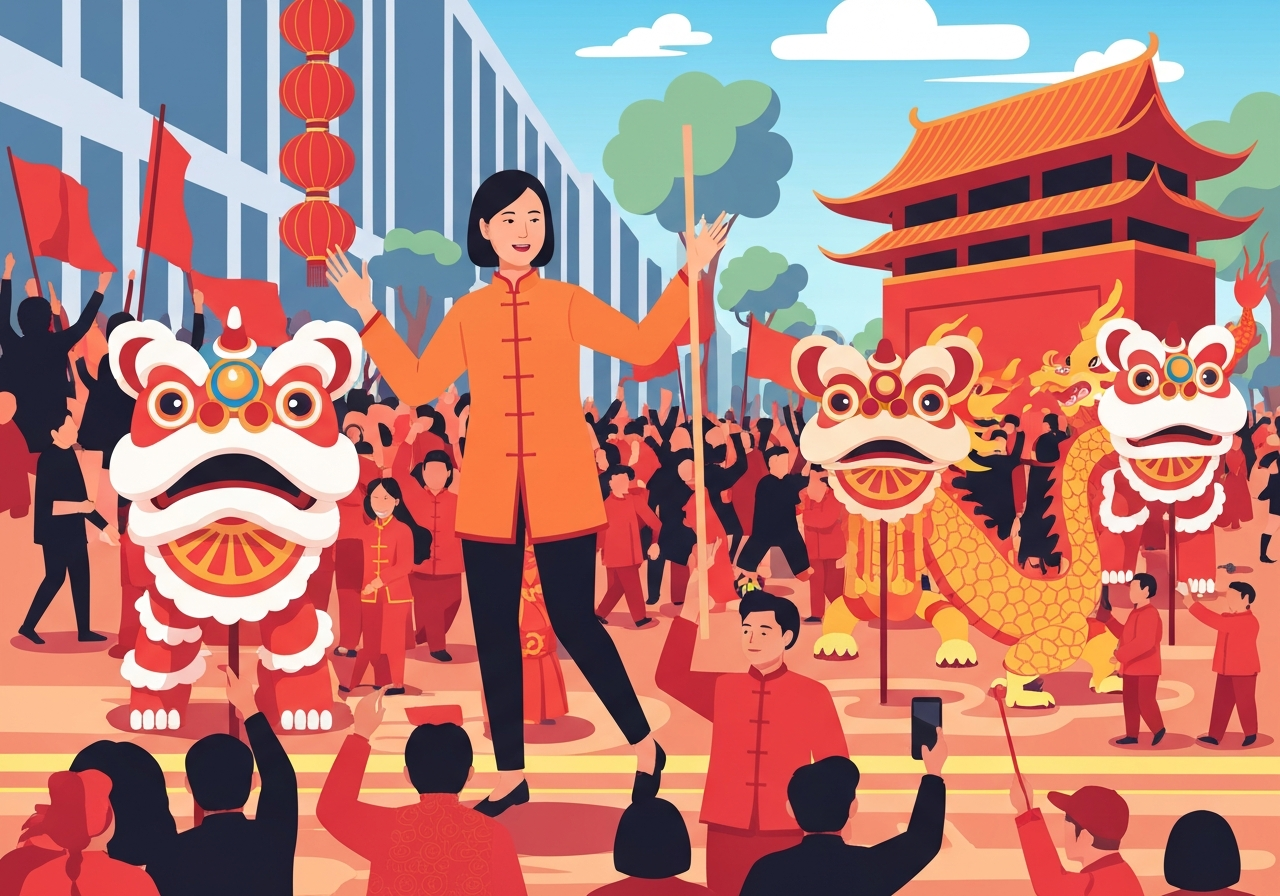
On Saturday, March 7, 2026, San Francisco’s Chinese New Year Parade drew large crowds as 22‑year‑old Eileen Gu served as grand marshal and received sustained applause along Kearny Street and Union Square. Born in San Francisco and raised in the Seacliff neighborhood, Gu rode in a red Mustang convertible, smiling, waving and responding to fans who repeatedly called her name. The celebration played out amid lingering debate over her decision to compete for China at international events, but strollers, parents and teens lining the route offered near‑unanimous approval. Local reaction on the parade route emphasized hometown pride more than the political criticism that has trailed Gu in national commentary.
Key takeaways
- The parade took place on March 7, 2026, in San Francisco’s Chinatown, with Eileen Gu as grand marshal and large, enthusiastic crowds along the route.
- Gu, 22, was born in San Francisco, attends Stanford University (international relations) and is a high‑profile athlete and model.
- Forbes reported Gu earned $23 million last year, making her one of the world’s highest‑paid female athletes.
- The article reports Gu won one gold and two silver medals at the 2026 Milan Winter Olympics and describes her as a six‑time Olympic medalist in total.
- Gu has faced criticism from conservative commentators over her decision to compete for China; prominent critics named in reporting include Tucker Carlson and Senator JD Vance.
- On the parade route, however, spectators greeted Gu with cheers, phone cameras and applause rather than visible protest.
- Reports in national outlets — including a Wall Street Journal item alleging payments by Chinese authorities — have intensified scrutiny; those claims are noted but not independently verified here.
Background
San Francisco’s Chinese New Year Parade is an annual event that draws hundreds of thousands of attendees and global television viewers. The grand marshal role, often given to a figure with connections to the Chinese‑American community or broader cultural prominence, has gone in recent years to personalities such as Awkwafina (2024) and Joan Chen (2025).
Eileen Gu emerged on the world stage as a freestyle skier, earning significant international medals and commercial endorsements. She was born in the United States and has a family connection to China through her mother, Yan Gu, which guided her 2019 decision to compete for China in international competition. That choice has been portrayed differently across media landscapes — celebrated in China and criticized in parts of the U.S. political commentary sphere.
The geopolitical backdrop includes heightened U.S.‑China tensions and rising domestic debates over national loyalty and athlete representation. Against that backdrop, Gu’s commercial success (Forbes: $23 million in earnings last year) and concurrent academic life at Stanford make her a uniquely visible and complicated public figure.
Main event
Gu’s appearance as grand marshal on March 7 began with a relaxed procession through downtown neighborhoods, where she rode in a convertible accompanied by two police officers and periodically stopped to address spectators. Cameras and smartphones were extended above heads along Kearny Street and at Union Square, and parents lifted children for better views. Observers described repeated waves of cheering each time her car turned a corner.
At a brief stop near Portsmouth Square, Gu addressed the crowd with a short New Year’s greeting, wishing prosperity and urging people to “pursue your passions” and “bring it back home, San Francisco.” Her demeanor was consistently affable and engaged; she made heart gestures and waved to fans seated in bleachers and against barricades.
Despite prior national controversies — including commentary focused on her choice to represent China and reporting that raised questions about payments tied to that affiliation — no organized protests materialized along the parade route. Street‑level reporting emphasized celebration rather than confrontation, with local attendees prioritizing the holiday and community rituals over political debate.
Event organizers had named Gu grand marshal before the 2026 Winter Olympics in Milan; her medal haul there (reported as one gold and two silvers) added to the public profile that drew many parade viewers to the route specifically to see her.
Analysis & implications
Gu’s warm reception in San Francisco underscores a broader distinction between local sentiment and national political framing. In her hometown, cultural affinity, community pride and the festive atmosphere appear to have outweighed the geopolitical controversies that have animated cable news and opinion pages. This suggests that symbolic roles such as grand marshal can function primarily as community recognition rather than platforms for national policy debate.
At the national level, however, Gu’s choices continue to be parsed through partisan prisms. Conservative commentators have used her profile to raise questions about allegiance and influence; some outlets have amplified alleged financial ties reported by other media. Whether those narratives change public opinion more broadly depends in part on the availability of independent verification and the extent to which these stories enter everyday local conversations — which, in San Francisco on March 7, they did not.
Economically, Gu’s endorsements and reported $23 million in annual earnings illustrate the commercial value of athletes who bridge markets in the U.S. and China. That commercial calculus makes high‑profile athletes attractive to brands but also exposes them to geopolitical risk when national tensions rise. Companies and sponsors will likely continue to weigh visibility against reputational risk when associating with athletes whose identities cross politically fraught borders.
Looking ahead, the lack of protest at the parade does not eliminate future flashpoints. If national commentary re‑escalates or if new reporting substantiates unresolved claims about outside payments or influence, public sentiment in other locales could shift. For now, Gu’s hometown reception indicates a capacity for local community events to remain insulated — temporarily — from broader national controversies.
Comparison & data
| Item | Report/Value |
|---|---|
| Milan Winter Olympics (2026) medals | 1 gold, 2 silver (reported) |
| Total Olympic medals (as reported) | Described in coverage as a six‑time Olympic medalist |
| Reported annual earnings | $23 million (Forbes) |
| Recent parade grand marshals | 2024: Awkwafina; 2025: Joan Chen; 2026: Eileen Gu |
The table above summarizes figures that appeared in reporting around the parade and Gu’s profile. Note that descriptions of Gu’s total Olympic medal count appear in different terms across outlets; the Milan 2026 medal count (one gold, two silver) and Forbes’ earnings figure ($23 million) are specific data points cited in local and national coverage.
Reactions & quotes
Local spectators and parade organizers framed the event as a celebration; national commentators offered more politicized reactions. Below are representative quotes from coverage and public figures, set in context.
Before the wave of national commentary intensified, Gu had been asked about human‑rights reporting in China; she declined to adopt an expert stance in a public interview, citing limits to her expertise and research.
“I’m not an expert on this. I haven’t done the research. I don’t think it’s my business.”
Eileen Gu (statement to Time)
The remark was widely quoted in subsequent coverage and used by critics to argue she avoided taking public positions on sensitive issues; supporters said it reflected caution by a young athlete balancing multiple roles.
Political figures also weighed in. A prominent conservative commentator labeled Gu harshly on air, and a U.S. senator suggested she ought to have represented the United States, framing the matter in patriotic and civic terms.
“I certainly think that somebody who grew up in the United States… I would hope that they want to compete with the United States of America.”
Sen. J.D. Vance (comment to Fox News)
Those comments fueled a national debate about athlete nationality, benefits received and public expectations — debates that were largely absent from the parade’s on‑the‑ground atmosphere.
Unconfirmed
- The Wall Street Journal reported that the Chinese government paid Gu millions to compete; this account has been widely cited but remains subject to independent verification and is listed here as unconfirmed in the absence of direct documentation provided to this report.
- Allegations about specific sponsor arrangements or undisclosed contracts tied to government entities were mentioned in national reporting; detailed contract terms and payments have not been publicly confirmed in full.
Bottom line
Eileen Gu’s reception at San Francisco’s March 7, 2026, Chinese New Year Parade highlights the gulf that can exist between local community sentiment and national political narratives. In her hometown, crowd responses were overwhelmingly positive and focused on celebration rather than controversy. That localized embrace does not erase the broader debates about athlete nationality, influence and geopolitics, but it does show that community events can emphasize cultural ties and shared festivities over partisan conflict.
For observers and stakeholders — sponsors, civic leaders and the public alike — the episode underscores the importance of clear, independently verifiable information when media reports raise questions about payments or foreign influence. Absent definitive public documentation, the most durable impacts of this parade appearance are symbolic: a high‑profile hometown welcome and a reminder that public figures occupy different roles in different communities.
Sources
- SFGATE — local news report on parade and on‑the‑ground observations (local news)
- Associated Press — photographic coverage and wire reporting (news agency / photo)
- The Wall Street Journal — reporting cited on payments (national newspaper)
- Time — interview excerpts on human‑rights question (magazine)
- Forbes — earnings estimate cited ($23M) (business/financial media)
- USA Today — coverage of Gu’s responses to political commentary (national newspaper)